Virtual payments have revolutionized how businesses and individuals transfer money, offering unprecedented security, flexibility, and control. In this comprehensive guide, you'll discover the top virtual payments solutions and digital payment solutions for businesses that can transform your transaction experience, protect your sensitive financial information, and streamline your payment processes. From versatile virtual cards to innovative platforms that support multiple currencies, we'll explore everything you need to know to make informed decisions about your payment strategy in today's digital economy.
The Best Virtual Payments Solutions for Secure and Easy Transactions
- 4/22/2025
- Akan Nse
- 11 min
Discover top virtual payment solutions that ensure secure and easy transactions. Read our guide to make informed choices for your financial needs


What are Virtual Payments Solutions?
Virtual payments represent digital transaction methods that allow you to pay online without needing physical credit cards or cash. These secure electronic payments utilize virtual card numbers that function similarly to traditional credit card credentials but with enhanced security features.
When you use virtual cards, you're essentially creating a temporary digital payment method with its own unique card number, expiration date, and security code. This payment process offers significant advantages over traditional methods, particularly for businesses managing multiple transactions.
Each virtual card number serves as a unique payment identifier, making it easier to track expenses and reconcile accounts. Since these virtual card details can be generated instantly, you'll never face delays when needing to make urgent payments.

The Evolution of Virtual Payment Solutions
The evolution of electronic payments began in the late 1990s when digital transaction capabilities first emerged. However, virtual payments as we know them today gained significant traction in the mid-2000s when major credit card issuers like Visa and Mastercard recognized the growing demand for more secure online transaction methods.
Initially designed to protect consumers making online purchases, virtual card technology quickly demonstrated value for business applications. Many businesses seeking better expense management tools and improved cash flow discovered that virtual payment systems offered unprecedented control and visibility over spending.
By 2010, dedicated virtual card provider services began emerging, offering specialized solutions for businesses of all sizes. The technology has continued to evolve, with modern systems now integrating seamlessly with accounting software, enabling automated expense tracking and detailed reporting capabilities. These innovations have helped companies reduce reliance on both physical corporate cards and paper checks while maintaining strong security protocols with their bank partners.
Why Businesses Convert to Virtual Payments
Converting to virtual payments offers numerous benefits for your business:
- Enhanced cash flow management through faster processing times
- Opportunity to generate revenue through rebate programs
- Reduced processing fees compared to traditional payment methods
- Streamlined payment process by eliminating paper checks
- Improved working capital management through efficient handling of high-volume transactions
- Detailed payment information that simplifies reconciliation
- Elimination of delays associated with traditional payment options
- Automated transactions that reduce manual labor requirements
Top Virtual Payments Solutions in 2025
As we navigate through 2025, virtual payment solutions have become increasingly sophisticated, offering more robust features, enhanced security, and seamless integration with other business systems. The following providers represent the industry leaders, each with unique strengths that might align with your specific payment needs. Whether you're handling high transaction volumes, need international payment capabilities, or prioritize user-friendly interfaces, there's a solution here among today’s online payment processing solutions that can transform how your business processes payments.

Square
Square revolutionized the payment industry by enabling small businesses to accept payments anywhere. Their virtual payment solutions integrate seamlessly with their point-of-sale systems, supporting both Visa and Mastercard transactions.
Pros:
User-friendly interface; comprehensive business management tools; integrated analytics.
Cons:
Higher transaction fees for some business types; occasional processing delays for larger transactions.

PayPal
As one of the pioneers in electronic payments, PayPal continues to be a leading solution for businesses and consumers alike. Their virtual card options provide flexibility for online transactions, helping companies manage working capital more effectively.
Pros:
Wide market acceptance; robust security measures; seamless integration with most e-commerce platforms.
Cons:
Account freezes can occur during unusual activity; customer service can be challenging to navigate.

Stripe
Stripe has become the developer's choice for implementing virtual payments, offering powerful APIs and customization options. Their solution excels in handling complex payment process requirements and supports multiple bank connections for greater flexibility.
Pros:
Developer-friendly; extensive documentation; supports global currencies and payment methods.
Cons:
More technical setup required than some alternatives; higher fees for international transactions.

Adyen
Adyen provides a unified platform for businesses to accept payments across online, mobile, and in-store channels. Their virtual card payment options are particularly strong for international commerce and work well for companies transitioning from physical credit cards.
Pros:
Excellent global payment support; advanced fraud protection; unified commerce capabilities.
Cons:
Better suited for larger enterprises; minimum processing volume requirements.

Braintree
Owned by PayPal, Braintree specializes in mobile and web payment methods with strong support for virtual card transactions. Their developer tools make integration straightforward for both Mastercard and Visa virtual card numbers.
Pros:
Excellent developer tools; supports Apple Pay and Google Pay; competitive pricing.
Cons:
More complicated setup than some consumer-focused alternatives; occasional API changes require updates.

WorldPay
WorldPay offers comprehensive payment processing solutions with robust virtual credit card capabilities for businesses of all sizes. Their focus on security makes them popular in sensitive industries where bank-level security protocols are essential.
Pros:
Strong security features; global coverage; multi-currency support.
Cons:
Contract terms can be rigid; setup process can be lengthy.

Clover
Clover combines hardware and software solutions, including strong virtual payments capabilities that integrate with their popular POS systems. Their virtual card processing works seamlessly with their broader ecosystem and provides excellent alternatives to physical card distribution.
Pros:
Excellent hardware integration; user-friendly interface; strong reporting features.
Cons:
Hardware can be expensive; some features require additional monthly fees.

Stax Payments
Stax Payments (formerly Fattmerchant) uses a subscription-based pricing model for virtual card payment processing, potentially saving businesses significant money on transaction fees while improving revenue opportunities.
Pros:
Transparent pricing; excellent customer service; strong reporting tools.
Cons:
Monthly subscription fee may not be cost-effective for very small businesses.
Payment Depot
Payment Depot offers wholesale interchange rates for processing virtual credit card transactions, making them particularly attractive for businesses with higher transaction volumes and a need to optimize working capital.
Pros:
Transparent wholesale pricing; no percentage markup; excellent customer support.
Cons:
Monthly membership fee; best value requires higher processing volume.

Shopify Payments
For e-commerce businesses on Shopify, their native payment solution offers seamless integration and support for various virtual card types, including saved card number functionality. Their website integration makes it easy for customers to pay online.
Pros:
Direct integration with Shopify; reduced transaction fees for Shopify store owners; simplified setup.
Cons:
Only available to Shopify merchants; occasional hold periods for new merchants.

Helcim
Helcim provides merchant services with transparent pricing and strong virtual payments capabilities, including detailed payment data for reconciliation and account number management.
Pros:
Volume discounts automatically applied; no monthly fee; excellent merchant portal.
Cons:
Not as well-known as larger providers; limited international options.

Venmo
While primarily known for consumer payments, Venmo now offers business solutions with virtual card payment capabilities, particularly appealing to businesses targeting younger customers.
Pros:
Strong brand recognition with younger consumers; simple interface; social features.
Cons:
Less robust for complex business needs; limited reporting compared to dedicated business solutions.

Remitly
Specializing in international transfers, Remitly's virtual payments system focuses on making global transactions more affordable and accessible through secure banking channels.
Pros:
Excellent exchange rates; specialized in international transfers; strong mobile experience.
Cons:
More limited domestic payment features; primarily focused on remittances.

Cash App
Square's Cash App has evolved from a P2P payment tool to include business functionality with virtual card capabilities that integrate with broader Square systems and support both in-app and website transactions.
Pros:
Instant transfers available; seamless Square integration; popular with younger consumers.
Cons:
Business features less developed than dedicated business solutions; limited customer support options.

Volet.com
Launched in 2014, Volet.com brings blockchain technology to merchant services, focusing on international payment processing. Their innovative approach provides businesses with access to global markets through efficient cross-border transactions.
Pros:
Blockchain technology for fast, low-cost international transactions; supports over 150 countries and 110+ fiat currencies; instant P2P transfers without requiring crypto expertise.
Cons:
Newer to the merchant services space; more focused on international transfers than comprehensive merchant services.
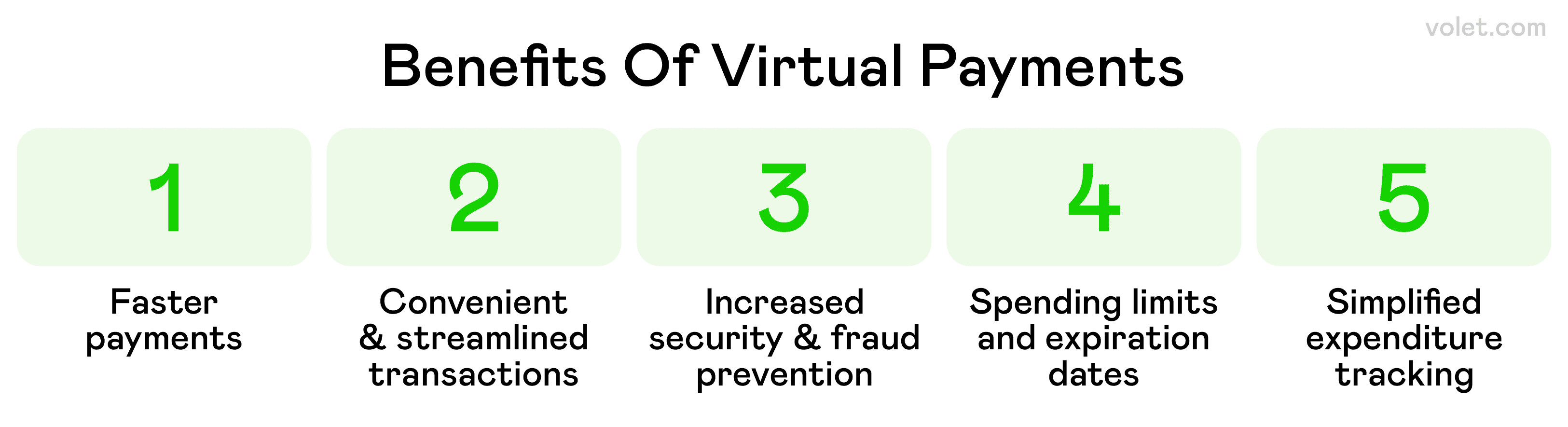
Benefits of Virtual Payments for Business Operations
Implementing virtual payments transforms how your business handles transactions:
Improved Cash Management
Virtual card payment systems provide real-time visibility into spending, helping optimize working capital. By streamlining the payment process, you'll reduce delays associated with traditional methods like paper checks and wire transfers. This improved cash flow visibility helps companies make better strategic decisions about resource allocation.
Enhanced Expense Control
The ability to issue virtual cards with predefined spending limits gives you unprecedented control over budgets. You can restrict cards to specific vendors, transaction types, or even limit them to a single transaction. These features make virtual credit card solutions ideal for expenses like car rentals and other travel costs that traditionally require physical cards, while ensuring compliance with company's policies.
Streamlined Reconciliation
Each virtual card number functions as a unique payment identifier, dramatically simplifying reconciliation. The detailed payment information automatically captures vendor details, purchase categories, and other relevant data, creating an audit trail that traditional bank statements can't match.
Reduced Fraud Risk
The temporary nature of virtual credit card credentials significantly reduces fraud exposure. If a virtual card provider detects suspicious activity, the specific card number can be immediately deactivated without affecting your primary accounts. This targeted account number management prevents cascading security compromises.
How to Implement Virtual Payments in Your Business
Transitioning to virtual payments requires careful planning:
- Assess your current payment challenges and objectives
- Research providers that align with your transaction volume and industry
- Consider integration requirements with existing accounting systems and bank relationships
- Evaluate pricing structures to ensure cost-effectiveness
- Develop implementation timelines and staff training plans for using virtual cards
- Communicate changes to vendors and establish acceptance procedures
- Create protocols for virtual card issuance including spending limits and permissions
- Establish procedures for account number security and payment data protection
Most virtual card payment platforms can be implemented within weeks, with immediate benefits for expense management and payment processing. Many solutions offer convenient in-app generation of temporary credentials tied to specific parameters, enhancing security while simplifying the user experience. The best solutions allow you to gradually transition from traditional methods while maintaining business continuity.
Closing Thoughts
Virtual payments represent a fundamental transformation in business transactions, financial management, and data security. Implementing the right solution for your needs enhances security, improves efficiency, and provides better spending control.
The payment methods landscape evolves rapidly with blockchain, AI, and mobile innovations from companies like Visa and Mastercard. Today's leading providers may be surpassed tomorrow, so regularly reassess your strategy. Transitioning to virtual payments can be gradual—start with specific departments or expense categories to validate benefits before full implementation.
Disclaimer
This article is provided for informational purposes only and does not constitute legal, financial, or professional advice. All content is based on publicly available information and personal opinions. Readers are advised to seek professional guidance before making decisions or acting based on the material presented. The author and publisher assume no liability for any actions taken or not taken by the reader based on the information contained herein.
FAQs
Virtual payments accelerate the payment cycle by eliminating delays associated with traditional methods, allowing funds to move more quickly through your business. Additionally, many programs offer rebates that generate direct revenue back to your company based on transaction volume.
Yes, many virtual card platforms seamlessly integrate with digital wallets like Google Pay and Apple Pay, allowing you to use virtual credentials through your mobile device for enhanced convenience while maintaining the security benefits of virtual card number technology.
Expense management becomes significantly more streamlined with virtual credit cards by automatically categorizing transactions, enforcing compliance with spending policies through preset spending limits, and eliminating manual receipt collection through digital payment information capture.
When you pay online using virtual cards, the best practice is to generate a unique card number for each merchant or transaction category. This approach maximizes security by ensuring your payment data remains compartmentalized, preventing widespread exposure if any single merchant experiences a breach.
Electronic payments through virtual systems transform your payment process by automating transaction initiation, approval workflows, and reconciliation steps. This comprehensive approach to payment methods reduces manual intervention, minimizes errors, and provides detailed payment information for accounting purposes.
Virtual cards offer superior control compared to physical cards when ensuring payments to vendors. With virtual cards, businesses can create unique payment identifiers for each vendor relationship, set precise spending limits, and establish automatic payment scheduling through their bank or virtual card provider. This eliminates the risks associated with sharing physical card details across multiple vendor touchpoints.
Yes, small businesses can achieve significant benefits from virtual cards, often with less implementation complexity than larger companies.
Virtual payment solutions are digital systems that allow businesses and individuals to make payments online using virtual card numbers or digital wallets.
Businesses use virtual payments to improve security, automate transactions, and simplify expense management.
Yes. Virtual payments use encryption, tokenization, and unique card numbers to reduce fraud risks.
Do More With Your Money
Manage digital money effortlessly: send, receive, and exchange crypto for business and everyday life
Let’s talk about your payment needs!
Message your manager in any language:
Author

Akan NseCrypto/Finance Content & Copywriter
I’m a fiction writer turned crypto copywriter who explains blockchain and AI with clarity and creativity.
Follow us to never miss a new article