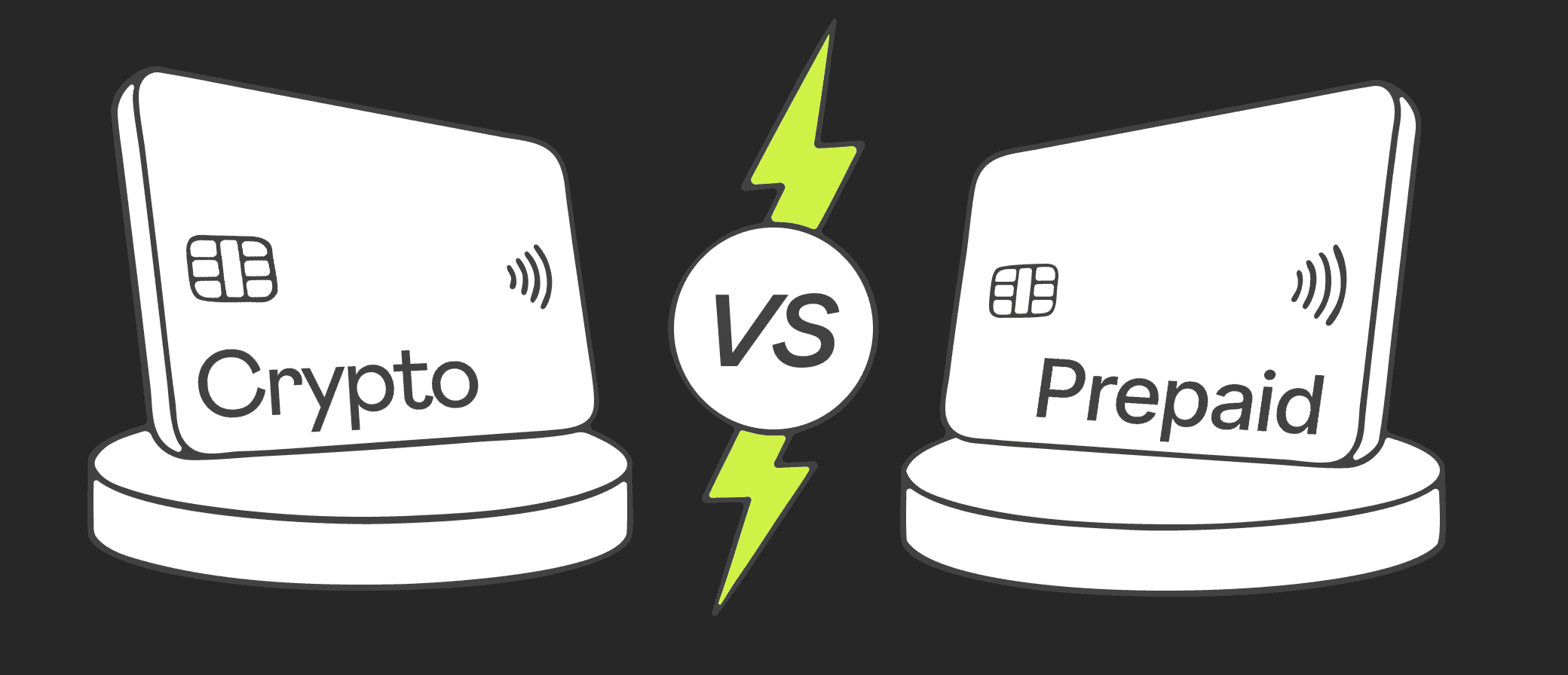
What's the real difference and why it matters for your fees
True debit (auto-liquidation)
Prepaid
Balance held in
Crypto, usually stablecoins
Fiat (loaded by you)
Crypto conversion
Happens automatically at the point of sale
Already done (you converted manually)
Exchange rate
Provider's rate at checkout, which can include a markup
Visa or Mastercard rate on non-USD purchases, plus any card FX spread
Typical effective cost
Spread at checkout, often marketed as free
Loading fee, shown upfront
Taxable event
Usually every purchase (depends on country)
Once per top-up, not once per purchase
Question {{i}} of 4
{{n}} purchases a month
1 purchase a month
A prepaid card fits you better
A true debit card fits you better
It's a close call
You convert on your terms and keep card spending in fiat.
The card converts for you at checkout. It's convenient, but the provider picks the rate.
Your answers point both ways. The deciding question: do you want to pick the conversion rate yourself?
Stablecoins convert at about 1:1, so holding them until checkout gives you little upside.
With volatile crypto, a debit card keeps your exposure until you pay, but a price drop can also shrink your spending balance.
With a mix, you can convert stablecoins for card spending and keep volatile crypto as an investment.
With {{n}} purchases a month, a debit card creates about {{y}} taxable events a year.
{{n}} purchases a month means about {{y}} taxable events a year with a debit card: manageable, but worth tracking.
With {{n}} purchases a month or fewer, per-purchase tax records stay manageable.
With 1 purchase a month, per-purchase tax records stay manageable.
You pay mostly in USD, so currency exchange costs barely affect your choice.
You often pay in other currencies, so compare FX markups, not just loading fees.
You'd rather not think about conversion, and that's exactly what a debit card does for you.
You want to choose when and at what rate you convert, and only a prepaid card gives you that.
Add 1,000 USD in BTC and the price drops 10%: 900 USD is left, so a 950 USD purchase is declined.
Little price risk with stablecoins, but the conversion at checkout can still fail.
Debit or prepaid: which card fits your crypto?
Four quick questions. See how each card type would handle your habits.
Question 1 of 4
What do you mostly hold?
How many card purchases do you make per month?
15 purchases a month
1
60
What currency do you usually pay in?
What matters more to you?
A prepaid card fits you better
You convert on your terms and keep card spending in fiat.
Your year with each card
True debit
Prepaid
Taxable events per year*
180
12
Who picks the rate
The provider, at checkout
You, when you load the card
Price drop risk
Add 1,000 USD in BTC and the price drops 10%: 900 USD is left, so a 950 USD purchase is declined.
Your balance stays in USD until you spend it.
Paying in other currencies
Check the provider's FX markup at checkout
Check the card's FX markup
* In many countries, including the US and the UK, each crypto sale is a taxable disposal. The prepaid figure assumes one card top-up a month. Illustrative only, not tax advice: rules vary by country.
Volet.com Digital Card: a prepaid virtual Visa in USD
Load from your Volet.com wallet: 2% + 1 USD, charged on top
Purchases: no fee
Issuance: 5 USD, then 2 USD a month
Non-USD purchases: FX spread of 0.1–1.9% applied to Visa's exchange rate
Apple Pay and Google Pay, including contactless payments in shops
Available in 70+ countries after full verification. Top it up from USDT: conversion to USD costs 1 USD, with no markup on the rate.
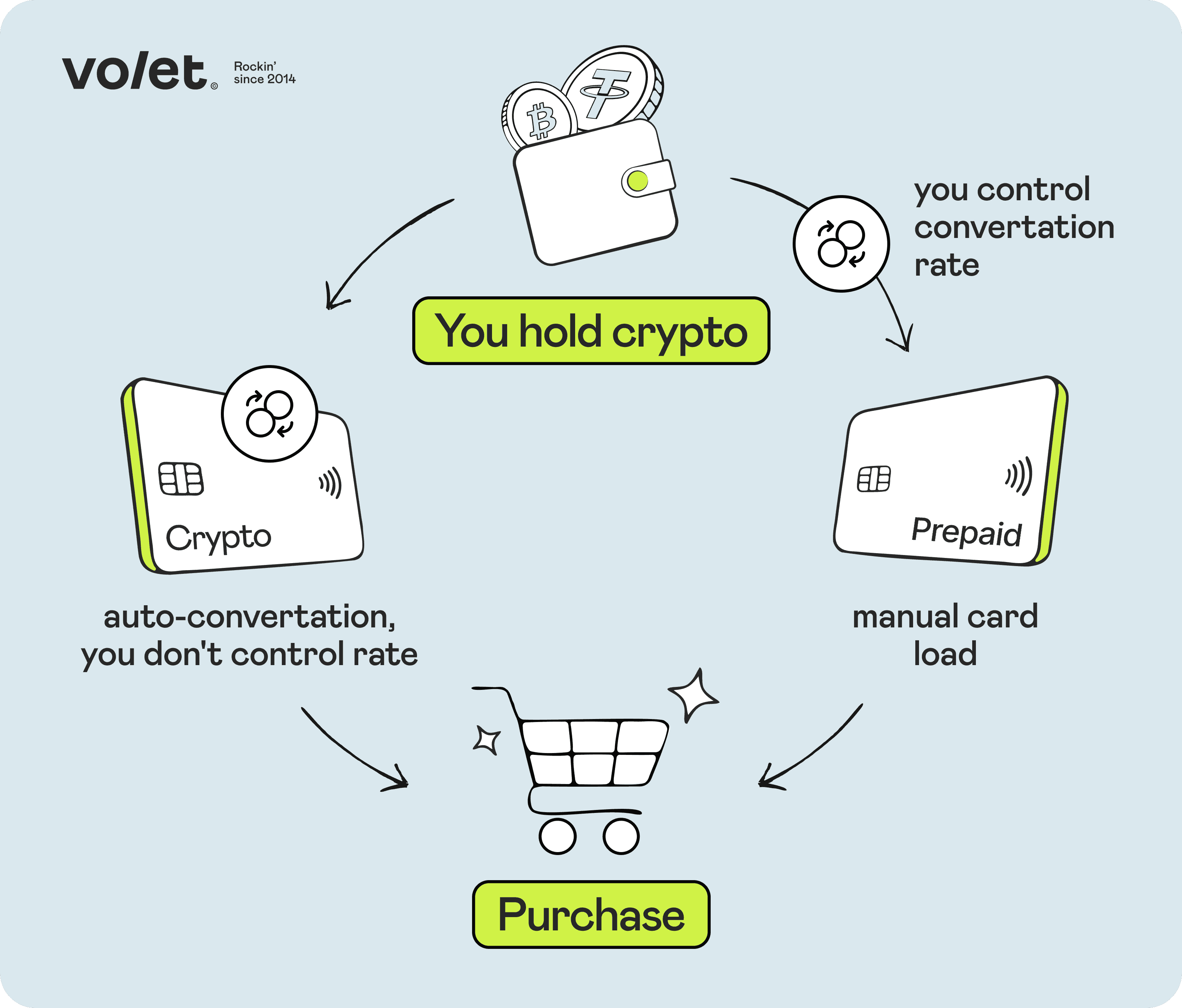
This is what most people picture when they hear "crypto debit card." Your balance sits in actual cryptocurrency — most often a stablecoin such as USDT or USDC, sometimes BTC, ETH, or another asset — and is only converted to fiat at the moment of purchase. The card is linked directly to your crypto wallet or exchange account.
When you tap the card at a checkout terminal, the provider instantly sells the required amount of crypto and forwards fiat to the merchant. From the merchant's side, the transaction looks identical to any standard Mastercard or Visa payment. From your side, your crypto balance decreases in real time.
This is sometimes called the "auto-liquidation" model: the card automatically sells (liquidates) your crypto for every payment. Coinbase Card is a well-known example: you keep various assets in your Coinbase account, and the card spends from them directly, converting them at the point of sale.
The main advantage: convenience. You don't need to top up anything, because the card spends straight from your crypto balance. If that balance is in volatile crypto such as BTC or ETH, you also keep exposure to price movements until the moment you pay.
The main drawback: the conversion happens at the moment you least control it — at checkout, when you can't shop around for a better rate. The spread applied at that instant is set entirely by the provider.
On top of that, in many countries, including the US and the UK, every single auto-liquidation transaction is a taxable event: each purchase counts as a disposal (in tax terms, a sale) of a crypto asset. With stablecoins, the gain on each sale is usually close to zero, but the sale may still need to be recorded. If the card spends BTC or ETH that has gone up in value, you may also owe tax on the gain, even when you pay for a $4 coffee.
To make this concrete, here's a hypothetical example: you pay with a USDT-funded debit card 15 times a month. Each payment is a separate sale of crypto, so you end up with 180 entries to track at year end, even if each one shows a gain of almost zero.
Tax rules differ by country, so treat this as an illustration, not tax advice, and check how crypto spending is taxed where you live.
Declined transactions with true debit cards can be more common than with prepaid cards, because the conversion itself happens at checkout: a liquidity issue, a compliance check, or a provider limit at that moment can stop the payment even when you have enough crypto. If your card spends volatile crypto, there's one more risk. Hypothetically, if you add $1,000 worth of BTC and the price drops 10% before you pay, only $900 is left, and a $950 purchase is declined.
Prepaid crypto card — balance converted to fiat before spending
With a prepaid card, you convert your crypto to fiat (usually USD or EUR) yourself, in the provider's app or website, before you can use the card. Once loaded, the card holds a fiat balance. When you pay with it, you are spending dollars or euros, not cryptocurrency.
Crypto.com Prepaid Visa Card is a well-known example: you top it up in advance, and cryptocurrency used for a top-up is converted into the card's fiat currency before spending. Volet.com Digital Card follows the same prepaid logic, but it's a regular prepaid card that holds USD: your USDT is converted to USD when you top up the card, so you always spend dollars.
The main advantage: predictability. You see the full cost before you spend, because the conversion and the loading fee are shown upfront, and your card balance is fixed in dollars. You load exactly what you plan to spend, and nothing is sold at checkout.
What this means in practice: say you hold USDT and want $500 available on a Volet.com Digital Card. Converting USDT to USD costs a flat $1 per operation, whatever the amount, with no markup on the exchange rate, and you see the exact USD amount before you confirm.
The loading fee of 2% + $1 is charged on top of the amount you load. To put $500 on the card, you need $511 in USD ($500 + $10 + $1), which takes about 512 USDT including the $1 conversion fee.
In your Volet.com account, you can do this in one of two ways:
Deposit USDT to your USDT wallet and top up the card straight from it: the conversion to USD happens automatically.
Deposit USDT straight to your USD wallet and top up the card from there. Either way, the conversion costs $1, and the funds appear on the card instantly.
The main drawback: the process requires a manual step. You need to top up the card before you spend, converting crypto to fiat on the way. If you let the balance run low mid-trip, you'll need to top up. For someone who wants to spend crypto without thinking about it, this friction is real.
Spend your fiat and crypto easily, anywhere
With truly global Volet.com virtual and plastic cards.
It is common to see crypto card providers advertise "0% fee on transactions" or "no conversion fees." The statement can be technically true and still misleading if you only look at the headline.
Providers need to generate revenue somewhere. For cards with "0% fees," the revenue often comes from the spread — the difference between the real market rate and the rate you receive when converting crypto to fiat. Some providers disclose this spread in their terms, so check them. One pattern to watch for: top-ups are free, but the conversion at checkout can include a markup of a couple of percent.
The spread is one of the most common hidden costs in the crypto card market. Building it into the rate isn't a problem in itself; the problem is when you can't see the final amount before you confirm.
Here's how it plays out in a model scenario when you hold USDT and spend $500 a month in USD across 15 purchases.
Prepaid card (Volet.com Digital Card as the example): you top up the card from USDT once a month and load $500. The conversion costs $1, the loading fee is $11 ($10 + $1, charged on top), the monthly fee is $2, and the card costs $5 to issue. That's $18 in the first month and $13 a month after that, all shown before you confirm. Taxable events: 12 a year, one per top-up.
True debit card: the card converts USDT at the provider's checkout rate on each of the 15 purchases, so your cost is the provider's spread, plus any card fees. Hypothetically, at a 1% spread on $500 that's $5 a month; at 2.5%, it's $12.50. Taxable events: 180 a year, one per purchase. With stablecoins, the gain on each sale is close to zero, but in many countries every sale still has to be recorded.
To compare the two honestly, ask a debit card provider for its effective conversion rate, not just its fee table. In the end, the total cost of the two models is often comparable; what differs is whether you see it before you pay. Monthly fees depend on the card, not on the model.
The Volet.com Digital Card: a prepaid card with transparent costs
Digital is a virtual Visa card in USD, issued in your name, with a three-year validity period, frictionless 3-D Secure, and Apple Pay and Google Pay support.
It is available to eligible users in 70+ countries — see the full list. It shows where the card can be issued, not where you can pay with it. If your country isn't on the list, Digital isn't available to you yet: check the other Volet.com card programs, which have their own country lists.
For Digital full identity and residential-address verification is required. Verification usually takes a few minutes, and the virtual card is issued within minutes of approval.
Digital does not support ATM cash withdrawals, but you can pay contactlessly in shops with Apple Pay or Google Pay. If you need cash, the Europe Plastic card (EU, Switzerland, Norway, Turkey, and Israel) and the APAC Plastic card (10 Asia-Pacific countries) support ATM withdrawals.
Converting USDT to USD — $1 per operation, no markup on the rate
Load from a Volet.com account — 2% + $1 (charged on top of the loaded amount)
Purchase transaction — $0
Currency exchange for non-USD transactions — FX spread under the card tariff, applied to Visa's exchange rate (0.1–1.9%)
If most of your spending is in a local currency, such as BRL or MXN, the FX spread applies to almost every purchase, not just to occasional payments abroad. Purchases in other currencies usually settle within 2–3 days, and the final amount can differ slightly from the pre-authorization you see at checkout.
The Digital Card's $2 maintenance fee is charged at the end of each month from the card or any Volet.com wallet with sufficient funds. If there are insufficient funds, Volet.com sends a reminder and attempts to collect the fee for 30 days. If it remains unpaid, further card loading is restricted; reactivation costs $5.
If you no longer need the money on the card, you can unload it back to your Volet.com wallet for $1.
Digital Card loading and spending limits:
Minimum load per transaction — $10
Maximum load per transaction — $10,000
Maximum load per day — $30,000
Maximum load per month — $50,000
Single purchase, purchases per day and per month — up to 30,000 EUR each
Digital Card can be loaded only from your Volet.com account. Loading it from any other source costs a 5% fee and gets the card blocked, so never send funds to the card directly from an external wallet or account.
Coinbase, Crypto.com, Visa, Mastercard, Apple Pay, and Google Pay are trademarks of their respective owners. Volet.com is not affiliated with Coinbase or Crypto.com.
Spend your fiat and crypto easily, anywhere
With truly global Volet.com virtual and plastic cards.
For true debit cards with auto-liquidation, yes. In many countries, including the US and the UK, each purchase triggers a taxable disposal event because the card sells your crypto at the moment of payment.
With a prepaid card, the taxable event happens when you convert crypto to fiat to load the card: once per top-up, not once per purchase. If you make frequent purchases, the difference in tax complexity between the two models is significant.
With a prepaid card, you can generally request a transaction dispute through your card provider, subject to the applicable card program and network rules; a chargeback is not guaranteed. For Volet.com Digital Card, the published chargeback fee is $25 per transaction, while refunds and reversals are free.
With true debit cards, the card network is the same, but the auto-liquidation layer adds complexity. Some providers handle disputes consistently; others are less clear about their process. Check the specific terms before relying on chargeback protection.
With a prepaid card, declines can result from insufficient fiat balance, restricted merchant categories, or geographic limits. For example, a prepaid card such as Volet.com Digital Card can't be used for gambling, betting, and some other restricted merchant categories.
With a true debit card, the real-time conversion itself can fail: a price move, a liquidity issue, or a compliance check at the moment of purchase can decline the payment even with crypto in your wallet. If declines are frequent, check the card type and the provider's restrictions.
It can, in two ways. First, network fees depend on the asset and the network and change with congestion, so check the fee in your wallet before sending.
Second, the asset affects how predictable your top-up is. Stablecoins like USDT or USDC convert at about 1:1, so what you convert is close to what you get, which makes budgeting straightforward.
Volatile assets like BTC or ETH add timing risk: the price you see when you decide to convert may differ from what you receive by the time the transaction confirms.
Volet.com Digital Card works for both. It's a virtual Visa card for online purchases and subscriptions, and once you add it to Apple Pay or Google Pay, you can also pay contactlessly in shops and on transport. Merchant, country, and card-program restrictions can still apply.
Physical prepaid cards can also be used at ATMs. The main limitation to check for any specific card is geographic: some programs restrict usage in certain countries or exclude certain merchant categories.
Possibly, but check the card's ongoing fees first. Many providers charge a monthly fee after a set period without transactions — this can quietly drain a small balance if you load the card for a trip and then don't use it again for months.
Volet.com charges $2 per month for the Digital Card regardless of activity. For occasional use, count the fixed costs first: $5 for issuance plus $2 a month comes to $29 in the first year, before loading fees (2% + $1 per load, charged on top) and any currency-exchange costs.