Asking 'which network is better' is the same as asking which tool is better: a hammer or a screwdriver
The question should be: what task are we actually trying to solve with this tool?
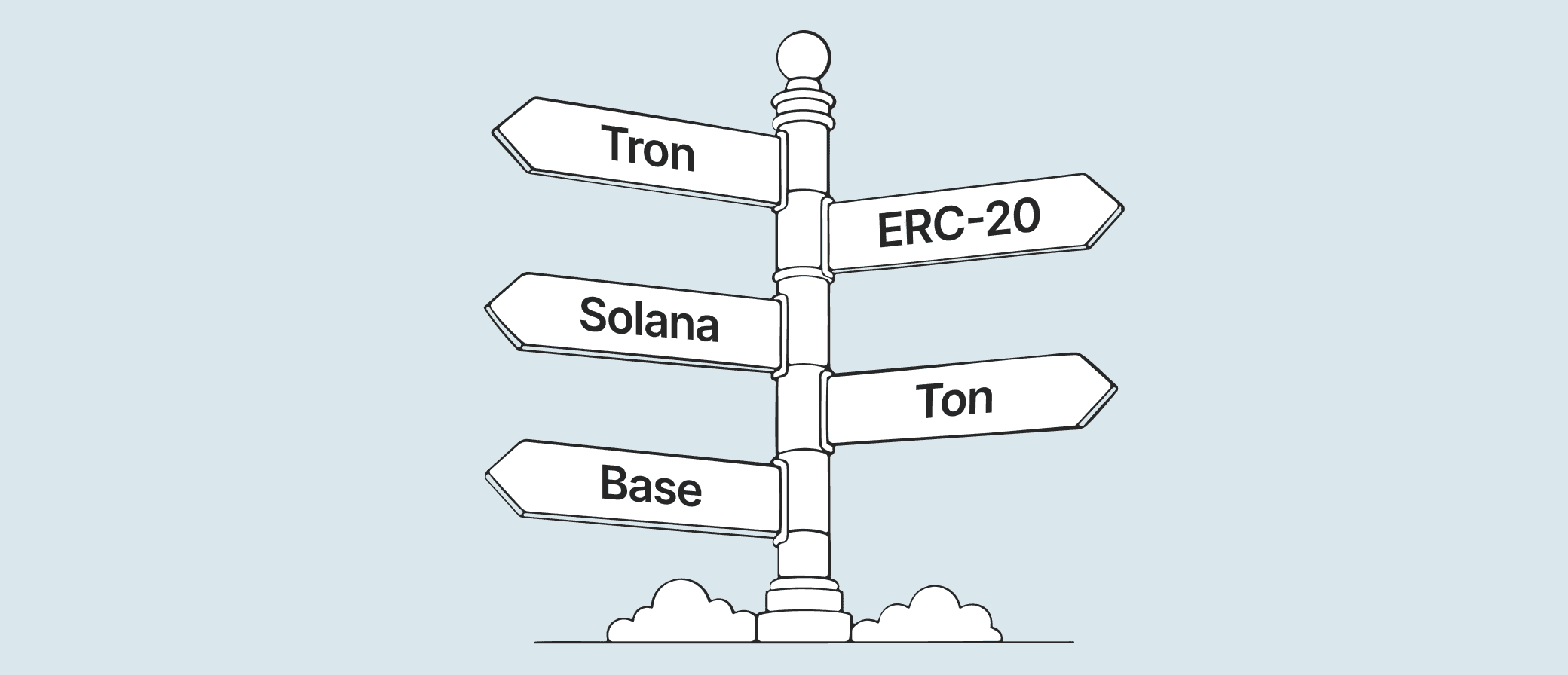
TRC-20 works for peer transfers and freelance payments. Solana and Ethereum L2s handle mass payouts. TON is the only practical choice inside Telegram. ERC-20 is the standard for large institutional transfers and DeFi. The rest of this guide explains why.
A Decision Framework
Before choosing a network, work through these questions:
What will the recipient do with the funds? Convert to local currency through a P2P market or exchange? Hold in USDT? Spend with a crypto card? Use within a Telegram bot? Each answer points to a different network.
Which stablecoin — USDT or USDC? If your counterparty requires USDC — common for EU-based platforms — your network choice narrows meaningfully. If USDT works for everyone involved, TRC-20 is the broadest default.
Does the receiving wallet or exchange support this network? Confirm the receiving side first, then set your network on the sending side.
How large is the payment? At different sizes, different factors dominate. Under $100, the network fee is proportionally significant. Between $100 and $10,000, what matters more is whether the recipient can actually receive and exit the payment. Above $10,000, liquidity depth, counterparty trust, and transaction finality take precedence over fee differences.
Is this a one-time transfer or a recurring process? A one-time transfer tolerates a slightly higher fee. A process that runs weekly or monthly with many recipients needs Solana or L2 — the network fee accumulates into a material cost.
Route selector
Which network fits your transfer?
Pick what you're actually trying to do — the right network depends on the use case, not a fee chart.
1 What are you doing?
2 Asset
3 Amount
$
Recommended
—
Fee by network, at this amount
Networks at a Glance
The table below covers the six networks that handle the overwhelming majority of stablecoin payments in 2026. Use it to orient yourself before the use-case sections that follow.
Near-universal acceptance: supported by virtually every exchange, P2P platform, and local off-ramp globally
Relatively expensive for mass payouts at volume
BEP-20 (BNB Chain)
$0.05–1
Small payments, subscriptions
Lower fees than TRC-20; widely supported on Binance and BNB ecosystem platforms
Not all major exchanges offer BEP-20 withdrawal for every asset
ERC-20 (Ethereum L1)
$0.05–0.50 typical ($15+ during congestion spikes)
Large transfers, institutional, DeFi
The institutional standard: supported by every custodian, OTC desk, and DeFi protocol; deepest liquidity
Fees unpredictable under congestion; queue at 1,000+ transactions
Ethereum L2 (Arbitrum, Base, Optimism)
$0.01–0.20
Mass payouts, high-frequency business payments
Low fees with full Ethereum mainnet compatibility; inherits Ethereum's security and tooling
Wallet and exchange support still narrower than TRC-20
Solana
< $0.01
Mass payouts, micropayments
Lowest fees of any major network; processes hundreds of transactions per second; ideal for high-volume automated payouts
USDT exists on Solana but has significantly thinner liquidity than on TRC-20; fewer exchanges and P2P markets support it for withdrawals
TON
< $0.01
Telegram-native payments, Telegram Mini Apps
Native to Telegram's 1 billion+ user ecosystem; no external wallet required for recipients using Telegram
Limited support outside the Telegram ecosystem
A note on Ethereum L2s: these are secondary networks — Arbitrum, Base, Optimism — that run on top of Ethereum but process transactions faster and far more cheaply, typically $0.01–0.20 per transfer. Think of them as express lanes built over the same highway. They are fully compatible with Ethereum wallets and tools, but not yet as universally supported by exchanges as TRC-20.
Why you see different fees when withdrawing from an exchange
The numbers in the table above apply when you interact with the blockchain directly — sending from a non-custodial wallet like Trust Wallet or MetaMask, where you pay the network yourself. On an exchange, the fee is different: for instance, for TRC-20, it is rarely more than 1 USDT.
The exchange's withdrawal fee bundles the network cost with its own margin — but it keeps the network portion low by batching many users' withdrawals into a single transaction, instead of sending each one separately.
For the most widely used networks, this usually makes withdrawing through an exchange cheaper than sending the same transfer directly from a non-custodial wallet. The fee you see on the exchange is simply what that platform has set, based on its own batching efficiency and margin.
Why Network Choice Is Not About "Best" — It's About Fit
Three situations from real life:
A freelancer in Vietnam receives USDT on Polygon. Her client sent it that way because fees are low — and technically he is right, the transfer costs fractions of a cent. The money arrived. Then she tried to cash out. Every P2P platform and local crypto shop in Ho Chi Minh City only accepts TRC-20 and BEP-20. Polygon is not on the list.
She can deposit to a centralized exchange and withdraw in TRC-20 — the extra step costs about $1. Or she can use a bridge, which costs a few cents more. But she has to know that these options exist, find a platform that supports the route, create an account if she does not have one, and complete the steps correctly. For a non-technical user receiving payment for the first time, that is a real barrier — even if the dollar cost is small.
This is also why platforms that support multiple networks on both the receiving and sending side matter. With Volet.com, a payment received on Polygon USDT can be withdrawn in TRC-20 without any intermediate steps — the network difference is handled internally, the same way a centralized exchange does it.
One account, many exchanges
Buy and sell crypto and stablecoins at great prices quickly and seamlessly. Volet.com connects you to the best the crypto world has to offer.
A CPA network switches to Ethereum mainnet for "security and reliability." Five hundred affiliate payouts a month, $50 each. Ethereum has a strong reputation, so the ops team picks it. At typical load, gas fees run $0.3–0.5 per transaction — which adds up to $150–250 a month in fees alone. During congestion spikes, that number climbs further. Solana or an Ethereum L2 would cost $5 total for the same batch. The network was secure. It was just the wrong tool for the job.
How often Ethereum fees spike to $15 or more
In a typical month, Ethereum runs at low load for roughly 25–28 days — fees stay in the $0.05–0.50 range. Moderate load, where fees climb to a few dollars, accounts for scattered hours adding up to around 2–5 days. Spikes above $10–15 are rare: usually a few hours, at most one day per month. During periods of intense market activity — a major NFT drop, a token launch, a sharp price move — you might see 2–3 such days in a row.
A SaaS platform picks Solana for contractor payouts. Smart choice on paper: near-zero fees, fast confirmations, clean API. Then they run the first batch. Eighty percent of their contractors use Binance to receive payments — and Binance supports USDT deposits on TRC-20 and ERC-20, not Solana SPL. The payouts fail to go through. Support tickets pile up. The team spends a week manually resolving misrouted transactions. Solana has excellent infrastructure. It just does not reach where their contractors actually are.
The question to ask before choosing a network in all three cases is not "which one is fastest, or cheapest, or most convenient for us at the moment" but "what will the recipient do with the funds, and does this rail support that path?"
Right Network Per Use Case
I just want to send USDT to a friend or pay a freelancer
TRC-20. More than 74 million holders use it, every major exchange supports it, and P2P markets in every region accept it.
Practical note: the fee for TRC-20 depends on the recipient's wallet history. Sending to a new address that has never received USDT activates it on-chain and costs $2–4. Sending to a wallet that has received USDT before costs roughly half that.
I'm withdrawing USDT from an exchange
Check the receiving side first — your wallet, P2P platform, or exchange account — and find out which network it expects for USDT deposits. Then go back and select that same network on the withdrawal screen. Do not do it the other way around.
For most personal wallets and P2P services, TRC-20 is the right choice. Avoid ERC-20 for amounts under $200; the Ethereum fee can eat a significant slice of a small transfer. BEP-20 works too if both sides confirm they support BNB Chain.
What actually happens with your USDT at an exchange
Depositing on an exchange is not a conversion between networks. The exchange already holds funds on every network it supports. When your USDT arrives, it simply credits your account balance — a database entry, not a blockchain transfer. When you withdraw, the exchange pays you out from its own balance on whatever network you select.
No network-to-network transfer happens inside the exchange at any point; it is internal bookkeeping, not a transaction. That is exactly why "converting" from one network to another through a centralized exchange is so cheap and fast: the exchange already holds reserves on every network it supports, so there is no actual conversion to perform — just two ordinary deposits and withdrawals on two different rails.
I want to send money to a family member abroad — they are not into crypto
The destination matters more than the fee here. Your family member will convert the USDT to local currency — probably through a P2P market, a local crypto shop, or a bank transfer — and the network they can convert from depends entirely on what is available in their country.
TRC-20 is the dominant network for P2P markets and local exchange points in most of Southeast Asia (Vietnam, Philippines, Indonesia, Thailand), Sub-Saharan Africa (Nigeria, Kenya, Ghana), and Latin America (Colombia, Venezuela, Argentina).
BEP-20 works in some of these markets but with less coverage. Solana and Ethereum L2s are largely absent from local off-ramp infrastructure in these regions.
The practical approach: ask your recipient to check which network their local P2P platform or exchange accepts for USDT deposits before you send anything. Send on that network — even if the fee is slightly higher than an alternative. A $2 fee on TRC-20 costs less in total than a $0.01 Solana fee followed by a cross-network swap the recipient has to figure out on their own.
One exception: if your recipient is withdrawing to a centralized exchange or a platform like Volet.com, network choice matters much less. As explained earlier, exchanges hold reserves on every network they support — your recipient can receive on whichever network is cheapest and withdraw in any supported network afterward. In that case, just pick the cheapest network both sides support and send.
My client in the EU wants to pay me in USDC
USDC is not available on TRC-20. For EU-based clients, the most common options are ERC-20, Arbitrum (Ethereum L2), Base (Ethereum L2), and BEP-20. Ask your client which network their platform supports for USDC withdrawals, then give them a matching deposit address.
Ethereum L2s — Arbitrum and Base — are a good default: fees are under a cent and wallet support is broad. Avoid ERC-20 mainnet for amounts under $200; the gas fee makes small transfers expensive.
I'm building a product with payments inside Telegram
TON. It is native to the Telegram ecosystem, integrated directly into the Telegram wallet, and costs fractions of a cent per transfer. For payments through Telegram bots or Mini Apps, the recipient needs no external wallet download — they already have it.
But there is a major limitation: TON support outside Telegram is narrow. If your recipients need to convert TON-based USDT to local currency, verify the available off-ramp options in their region before you build on this rail.
I'm accepting payments from customers at checkout
TRC-20 leads for global audiences — it gives the widest range of wallets and exchanges that can send to you. BEP-20 is a reasonable second option. If your customers are primarily in the EU, add an ERC-20 or Ethereum L2 option given the USDT delisting trend on European exchanges.
What matters after the payment arrives is your settlement goal. If you want to hold USDT and withdraw later, the network fee is your only variable cost. If you want immediate fiat settlement, the conversion and settlement fees matter more than the network choice.
I'm building micropayments — tips, bonuses, cashback under $10
Fixed network fees make micropayments economically impossible on the wrong network. A $3 Tron fee on a $10 tip doesn't feel reasonable. The same transfer on Solana or an L2 costs less than a cent.
For any product built on small, frequent transfers — creator tips, loyalty rewards, in-game currency, affiliate micro-bonuses — the network selection is a fundamental architectural decision. Solana and Ethereum L2s are the only viable options at this scale.
ERC-20. Custodians, OTC desks, and regulated entities almost universally support it. DeFi liquidity on Ethereum is unmatched. At $10,000+, fee is not the variable that matters. What matters is that the counterparty accepts the transfer, that settlement is unambiguous, and that the transaction is final on the most liquid and institutionally recognized chain.
That is why for inter-company settlements, OTC deals, or anything requiring composability with DeFi protocols, Ethereum is the reference standard. Not because it is the cheapest, but because it is the one everyone in the institutional stack supports without question.
I need to pay 100 or more people every month
This is where network choice has the largest dollar impact. A platform paying 500 affiliates $50 each per month — $25,000 total — faces this math:
Network
Fee per transaction
500 transaction fees
Ethereum mainnet
~$0.3 typical; up to $3+ during congestion
~$150 typical; up to $1,500+ during spikes
TRC-20 (Tron)
~$2
~$1,000
Solana or Ethereum L2
~$0.01
~$5
Three things stand out:
Ethereum at typical load is actually cheaper than TRC-20 — around $150 vs $1,000 per batch. The reason most businesses running mass payouts still avoid Ethereum mainnet is not the typical fee but the unpredictable spikes: a congestion event on the day your payout batch runs can push costs to $1,500+ with no warning. For a recurring process with a fixed schedule, that variance is harder to absorb than a stable, higher fee.
Solana and Ethereum L2s cost $5 for the same batch regardless of load. This is not a marginal improvement — it is a structural one. Switching from TRC-20 to Solana or an L2 saves roughly $995 a month in network fees, nearly $12,000 a year.
At this volume, manual processing is not realistic on any network. You need API-based automation with parallel transaction dispatch. Volet.com parallelizes on-chain transactions, dispatching thousands in minutes through a single API call — and supports USDT and USDC across 9 networks, so network selection can be handled at the platform level rather than hardcoded per batch.
Scale your payments with Volet.com
Accept payments, send payouts, manage crypto and fiat across the globe — in one account.