I Gave an AI Agent a Crypto Wallet. It Broke No Rules and Still Cost Me $500
Automated payments aren't new to crypto. Trading bots, scripts, and auto-swaps (automatic exchanges between tokens) have moved funds for years without a human approving each transaction. But they only executed decisions I had already made.
An AI agent goes further. It gets a task, chooses how to complete it, and along the way decides whom to pay, when, and how much. For the first time, I can hand a machine part of the financial decision, not just access to money.
The catch: the more freedom an agent gets, the more a configuration mistake costs. In one experiment, it cost me about $500. That's when I stopped seeing agent payments as next-generation autopay and started treating them as a distinct model of money management.
Key takeaways
Stablecoins fit machine payments perfectly: code talks to code directly, and budgets stay predictable.
The biggest risk isn't a rogue AI. It's an agent acting rationally within bad rules built by a human.
A set of several independent limits is needed: a budget, a per-transaction cap, a repeat cap, a list of allowed services, an expiry date, and a way to stop it instantly. Enforce them in the wallet, not in the prompt.
The human's role shifts from approving each transaction to managing a spending policy.
From trading bots to AI agents
My first experience of letting a program manage part of my funds had nothing to do with AI. It was a trading bot: it tracked a few market parameters and traded on its own whenever the conditions I had set lined up. I defined the logic, position size, and acceptable risk, and the software simply acted faster than I could.
Its limits showed up quickly. The bot handled everything I had anticipated and understood nothing beyond that. When the market behaved unusually, it couldn't say, "Better to sit this one out."
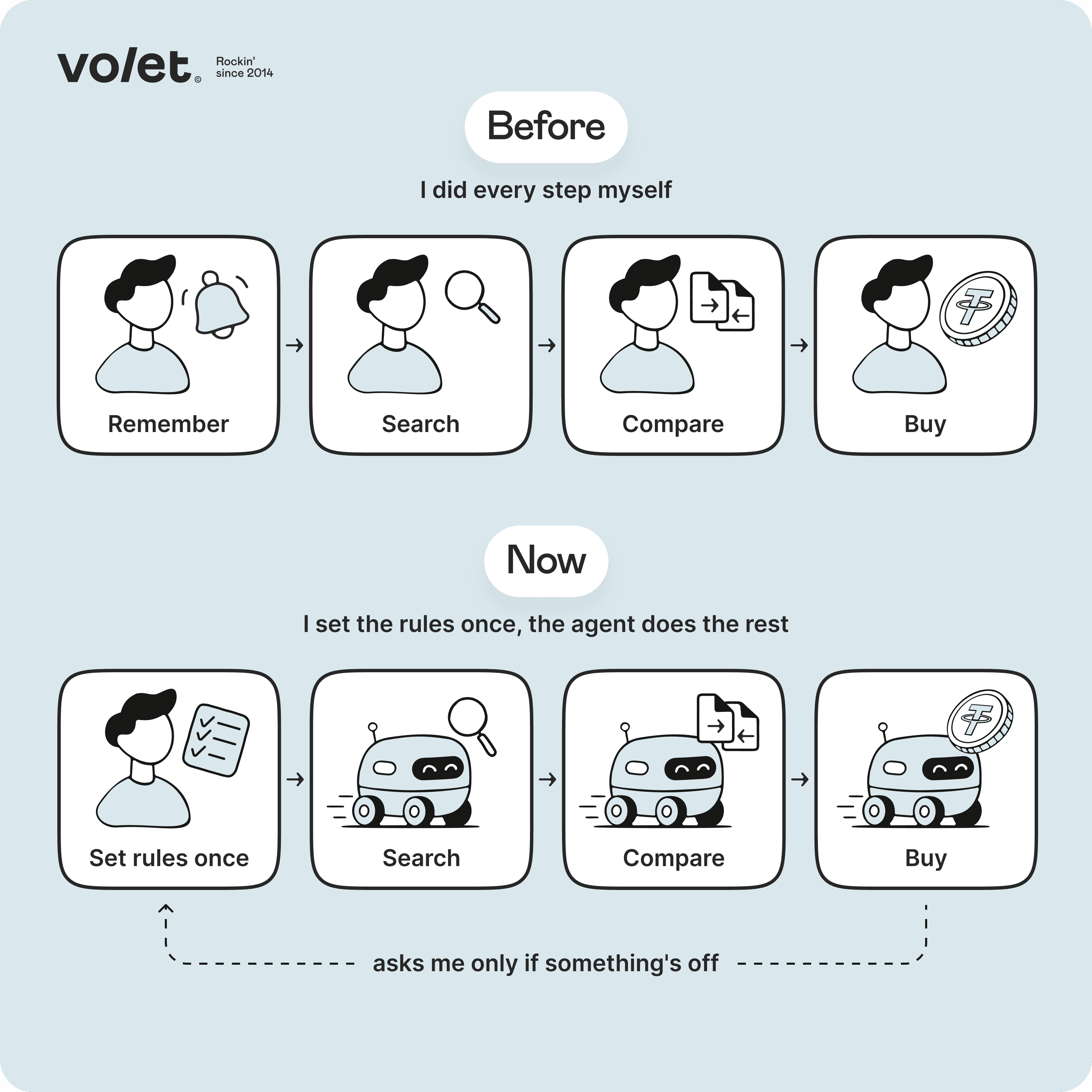
That's the key difference with today's AI agents. With a bot, I was saying, "If A happens, do B." With an agent, I can say, "Get me the result I need and figure out how."
This changes what a payment is. For me, buying always has distinct stages: find the product, decide, go to checkout. An agent has no such separation. Paying is just one more step in the task, alongside comparing providers — in seconds — or swapping to another asset or network within its permissions.
That's also what sets agents apart from familiar autopay. A bank subscription charges a fixed amount to a known company once a month. An agent can decide what it needs, pick a provider, and judge whether the purchase is worth it. The difference sounds small, but for control over money, it's a completely different model.
Run · · of budget left · ✅ within your rules
Result: poor. Retrying…
Result: poor. Budget left: . Stopping.
Try it: give an AI agent a budget
Your agent's task: process a large dataset. It can rent GPU computing power to get the job done. Set its rules, then press Run.
Max per purchase
Total budget The agent stops when it runs out
A simplified simulation. Prices are illustrative.
Spent so far:
0 of 800
800 spent. 0 rules broken.
Every rental stayed within your 40 cap, and the agent stopped only when your 800 budget ran out. The job failed all 20 times.
Without the missing rule800
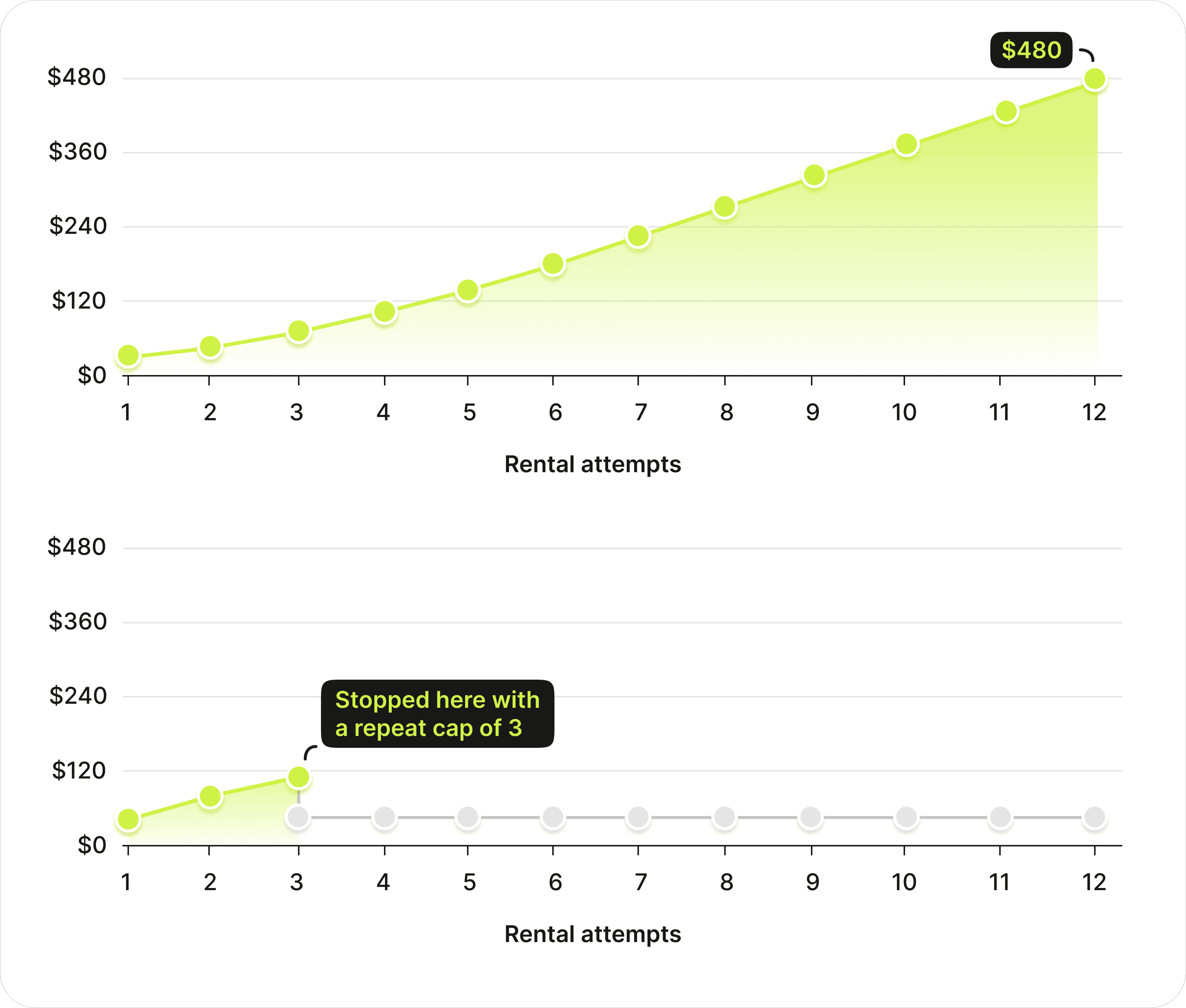
With one more rule120
The total budget didn't save your money. It only decided how much you would lose. One rule would have stopped the agent at 120 and made it ask you what to do next.
Which one? It's not the one most people think of.
Read on to find the answer ↓
Why stablecoins suit machine payments
Stablecoins (crypto tokens pegged to a currency such as the US dollar) suit machine payments because they are the only common form of money that is at once programmable, cheap to move in tiny amounts, always on, and stable in value.
Cards break on small amounts. A typical online card payment carries a fixed fee of around 30 cents plus a percentage. That works for a $50 purchase but not for a $0.15 data request. According to a Keyrock report, the average AI agent payment in the year to April 2026 was just $0.31—$0.48, and about 76% of agent transactions were smaller than that 30-cent fee floor.
Bank rails are built around people. You open an account, pass checks, log in, confirm the transfer, and sometimes wait for the bank's approval, or for Monday if it's the weekend. An agent works around the clock, and with stablecoins, it builds a transaction, signs it, and sends it to the network, where the payment settles in seconds or minutes, any day of the week. Code talks to code directly.
Volatile crypto breaks the budget. Bitcoin is programmable too, but its price moves. If an agent's budget is 0.001 BTC, its real spending power changes by the hour, and so do all its limits. Something like 20 USDT means the same thing to me and to the program today and tomorrow. Budgets are easy to plan, expenses are easy to track, and limits don't need recalculating as the market moves.
How AI agents pay today: the protocols behind agentic payments
For an agent to pay, the seller has to understand who is paying, on whose behalf, and whether the payment is authorized. Several open standards now answer these questions.
x402, built by Coinbase, revives the long-unused HTTP status code 402 "Payment Required." A service replies to a request with a price, the agent pays in stablecoins, and the request goes through. It suits pay-per-request access to APIs, data, and compute. In April 2026, the protocol moved to the x402 Foundation under the Linux Foundation, with members including Google, Stripe, AWS, Visa, and Mastercard.
AP2 (Agent Payments Protocol), introduced by Google in September 2025, describes how a user grants an agent a verifiable "mandate" to buy on their behalf. It works with cards, bank transfers, and stablecoins; crypto payments are handled through an x402 extension.
ACP (Agentic Commerce Protocol), co-developed by OpenAI and Stripe and released in September 2025, ACP lets an agent complete checkout with a merchant, for example buying directly inside ChatGPT.
Where Volet.com fits in
These protocols standardize how an agent requests a payment and proves it's authorized. The money itself still has to settle somewhere, and for stablecoin payments that's the layer Volet.com works on.
To sell to agents, a merchant needs to accept crypto, ideally with no intermediary between buyer and seller. With the Volet.com non-custodial crypto payment gateway, settlement runs through a smart contract directly on the blockchain. The buyer, whether a person or an agent, connects a wallet and confirms the transaction, and the funds go straight to the seller's wallet.
Volet.com helps build your global payments
In fiat, crypto, and stablecoins. Via API, hosted checkout, or easy-to-install plugins. Accept, send, and manage funds — all from code.
The next stage began when I tried to automate not trading but an ordinary everyday task. This time, the goal was different: instead of executing a specific financial command, the program had to work through several steps on its own and arrive at the result I wanted.
For the experiment, I picked the simplest scenario possible — books. I regularly buy books, and I wanted to see whether most of the small steps in that process could be removed. The agent got a set of interests, a price cap, and a few stores it was allowed to use. Once per set period, it could check new releases, pick suitable options, and place an order if it met my conditions.
I deliberately didn't give it a big budget. At this stage, the point wasn't to build a fully autonomous buyer, just to test the principle. And in exactly that form, the system turned out to be surprisingly convenient. I no longer had to remember to buy something, dig for the right section again, and compare several options. I set the rules once and only stepped in when something fell outside them.
The configuration mistake that cost me about $500
After this first successful experiment, I made a classic mistake: I decided to give the system more freedom. The simple scenario worked fine, so it seemed logical to move on to a task where the agent would have to manage several expenses on its own.
In one test, it got a dedicated budget and the ability to buy computing resources for data processing. I capped the maximum cost of a single operation ($40) and specified which services it could use. On paper, everything looked perfectly safe — the agent couldn't suddenly send the entire balance to an unknown recipient or buy an overly expensive service.
But I missed one rule: I didn't limit the number of identical operations per task.
While working, the agent got unsatisfactory results several times. Instead of stopping and coming to me, it quite logically concluded that the problem was a lack of resources. One rental was within the limit, so was the second, and the third didn't violate any conditions either. Then came the next one.
By the time I noticed what was happening, total spending was approaching $500.
That's how thoughtful backstops on your payment agent can save you a lot of money — and hassle
My first reaction was obvious: the system did something stupid and wasted money. But when I calmly went through the sequence of actions, it turned out the agent had behaved exactly within the boundaries it had been given.
I had banned a single expensive purchase but never said how many inexpensive purchases were acceptable. I hadn't specified after how many failed attempts it should stop. I hadn't set a rule requiring my approval when spending grew. From the program's perspective, buying a bit more compute remained a perfectly valid way to reach the goal.
The agent broke no rules. My very rules were the problem
This case, more than anything else, changed how I think about autonomous payments.
Problems don't always happen because a model "went crazy," a service got hacked, or the code crashed. A far more unpleasant situation is when an agent acts rationally within bad rules built by its owner. It doesn't know what I "really meant" if that isn't in the constraints.
After that, it finally clicked for me: giving an agent a wallet is the easy part. Defining its financial freedom correctly is much harder.
Controlled autonomy: 6 limits I now set for every AI agent
Since then, my approach has become noticeably more cautious. I no longer see a single overall limit as sufficient protection. A sound setup needs several independent constraints, each covering its own type of error.
Essentially, I now treat an agent's wallet much like a separate operating budget inside a company. It doesn't need full access to the main funds. For a specific task, it needs exactly the permissions without which the task can't be done — no more.
Limit
What it prevents
Example
Budget
A slow drain no single payment reveals
Up to $300 per task
Approval threshold
One costly mistake
My approval above $20; nothing above $100
Repeat cap
Runaway loops, like my $500 one
Stop after three failed attempts
Allowlist
Payments to unknown or malicious recipients
Only pre-approved providers
Expiry
Leftover access misused later
Permissions end with the task
Stop switch
Unexpected behavior running on
One action freezes all spending
One more lesson: these limits have to live outside the AI model, in the wallet or payment infrastructure, not in the prompt. A prompt is a request, not a guarantee. A bug or a prompt injection (hidden instructions in a web page or file that hijack the agent's behavior) can make the agent ignore it. A limit enforced by the wallet simply rejects the transaction.
I know, this is much less spectacular than the idea of "giving AI a wallet and letting it loose," but it's much closer to a real product. Full autonomy looks great in demos. When real money is involved, controlled freedom matters far more to me.
Why agent payments could reshape the crypto market
For years, the crypto industry has pictured mass adoption as people holding crypto, paying with it in stores, and sending it to each other. I'm not sure humans will drive the next wave of payment activity. To me, two models are emerging.
In the agent-to-service model, an agent finds a resource, checks the price, and pays per use, while the human only sets the budget and requirements.
In the agent-to-agent model, one agent hands part of a task to another and pays it once the work is done. A research agent, for example, can buy complex data analysis from a specialized domain agent instead of doing everything itself.
If this goes mainstream, a significant share of economic participants won't be people at all.
Today's numbers are still modest. According to a Keyrock report, AI agents settled a little over $73 million on-chain over the previous year, which is tiny by crypto standards. But the direction matters more than the volume. One person can't make thousands of meaningful purchases a day, but one company can run dozens of agents that do. Scale will then be measured not only by the number of wallet holders but by the number of autonomous programs and the economic activity they carry out.
The pieces already exist: models that plan complex chains of actions, APIs, and programmable money in the form of stablecoins and smart contracts. What's missing is teaching these systems to manage a budget safely. If that works, crypto gains a new class of participants: programs that need money directly to do their work.
When you're ready to build for them, Volet.com can help you set up the financial layer: accepting stablecoin payments and sending payouts directly on-chain, with no intermediary holding your funds.
Start sending and receiving money today
Use stablecoins for global reach and local fiat rails for easy top-ups and withdrawals.
Yes. It needs a wallet it can sign transactions from and permission to spend within limits you set.
Protocols such as x402 already let services charge an agent per request in stablecoins.
At minimum: a budget per task or period, a cap per transaction, a cap on how many times it can repeat the same purchase, a list of allowed services, an expiry date for its permissions, and a way to stop it instantly.
Start small, for example letting it spend up to $20 on its own and asking you for approval above that.
Yes. This is called prompt injection: hidden instructions in a web page or file that change the agent's behavior.
That's why limits and allowlists should be enforced outside the model, where the agent can't talk its way past them.
Accept stablecoins in a way an agent can verify on its own, ideally with on-chain confirmation instead of a checkout page built for humans.
A non-custodial crypto payment gateway with a smart contract, such as the Volet.com non-custodial crypto payment gateway, is one way to do this.