Explore the two main types of stablecoins and how they can enhance your investment strategy. Discover their features and benefits in our latest article
I still remember the first time I bought Bitcoin back in 2017. What a rollercoaster that was! 📈📉 One day I was up 15%, the next day down 20%. My stomach couldn't handle the stress—and neither could my investment strategy.
That's when I discovered stablecoins, and honestly? They changed my entire approach to crypto.
In this article, I'll walk you through everything I've learned about stablecoins over the years—what they are, the different types (especially the two main categories you need to know about), and how they can fit into a smart investing strategy. I've made plenty of mistakes along the way so you don't have to!
The concept of stablecoins, highlighting their types, core characteristics, and advantages in the cryptocurrency market.
What is Stablecoin?
The crypto market is notorious for its volatility, something I learned the hard way when I checked my portfolio during the 2018 crash and nearly spilled my coffee all over my laptop. That's precisely the problem stablecoins aim to solve.
A stablecoin is a type of cryptocurrency designed to maintain a stable value by pegging its price to another asset, most commonly the U.S. dollar. Unlike Bitcoin or Ethereum, which can swing wildly in value, stablecoins work to provide the stability of traditional financial systems with the innovation of blockchain technology.
The History and Evolution of Stablecoins
Stablecoins didn't just appear overnight. The first widely recognized stablecoin, Tether (USDT), was launched in 2014. At the time, I was still trying to figure out what Bitcoin was, let alone these new "stable" digital assets!
The need for stablecoins became apparent as the crypto market matured. Traders needed a way to:
Exit volatile positions without converting back to fiat currency
Have a stable medium of exchange within the crypto ecosystem
Reduce exposure to crypto market volatility
The stablecoin market has grown exponentially since those early days. When I first started using them in 2019, the total market cap was around $5 billion. Today? We're talking about hundreds of billions of dollars. Talk about growth!
Several key figures and companies helped shape the stablecoin landscape we know today:
Tether Limited (creators of USDT): While somewhat controversial due to questions about their reserve assets, they pioneered the concept.
Circle (founded by Jeremy Allaire and Sean Neville): The company behind USD Coin (USDC), which has become one of the most trusted stablecoins in the market.
MakerDAO (led by Rune Christensen): Created DAI, one of the first decentralized stablecoins that operates through smart contracts.
I remember when USDC first launched, I was skeptical. "Another stablecoin?" I thought. But as regulated financial institutions began embracing it, I realized just how important having multiple options in this space would be.
Classification of stablecoins based on their underlying support and operational methods.
Types of Stablecoins: The Two Main Categories You Need to Know
If there's one thing I've learned after years in crypto, it's that not all stablecoins are created equal. Understanding the different types is crucial for making informed investment decisions.
There are two primary categories of stablecoins that dominate the market: collateralized stablecoins and algorithmic stablecoins. Let me break these down for you.
Collateralized Stablecoins: The "Backed by Something" Coins
Collateralized stablecoins maintain their value because they're backed by something tangible. Think of them like the gold standard of old, except now we have several variations:
Fiat-Backed Stablecoins
These are the stablecoins I started with, and probably what you should too if you're just getting started. Fiat-backed stablecoins are pegged to traditional fiat currencies like the U.S. dollar and (supposedly) backed 1:1 by actual currency held in reserve.
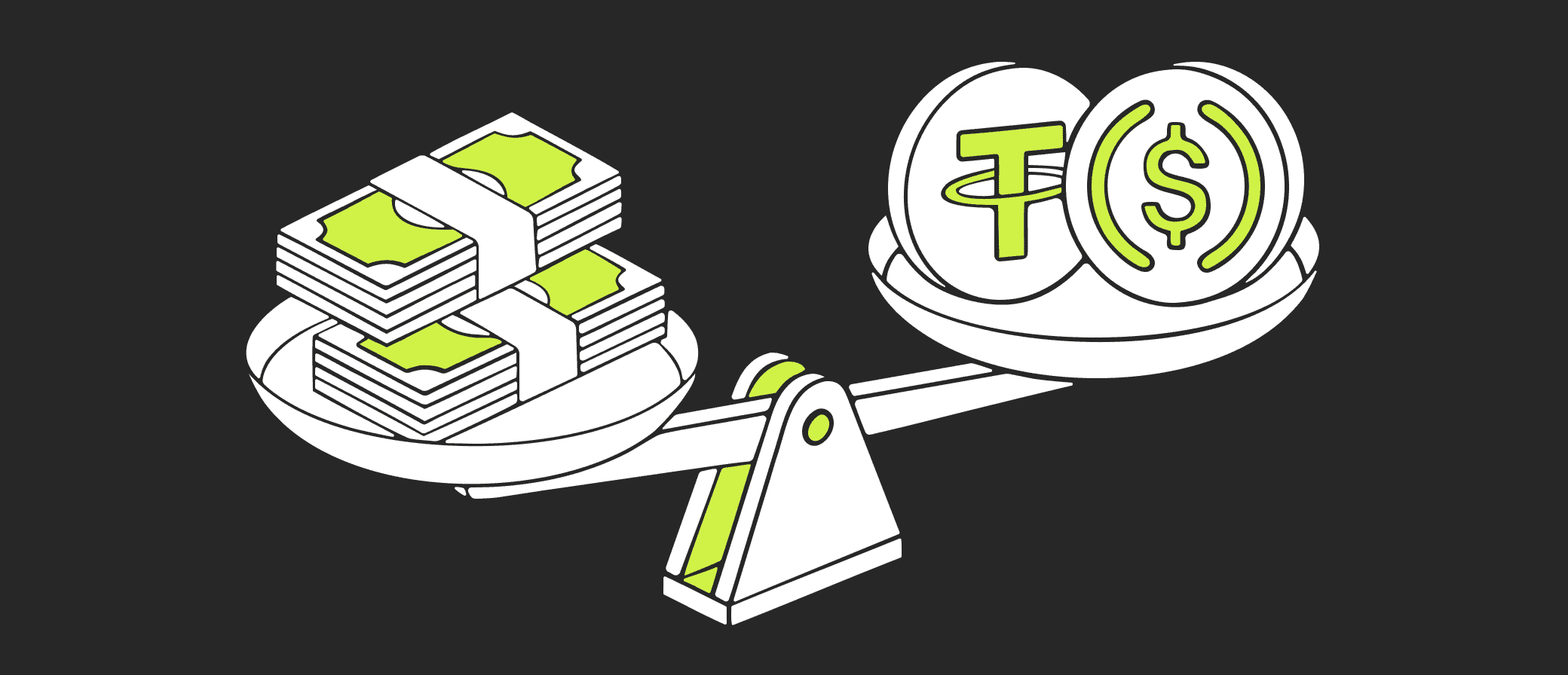
These fiat-pegged stablecoins represent the most straightforward approach to stability in the crypto world, their value is designed to mirror that of established fiat currencies like the U.S. dollar.
Pros:
Easy to understand (1 token = 1 USD)
Generally maintain their peg well
Widely accepted on centralized exchanges
Perfect for beginners
Cons:
Require trust in centralized stablecoin issuers
Subject to traditional financial systems regulations
Not always fully transparent about reserve assets
Popular examples include:
Tether (USDT): The first major stablecoin and still boasts the largest market cap
USD Coin (USDC): My personal go-to for most transactions
Binance USD (BUSD): Though this has been phased out in some markets due to regulatory concerns
I learned an important lesson in 2022 when some stablecoins temporarily lost their pegs: always check the issuer's transparency reports before you park significant funds in any stablecoin!
Crypto-Backed Stablecoins
The next evolution came with crypto-backed stablecoins, which use other cryptocurrencies as collateral. These operate through smart contracts and are typically overcollateralized to account for market volatility.
My first experience with DAI (the most popular crypto-collateralized stablecoin) involved me spending hours trying to figure out how to open a Vault in MakerDAO. Was it worth the effort? Absolutely, it opened my eyes to the world of decentralized finance (DeFi).
Pros:
More decentralized than fiat-backed options
Transparency (all collateral visible on-chain)
No need to trust a centralized entity
Perfect for DeFi applications
Cons:
More complex to understand
Require overcollateralization (typically 150%+ of value)
Vulnerable to extreme market crashes
Liquidation risks
Key crypto-collateralized stablecoins include:
DAI: The pioneer in this category, managed by MakerDAO
LUSD: From Liquity protocol, using ETH as collateral
sUSD: Synthetix's stablecoin, backed by SNX tokens
I once had a position liquidated during a flash crash because I didn't maintain a healthy collateralization ratio. Learn from my mistakes, always buffer more than you think you need!
Commodity-Backed Stablecoins
Some stablecoins are backed by physical assets like precious metals. Gold-backed stablecoins have gained traction for those looking to combine crypto's convenience with gold's historical stability.
I dabbled with PAXG (Paxos Gold) during the inflation concerns of 2021-22. The concept is fascinating, each token represents ownership of one fine troy ounce of gold stored in professional vaults.
Pros:
Backed by tangible physical commodities
Hedge against both crypto and traditional market instability
Potential tax benefits compared to owning physical gold
Exposure to gold without storage concerns
Cons:
Still require trust in the issuer and custodian
May carry higher fees
Less liquid in the crypto ecosystem
Limited use for everyday transactions
Notable examples include:
PAXG (Paxos Gold)
Tether Gold (XAUT)
DigixGold (DGX)
Different approaches used by algorithmic stablecoins to maintain price stability within cryptocurrency ecosystems.
Algorithmic Stablecoins: The Math-Based Approach
Now for the more experimental category, algorithmic stablecoins. Instead of being backed by collateral, these maintain their peg through algorithms and smart contracts that automatically adjust supply based on market demand.
I remember watching the meteoric rise (and subsequent crash) of Terra UST in 2022 with a mix of fascination and horror. This category is definitely not for beginners!
Pros:
Truly decentralized with no central authority
No collateral requirements make them capital-efficient
Innovative approach to stability
Potential for higher yields through related tokens
Cons:
Unproven long-term stability mechanisms
Vulnerable to "death spirals" during extreme market stress
Complex mechanisms that few truly understand
Higher risk profile overall
Examples include:
Frax (FRAX): A partially algorithmic stablecoin that's survived market turbulence
AMPL: Uses rebasing to adjust token supply
USDD: Tron ecosystem's algorithmic stablecoin
Hybrid Models: Getting the Best of Both Worlds
There's also an emerging category of hybrid stablecoins that combine elements of both collateralized and algorithmic approaches:
Frax Finance (FRAX): Part collateralized, part algorithmic
USDD: Uses both external assets and algorithmic mechanisms
sUSD: Employs both SNX collateral and algorithmic controls
I've found these hybrid models fascinating as they attempt to address the limitations of both pure approaches.
Two Types of Stablecoins for Smart Investing
When it comes to investing strategies, I categorize stablecoins slightly differently. Here's how I think about them:
Safe Haven Stablecoins
These are what I use when I need reliability above all else. They're your financial storm shelter during market turbulence.
My top picks in this category are USDC and DAI. I use USDC when I need something compatible across both centralized and decentralized platforms, and DAI when I want to stay fully within the DeFi ecosystem.
Yield-Generating Stablecoins
These are stablecoins I use specifically to earn returns through various protocols. While theoretically just as stable, they come with additional yield opportunities—and risks.
For example, instead of just holding USDC, I might deposit it into Aave or Compound to earn interest. Or I might provide USDC-DAI liquidity to a decentralized exchange to earn trading fees.
Some platforms even offer their own yield-bearing versions of popular stablecoins:
stETH: Lido's staked ETH token (not exactly a stablecoin but used similarly)
cUSDC: Compound's interest-bearing USDC token
aDAI: Aave's interest-bearing DAI token
But remember, increased yield always comes with increased risk! I learned this the hard way when a protocol I was using had a smart contract exploit. Now I always diversify my stablecoin holdings across multiple platforms.
Highlights of the diverse functions of stablecoins within decentralized finance, showcasing their roles in liquidity, lending, trading, and earning rewards.
The Role of Stablecoins in Decentralized Finance (DeFi)
Stablecoins play a crucial role in DeFi, they're essentially the foundation that much of the ecosystem is built upon.
From my experience, here's how they're used:
As base trading pairs on decentralized exchanges
Collateral for borrowing other crypto assets
Liquidity provision in automated market makers
Yield farming opportunities
Medium of exchange for decentralized services
The first time I provided USDC-DAI liquidity on Uniswap and started earning trading fees, I had that "money working for me" epiphany. This is what financial freedom looks like in the digital age!
Cross-Border Payments and Remittances
One area where stablecoins absolutely shine is international transfers. Traditional remittance services used to charge me 5-8% to send money overseas. With stablecoins? I can move any amount for mere cents.
I help my cousin in the Philippines by sending USDC monthly, which he can either hold or convert to local currency. The transaction:
Takes minutes instead of days
Costs pennies instead of percentage fees
Works 24/7/365 (no banking hours!)
Requires no intermediary approval
The financial inclusion aspect here cannot be overstated, billions of people lack access to traditional banking systems but can access stablecoins with just a smartphone.
Stablecoins vs. Central Bank Digital Currencies (CBDCs)
As central banks worldwide explore digital currencies, I've been watching the parallels and contrasts with stablecoins.
While stablecoins are primarily private initiatives, CBDCs are government-issued digital versions of national currencies. China's Digital Yuan is the most advanced major CBDC project, but many other monetary authorities are researching their own versions.
The key differences I've observed:
Privacy: Stablecoins offer varying degrees of privacy; CBDCs will likely include monitoring capabilities
Control: Stablecoins operate on open networks; CBDCs will have centralized control
Innovation: Stablecoins encourage market-driven features; CBDCs will reflect central bank priorities
Adoption: Stablecoins grow through market demand; CBDCs may be implemented through regulation
As someone who values both innovation and stability, I'm curious to see how these systems evolve alongside each other.
The Stablecoin Market: What You Need to Know
The stablecoin market has expanded dramatically in recent years. When I first started using them in 2018, the market cap was around $2 billion. Today, it exceeds $150 billion, a reflection of their growing utility.
Major Players and Market Cap
Here's a breakdown of the most widely used stablecoins by market cap:
Tether (USDT): Still the dominant player, with the largest market cap despite ongoing controversies about its reserves.
USD Coin (USDC): Gained significant market share by focusing on regulatory compliance and transparency.
DAI: The largest decentralized stablecoin, maintained its peg even during extreme market conditions.
Binance USD (BUSD): Once a major player but has seen declining usage due to regulatory challenges.
Frax (FRAX): Leading the partially algorithmic approach with growing adoption.
I've used all of these at different times for different purposes. My personal strategy involves keeping the majority of my stable holdings in USDC and DAI, with smaller amounts in others for specific use cases.
Outlines of key considerations and challenges shaping the regulatory environment for stablecoins.
Regulatory Landscape of Stable Coins
The regulatory environment for stablecoins is evolving rapidly. As someone who wants to stay on the right side of regulations, I've watched this space closely.
Key developments I've observed:
Increased scrutiny of reserve assets and transparency requirements
Proposals for bank-like regulations for stablecoin issuers
Concerns about systemic financial stability risks
Debates about the role of stablecoins versus traditional finance
My approach? I stick with stablecoins that are:
Transparent about their operations
Compliant with existing regulations
Backed by companies with good governance records
How I Use Stablecoins in My Investment Strategy
Over the years, I've developed several strategies for incorporating stablecoins into my overall crypto portfolio:
The "Safe Harbor" Strategy
During times of market uncertainty, I convert a portion of my volatile crypto assets to stablecoins. This preserves value while keeping funds in the crypto ecosystem, ready to deploy when opportunities arise.
Example: In late 2021, when I noticed some concerning market signals, I converted 30% of my ETH holdings to USDC. When prices dropped in early 2022, I was able to buy back at much lower prices.
The "Yield Hunter" Approach
Rather than letting stablecoins sit idle, I put them to work in various DeFi protocols to earn yields far exceeding traditional bank rates.
My personal rule: Spread stablecoin deposits across at least 3-4 different protocols to manage risk. I typically allocate:
40% to established lending platforms (Aave, Compound)
30% to automated market makers for liquidity provision
20% to newer protocols with higher yields but greater risk
10% kept liquid for opportunities
The "Dollar-Cost Averaging" Method
I keep a reserve of stablecoins specifically for regular purchases of volatile crypto assets. By setting up automated weekly purchases, I avoid the stress of timing the market.
This has been my most psychologically rewarding strategy, I simply set it and forget it, accumulating assets through all market conditions.
The "Arbitrage Explorer"
This is a more advanced strategy I occasionally employ: using stablecoins to capture price differences between exchanges or protocols.
For example, if DAI is trading at $0.99 on one exchange and $1.01 on another, there's an opportunity to purchase on the first and sell on the second. Small percentage gains, but they add up!
Highlights of the advantages of using stablecoins, emphasizing their potential to transform financial services and broaden economic participation.
Benefits and Risks of Using Stablecoins
Like any financial tool, stablecoins come with both advantages and potential pitfalls.
The Benefits I've Experienced
✅ Stability in a volatile market: Preserving value during downturns
✅ 24/7 transactions: No waiting for banks to open or trades to settle
✅ Global accessibility: Sending value anywhere with internet access
✅ Lower fees: Especially for international transfers
✅ Yield opportunities: Earning returns far above traditional savings
✅ Self-custody options: Maintaining control of my assets
The Risks I've Learned About (Sometimes the Hard Way)
❌ Counterparty risk: The issuer might not maintain adequate reserves
❌ Regulatory uncertainty: Rules can change quickly
❌ De-pegging events: Some stablecoins have temporarily lost their pegs
❌ Centralization concerns: Many popular stablecoins have central points of failure
❌ Market contagion: Problems in one stablecoin can affect the entire ecosystem
My $0.02? Start small, diversify across different types of stablecoins, and never invest more than you can afford to lose—even in "stable" assets.
The Future of Stablecoins
Based on the trends I'm seeing, here's where I think stablecoins are headed:
Integration with Traditional Finance
We're already seeing financial institutions partnering with stablecoin issuers or launching their digital assets. I expect this trend to accelerate, with stablecoins becoming an increasingly important bridge between crypto and traditional finance.
The big banks that once dismissed crypto are now exploring stablecoins, that tells you everything about where this is going!
Innovation in Decentralization
The next generation of stablecoins will likely feature more sophisticated decentralized models that address the weaknesses exposed in previous iterations.
I'm particularly watching developments in:
Real-world assets tokenization as collateral
Advanced Oracle systems for price stability
Governance improvements for decentralized stablecoins
Cross-chain compatibility solutions
Regulatory Adaptation
Regulation is inevitable, but I believe it will ultimately strengthen the stablecoin ecosystem by weeding out bad actors and establishing clear rules.
Smart investors are positioning themselves with stablecoins that are already working toward compliance rather than fighting it.
Closing Thoughts
Stablecoins have transformed how I interact with both crypto and traditional financial systems. They've given me tools for preserving value, earning yields, and transferring funds that simply didn't exist before.
Whether you're just getting started or you're a seasoned crypto veteran, understanding the two main types of stablecoins, collateralized and algorithmic, provides a foundation for making smarter investment decisions in this rapidly evolving space.
Frequently Asked Questions
Fiat-pegged stablecoins are cryptocurrencies designed to maintain a fixed exchange rate with traditional fiat currencies like the U.S. dollar. They accomplish this by maintaining reserves of the pegged currency (or equivalent assets) equal to the stablecoins in circulation. For every stablecoin issued, there should theoretically be $1 (or equivalent) held in reserve. Companies like Circle (USDC) and Tether (USDT) regularly publish audits or attestations to verify these reserves, though transparency standards vary across different stablecoin issuers.
The two main types of stablecoins are collateralized stablecoins (backed by reserves like fiat currency, cryptocurrency, or commodities) and algorithmic stablecoins (which maintain their peg through automated supply adjustments based on market demand). Collateralized stablecoins currently dominate the market due to their greater stability and trust among users.
Crypto-backed stablecoins maintain their value through over-collateralization, typically requiring users to deposit cryptocurrency worth significantly more than the stablecoins they mint (often 150% or higher). This excess collateral acts as a buffer against market volatility. Additionally, these systems employ liquidation mechanisms that automatically sell collateral if its value falls below the required thresholds.
Algorithmic stablecoins generally carry higher risks and are not recommended for beginners. They rely on complex economic mechanisms rather than direct collateral, making them more vulnerable to "death spirals" during extreme market conditions. Beginners should start with established fiat-backed stablecoins like USDC or GUSD, which have simpler mechanisms and stronger stability records.
Stablecoins are privately issued digital currencies designed to maintain a stable value, while CBDCs are digital versions of national currencies issued directly by central banks. The key differences include: governance (private vs. government), design flexibility (market-driven vs. centrally planned), privacy considerations, and regulatory status. CBDCs will likely have stronger government backing but potentially greater restrictions on use.
Disclaimer
This article is provided for informational purposes only and does not constitute legal, financial, or professional advice. All content is based on publicly available information and personal opinions. Readers are advised to seek professional guidance before making decisions or acting based on the material presented. The author and publisher assume no liability for any actions taken or not taken by the reader based on the information contained herein.