USDT (Tether) and USDC (Circle) are both stablecoins — digital dollars that live on a blockchain and are designed to always be worth $1. The difference comes down to who issues them, how their reserves are structured, what particular use cases they're most widely used in, and how much risk each one carries.
What's the Difference Between USDT and USDC? A Clear Comparison
- 4/5/2026
- Mikhail Kenegesov
- 10 min
If you're trying to decide which stablecoin to hold, send, or accept as payment, this guide breaks down everything that matters.

Key Takeaways

USDT is the default on centralized exchanges in most of the world — the most liquid asset in crypto, the trading pair that powers emerging-market volume, and the stablecoin that freelancers and businesses outside the US and Europe rely on daily.
USDC is the default in regulated markets, on decentralized exchanges, and in DeFi — the institutional pick, the compliance-friendly option, and the stablecoin with the clearest reserve structure and the strongest position on the networks where crypto is heading.
The balance is shifting. As regulation tightens and DEX activity grows, USDC's structural advantages are compounding. But USDT's global reach in emerging markets isn't going away anytime soon. Many experienced crypto users hold both — and that's often the smartest approach.
What Are Stablecoins and Why Do They Matter
A stablecoin is a cryptocurrency designed to maintain a steady value — typically $1. Unlike Bitcoin or Ethereum, whose prices can swing 10–20% in a single day, stablecoins offer a way to stay in the crypto ecosystem without the volatility.
The most common type is fiat-backed: the issuing company holds reserves (usually US dollars, Treasury bills, or cash equivalents) to back every token in circulation. When you hold 1 USDT or 1 USDC, the issuer claims to hold a matching dollar (or equivalent asset) in reserve.
Stablecoins have become the backbone of crypto transactions. They're used for trading, cross-border payments, payroll, DeFi (decentralized finance — lending, borrowing, and earning yield through blockchain protocols), and simply holding value in digital dollars without relying on a traditional bank account. For people in countries with currency instability or limited banking access, stablecoins offer a practical way to hold and move US dollars around the clock — no bank hours, no intermediaries.
USDT and USDC together represent over 80% of the entire stablecoin market. To understand the difference between USDT and USDC, it helps to start with what these stablecoins actually are.
What is USDT
Tether (USDT) was launched in 2014 by Tether Limited, making it the first stablecoin to gain widespread adoption. The company is registered in the British Virgin Islands and has operational ties to El Salvador.
Market position: USDT is the third-largest cryptocurrency overall (behind Bitcoin and Ethereum) with a market cap of approximately $184 billion as of March 2026. It commands roughly 60–65% of the entire stablecoin market.
Reserves: Tether states that USDT is backed by a mix of assets including US Treasury bills (over $94 billion as of early 2026), cash equivalents, money market funds, secured loans, Bitcoin, gold, and other investments. The company publishes quarterly attestation reports — not full audits — which has been a persistent point of criticism. In 2025, S&P downgraded USDT's stability rating, citing concerns about reserve composition and transparency gaps.
Blockchain networks: USDT operates natively on 10+ blockchains. Each network has different speeds and fees. Key networks include Ethereum (where USDT uses the ERC-20 token standard), Tron (TRC-20), BNB Chain, Solana, Polygon, Avalanche, Arbitrum, Optimism, and TON. This wide availability is a key factor behind its worldwide dominance.
Key strength: Unmatched liquidity. USDT has the most trading pairs and the highest daily volume of any stablecoin — often exceeding $60–80 billion per day. If you need to move between positions quickly on any major exchange, USDT is the default.
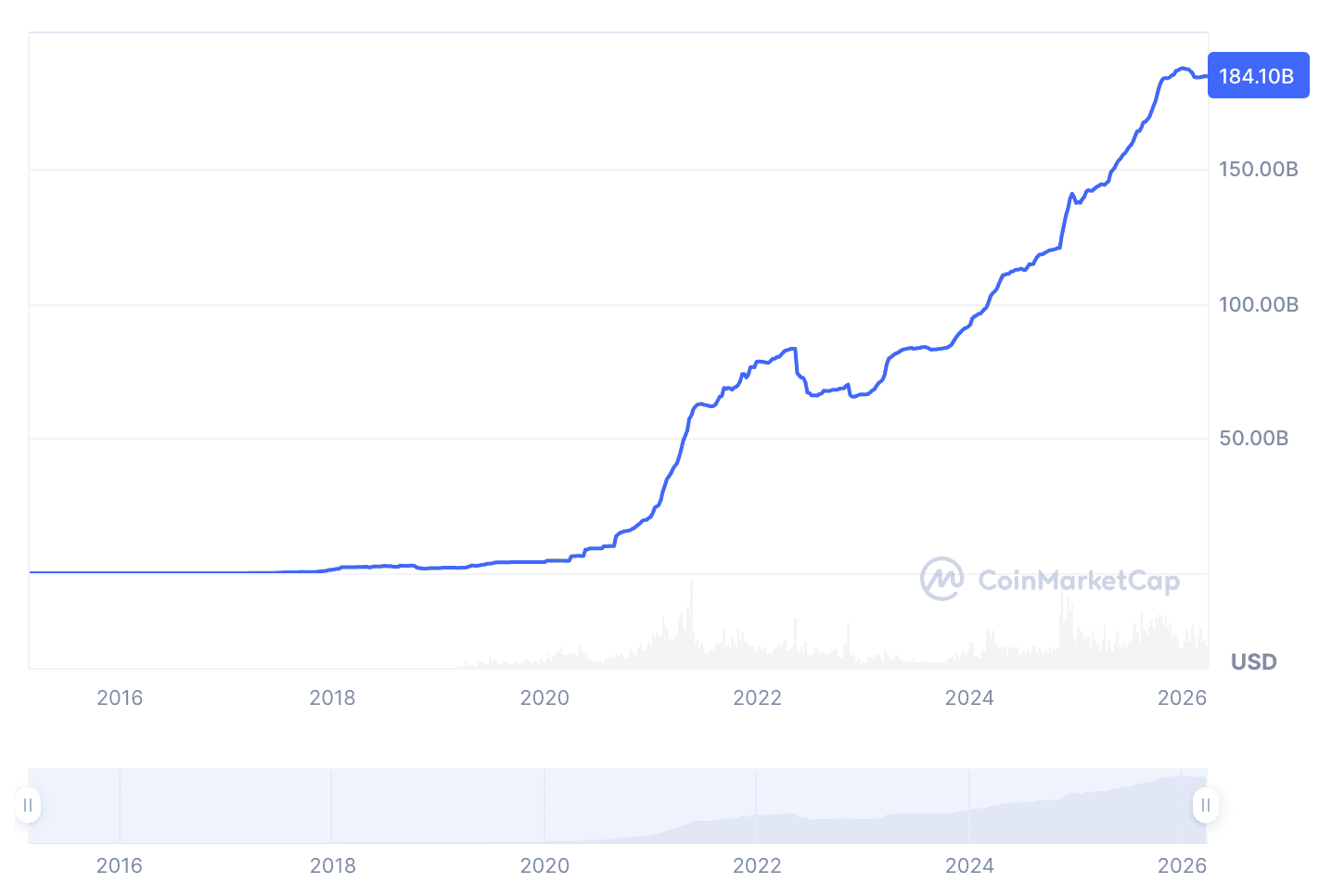
USDT (Tether) Market Cap. Source: coinmarketcap.com
What is USDC
USD Coin (USDC) was launched in 2018 by Circle, a US-based fintech company, in partnership with Coinbase under the Centre Consortium. Circle has since taken full control of USDC governance. In June 2025, Circle completed its IPO on the New York Stock Exchange under the ticker CRCL — becoming one of the first stablecoin issuers to be publicly listed.
Market position: USDC holds a market cap of approximately $78 billion, ranking it among the top 6 cryptocurrencies. It represents roughly 25% of the stablecoin market and has been growing its share, particularly among institutional users.
Reserves: USDC is backed by cash and short-term US Treasury securities. Reserves are custodied at Bank of New York Mellon and managed by BlackRock via the Circle Reserve Fund (an SEC-registered government money market fund). Circle publishes weekly reserve disclosures and monthly third-party attestations conducted by a Big Four accounting firm — a significantly higher level of transparency than USDT.
Blockchain networks: USDC operates natively on 16+ blockchains, including Ethereum, Solana, Hyperliquid, Base, Avalanche, Arbitrum, and others. Notably, USDC has minimal presence on Tron (less than 0.1% of usage), whereas Tron is a major network for USDT.
Key strength: Regulatory compliance and institutional trust. USDC is the preferred stablecoin for fintech platforms, corporate treasuries, and institutional investors. The partnership with BlackRock, the NYSE listing, and proactive engagement with US regulators have positioned USDC as the "clean" stablecoin of choice. Visa, for example, has been using USDC on Solana for cross-border settlement.
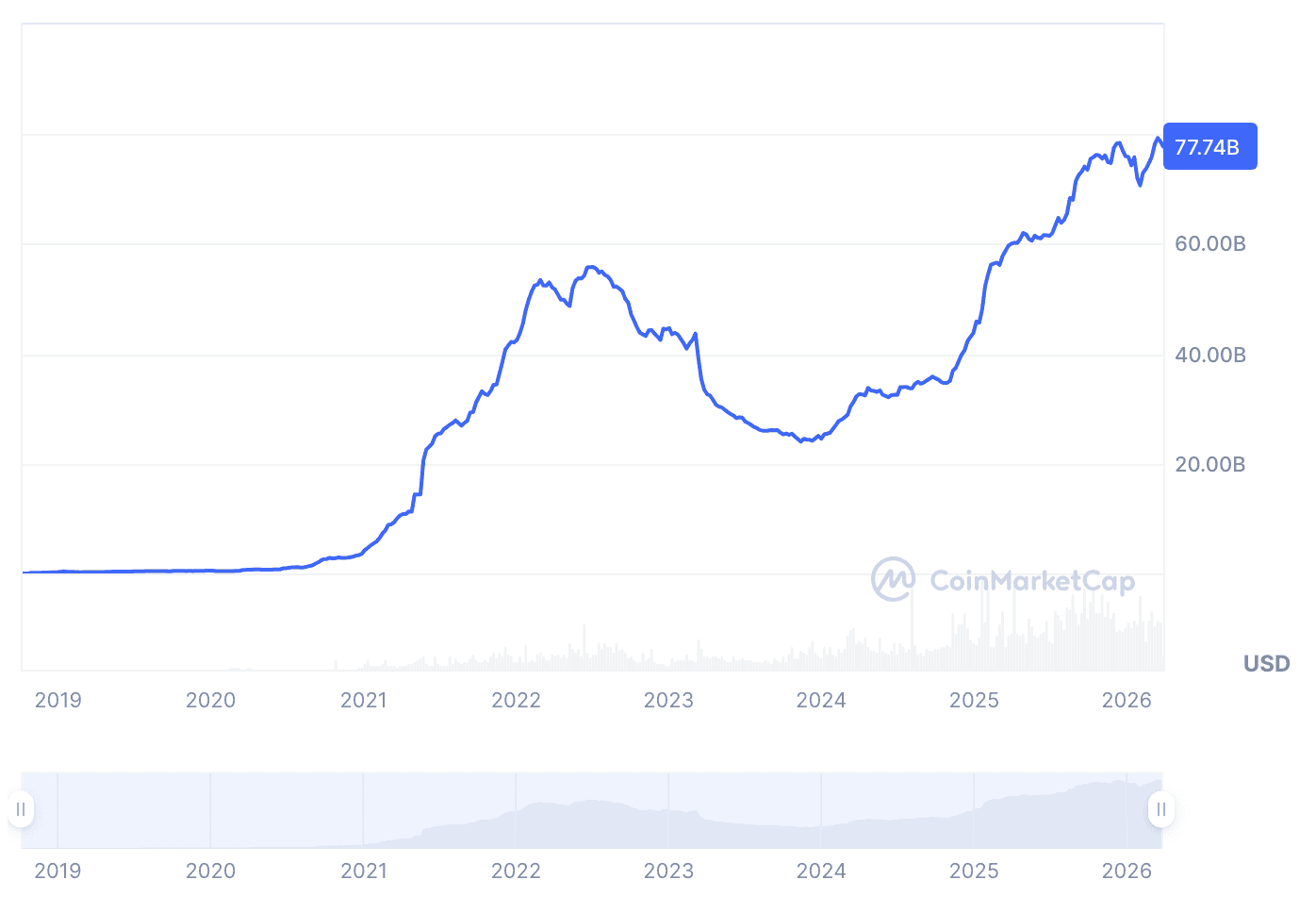
USDC (Circle) Market Cap. Source: coinmarketcap.com
More details: Swap USDT and USDC easily — with Volet.com
USDT vs USDC — Key Differences at a Glance
Feature | USDT (Tether) | USDC (Circle) |
|---|---|---|
| Issuer | Tether Limited (BVI) | Circle (USA, NYSE-listed) |
| Launch year | 2014 | 2018 |
| Market cap | ~$184B | ~$78B |
| Market share | ~60–65% | ~25% |
| Reserve composition | Treasuries, cash, loans, BTC, gold | Cash + short-term Treasuries only |
| Reserve custodian | Not fully disclosed | Bank of New York Mellon |
| Reserve manager | Tether Limited | BlackRock (Circle Reserve Fund) |
| Audit frequency | Quarterly attestations | Weekly disclosures + monthly attestations |
| Auditor | BDO Italia (attestations); Big Four full audit announced March 2026 | Deloitte (Big Four) |
| Key blockchains | Ethereum, Tron, BSC, Solana | Ethereum, Solana, Hyperliquid, Base, Avalanche, Arbitrum |
| Daily trading volume | $60–80B+ | $5–15B |
| Regulatory status | Faced fines; not US-regulated | US-regulated, NYSE-listed |
| Geographic strength | Asia, Latin America, emerging markets | USA, Europe, institutional markets |
Which Stablecoin Is Better for You
There is no single best stablecoin for everyone. The right choice depends on your use case.
For trading and exchange use — it depends on where and how you trade.
On centralized exchanges (CEX), USDT still dominates in most regions — deeper liquidity, more trading pairs, lower slippage on large trades. But the landscape is splitting: in Europe (under MiCA regulation) and increasingly in the US, exchanges are restricting or delisting USDT and working exclusively with USDC. If you're trading on a European CEX, USDC may be your only option.
On decentralized exchanges (DEX), the picture has flipped. USDC has more liquidity on Ethereum L2 networks and Solana — the chains where most DEX activity happens today. Hyperliquid, one of the largest decentralized trading platforms, operates entirely in USDC. As CEX market share gradually shifts toward DEX, this gives USDC a growing structural advantage.
For long-term holding — USDC has the edge.
If you're parking funds in stablecoins for weeks or months, the transparency of USDC's reserves, monthly attestations, and regulatory backing provide more assurance. You can verify exactly what backs your tokens. For long-term storage, knowing that reserves are held in BNY Mellon and managed by BlackRock offers a level of institutional confidence that Tether doesn't match.
The SVB paradox: when "safer" doesn't mean "stable".
USDC is widely considered the safer stablecoin. But in March 2023, it was USDC — not USDT — that suffered a dramatic fall. When Silicon Valley Bank (SVB) collapsed, Circle disclosed that $3.3 billion of USDC's cash reserves (roughly 8% of total reserves at the time) were held at SVB. The news triggered a run. USDC dropped to $0.87 on major exchanges. Meanwhile, USDT traded at a premium — briefly reaching $1.06 on Kraken — as capital fleeing USDC flowed into Tether.
For cross-border payments and remittances — it depends on the region.
USDT is more widely accepted in Asia, Latin America, and Africa — the regions where remittances are most needed. USDC is the default in the US and Europe, largely because local exchanges in those regions increasingly support only USDC under new stablecoin regulations. In practice, which stablecoin you use often comes down to which region your counterpart is in — if they're in Europe, they'll likely want USDC because that's what their platform works with; if they're in Southeast Asia, USDT is the standard.
Here's what a typical flow looks like: Say you're a freelancer in the Philippines who just received 500 USDT for a project and wants to swap it into cash or transfer it to your bank account. You deposit it to a platform like Volet.com — the stablecoin deposit costs just $1 flat, regardless of the amount. From there, you convert USDT to Philippine peso and withdraw to your local bank account (from 1%). The whole process takes minutes, not the 3–5 business days of a traditional wire transfer. Traditional remittance services typically charge 5–7% for the same route.
Volet.com supports both USDT (across 9 networks) and USDC (across 7 networks) with withdrawal options in 21 fiat currencies — giving you flexibility regardless of which stablecoin you receive.
More details: Start sending and receiving money today with Volet.com
For business and accepting payments — USDC for regulated markets, USDT for maximum reach.
If your business operates in the US or EU, USDC may be your only practical option — exchanges and payment providers in these regions are increasingly dropping USDT under new stablecoin regulations. If you need to reach the broadest possible customer base — especially in emerging markets where USDT is the default — accepting it is essential. Many businesses accept both.
One practical consideration: traditional card processors charge 2.9%+ per transaction, and high-risk merchants often pay 4–8%. Crypto acquiring changes the economics entirely. Platforms like Volet.com offer stablecoin acquiring starting from 0.25%, with support for both USDT and USDC across multiple networks — no chargebacks on crypto transactions, no 3D Secure friction for the buyer.
Read more: How crypto acquiring may help you expand on emerging markets
For DeFi — USDC dominates.
USDC is the preferred stablecoin on both regulated DeFi protocols (Aave, Compound) and decentralized exchanges — it has deeper liquidity on Ethereum L2 networks and Solana, and is the sole stablecoin on Hyperliquid, one of the largest DEX platforms. The BlackRock partnership has also opened up real-world asset (RWA) yield opportunities — holders can invest in tokenized money market funds without leaving the stablecoin ecosystem. USDT still has a presence in DeFi lending on Tron and BNB Chain, but its role on DEX platforms has diminished as activity shifts to L2 networks where USDC leads.
Use case | USDT | USDC |
|---|---|---|
| Trading: CEX | ✅ Deepest liquidity, most pairs in Asia/LatAm/Africa | ✅ Often the only option on European and US exchanges |
| Trading: DEX | Declining role as activity shifts to L2s | ✅ More liquidity on L2s, Solana; sole stablecoin on Hyperliquid |
| Long-term holding | Opaque reserves, quarterly attestations | ✅ Audited monthly by Deloitte, reserves managed by BlackRock |
| Remittances | ✅ Default in Asia, LatAm, Africa | Default in US and Europe (driven by regulation) |
| Business payments | ✅ Maximum reach in emerging markets | ✅ May be the only option in US/EU under new regulations |
| DeFi | Present on Tron/BNB Chain lending | ✅ Dominates DEX, regulated protocols, RWA yield |
One account, many exchanges

Buy and sell crypto and stablecoins at great prices quickly and seamlessly. Volet.com connects you to the best the crypto world has to offer.
FAQ
USDT (Tether) and USDC (Circle) are both dollar-pegged stablecoins — cryptocurrencies designed to maintain a $1 value. USDT was launched in 2014 and is the largest stablecoin by market cap (~$184B). USDC launched in 2018 and is known for stronger regulatory compliance and reserve transparency, with its issuer Circle publicly listed on NYSE.
There is no single "best" stablecoin — it depends on where and how you use it. The main difference between USDT and USDC is increasingly regional and structural.
USDT dominates centralized exchanges in Asia, Latin America, and Africa. USDC dominates decentralized exchanges, DeFi, and regulated markets (US, Europe).
For long-term holding, USDC's transparent reserves offer more assurance. Many users hold both to cover different use cases.
Directly spending stablecoins at most stores isn't possible yet — merchants typically don't accept USDT or USDC at the register. However, platforms like Volet.com let you deposit stablecoins (USDT across 9 networks, USDC across 7 networks), convert to fiat, and load a prepaid card for use at any point of sale, online store, or ATM. This makes stablecoins practically spendable in 150+ countries.
Yes. While USDT and USDC are designed to hold a $1 value, there are several ways you can lose money.
- Depegging: both stablecoins have temporarily traded below $1 during market stress (USDC dropped to $0.87 in March 2023; USDT fell to $0.90 in October 2018). If you sell during a depeg, you lock in the loss — even if the peg recovers days later.
- Sending to the wrong network: if you send USDT on Solana to an address that only accepts USDT on Ethereum, the funds may be permanently lost.
- Platform risk: if the exchange or wallet where you hold stablecoins faces insolvency or a hack, your funds are at risk regardless of the stablecoin's peg.
- Both USDT and USDC are centralized — the issuers can freeze specific wallet addresses if required by authorities or due to suspected illicit activity.
Choose the right blockchain network. Sending on Solana, Arbitrum, Base, or TON costs less than $0.01 per transaction. Tron — once the cheapest option — now costs $2–4 per transfer. Ethereum L1 can range from $0.05 to several dollars depending on network congestion. Always verify that the recipient's platform supports the network you're sending on.
Do More With Your Money
Manage digital money effortlessly: send, receive, and exchange crypto for business and everyday life
Let’s talk about your payment needs!
Message your manager in any language:
Author

Mikhail KenegesovProduct Editor
I curate knowledge management initiatives and lead customer support operations in FinTech, affiliate-driven digital platforms, and AI model training projects.
Follow us to never miss a new article