And Why Stablecoins Are Becoming the Dollar's New Interface, Not Its Replacement
A few years ago, stablecoins were basically plumbing for crypto exchanges. A trader sold BTC for USDT, waited for the next trade, and rarely thought about the token having any use outside the market.
That's changed. Companies now pay contractors in stablecoins, fintechs run cross-border settlements through them, and people in countries with weak local currencies get access to a digital dollar without needing a US bank account.
That's exactly why regulators can't keep treating stablecoins as a passing crypto-market fad. The demand is already there, volumes run into the trillions, and the digital dollar is handling jobs that banks either do slowly or price too high to bother with.
Key Takeaways
Legalization doesn't turn stablecoins into risk-free money. It makes them more mature. A regulated stablecoin comes with an issuer, reserves, redemption rules, oversight, and accountability — and with those come checks, freezes, and restrictions.
For businesses, that's not a reason to avoid stablecoins. In fact, it's the first real chance to build durable products around them instead of running one-off operations at your own risk.
For users, the takeaway is even simpler: now you can actually tell who you're trusting with your money.
Stablecoins Became Payment Infrastructure Before the Rules Caught Up
A few years back, I needed to pay $2,000 to a contractor in Argentina. We'd agreed on the price, the timeline, the scope — but then it came time to actually settle up, and we ran into the usual problem: how do you send money to someone in another country.
A bank transfer looked simple only on the surface. I'd have needed to figure out whether his bank would even accept a payment from our jurisdiction, how many intermediaries would sit between sender and receiver, how much would get skimmed off along the way, and whether either side would get hit with a request for extra paperwork after the money was already sent. It might land fast. It might sit in bureaucratic limbo for weeks.
In the end, he just sent me a crypto wallet address and told me which network to use. I sent 2,000 USDT. A few minutes later he confirmed receipt, and that was that — the financial side of the project was closed. No waiting on banking hours, no untangling a correspondent chain, no guessing in advance how much would actually land on the other end after fees.
That story is a decent explainer for why stablecoins found real-world use long before regulators settled on what to call them. They solved a practical problem the traditional financial system rarely solves well — especially when the parties are in different countries, the payment is urgent, and the amount isn't big enough to justify a multi-step banking procedure.
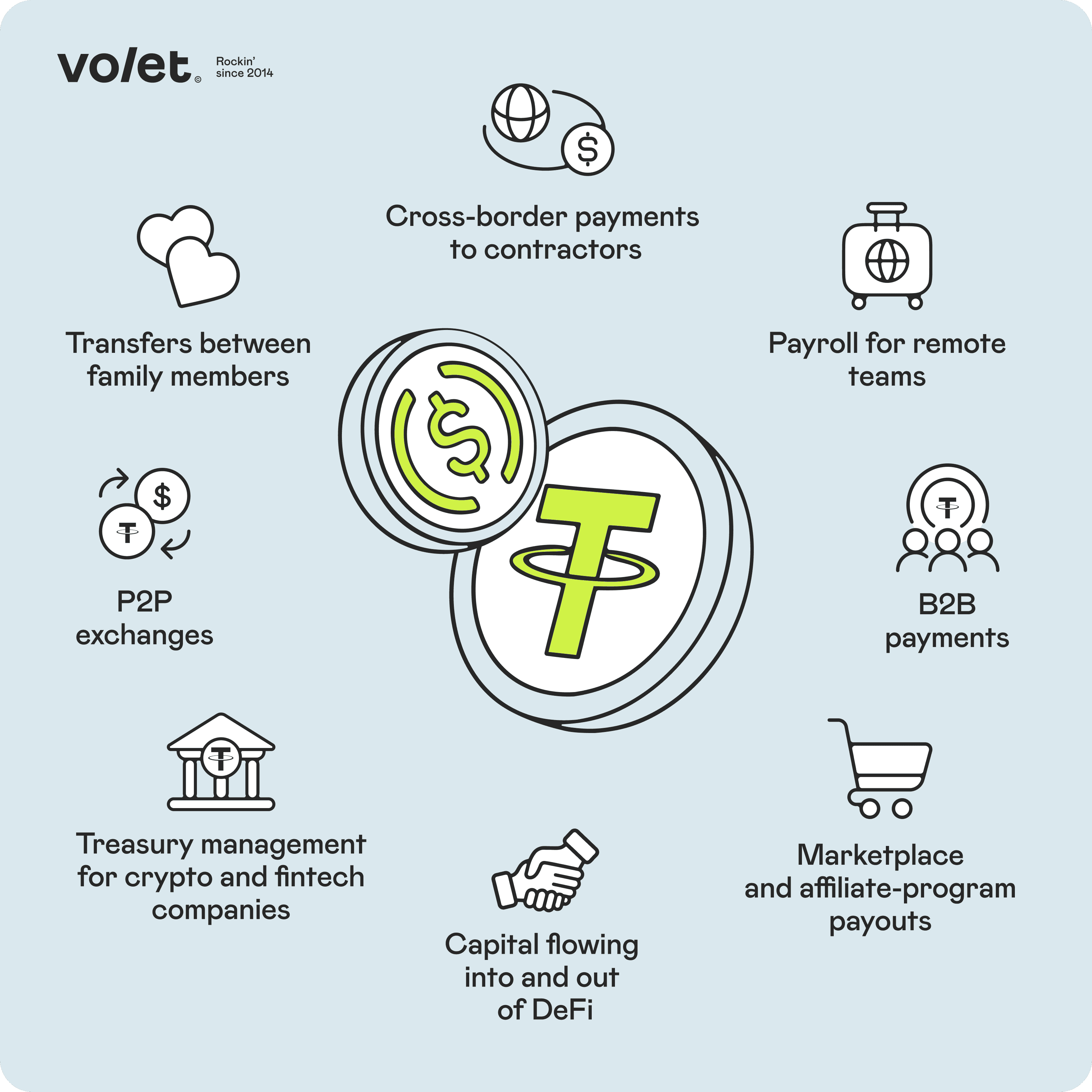
Here is what stablecoins are really good for
A "Legalized" Stablecoin Means Clear Rules, Not a Government Guarantee
The word "legalization" makes it sound like stablecoins were banned yesterday and got the green light today. In practice it's messier than that — there's no single global status, and different countries are trying to solve different problems.
I don't see the current wave of legalization as the start of the market, but rather it's a belated acknowledgment that the market has been here for a while.
When I talk about legalization, I mean stablecoins moving into a financial system where issuers and intermediaries face formal requirements. Those requirements usually come down to a handful of questions:
Which entities are allowed to issue the token?
What assets make up the reserves?
Where are those reserves held, and by whom?
How can a holder redeem tokens for real money?
What has to be disclosed, and how often?
Who audits the reserves and the reports?
What happens if the issuer goes bankrupt?
What KYC (Know Your Customer), AML (Anti-Money Laundering), and sanctions rules apply to transactions?
For a business, that framework matters as much as transaction speed does. When a token has a licensed issuer, a known jurisdiction, and public redemption rules, it's a lot easier to bring up with a bank, an auditor, or a payments partner. A company can scope out the requirements before launch instead of waiting for some counterparty to suddenly decide any blockchain-based operation is too risky to touch.
There's another important wrinkle: legal status also strengthens control. A company operating under the rules has to meet sanctions requirements, screen its users, and act on lawful government requests. In that context, the ability to freeze an address isn't a bug — it's a built-in feature.
Circle (the issuer of USDC) spells this out directly in USDC's terms: it can blacklist an address, freeze the tokens tied to it, and comply with a government order. Tether (the issuer of USDT) has comparable authority — it reserves the right to block addresses and restrict operations whenever the law requires it or its own review turns up a violation.
For law enforcement, that's a genuinely useful tool — it can stop stolen funds or money tied to a crime in its tracks. For the average holder, the takeaway is different: a centralized stablecoin is not the same thing as digital cash that nobody controls.
So here's how I'd put it: legalization doesn't mean the government is vouching for the token's safety under all circumstances. It means someone is now accountable for issuance, reserves, disclosure, and redemption.
That's a real improvement over the old uncertainty. It's just not insurance against everything that can go wrong.
The US shapes the stablecoin market more than any other country, for the obvious reason that almost the entire market is dollar-denominated.
Two issuers still dominate that supply, though less completely than they used to: per DeFiLlama data as of July 2026, Tether holds roughly 60% of stablecoin supply and Circle roughly 24% — a combined 84%, down from a combined 97% just over a year earlier, as newer entrants like PYUSD and USDS (see details below) have chipped away at the two-company dominance.
Even market dominance this large turns out to be a moving target once legalization starts reshaping who gets to compete.
On July 18, 2025, the GENIUS Act — short for Guiding and Establishing National Innovation for U.S. Stablecoins Act — was signed, creating the first dedicated federal regime for payment stablecoins. The law doesn't automatically treat every dollar-pegged token as legal — it defines which entities can issue them in the US and what they're required to do.
One of the core provisions: reserves at no less than a 1:1 ratio, backed by liquid assets — cash, bank deposits, short-term US Treasuries, and certain money-market instruments. Issuers also have to publish their reserve composition monthly, disclose redemption terms, and report all fees. An independent accounting firm reviews the monthly figures, and management has to attest to their accuracy.
The GENIUS Act is also explicit about what it doesn't do. Payment stablecoins:
are not backed by the full faith and credit of the US government;
do not carry a government guarantee;
are not covered by FDIC* deposit insurance;
are not legal tender.
*FDIC (Federal Deposit Insurance Corporation) — an independent agency of the U.S. government that protects depositors against the loss of their deposits if an FDIC-insured bank fails (typically up to $250,000 per depositor, per insured bank).
To me, that's one of the most important parts of the law. In public discussion, "regulated" quietly turns into a synonym for "safe" — even though the GENIUS Act itself explicitly rejects that reading.
The CLARITY (Digital Asset Market Clarity) Act keeps coming up alongside GENIUS, but the two bills are solving different problems. GENIUS is about payment stablecoins specifically. CLARITY is meant to set the broader market structure for digital assets — dividing authority between the SEC and CFTC**, defining the status of digital commodities, and setting rules for exchanges, brokers, and other intermediaries.
** SEC (Securities and Exchange Commission) — the U.S. government agency responsible for regulating securities (like stocks, bonds, and investment contracts) to protect investors and maintain fair, orderly markets.
CFTC (Commodity Futures Trading Commission) — the U.S. government agency responsible for regulating derivatives markets (like futures, options, and swaps) and overseeing physical commodities (traditionally gold, oil, wheat, etc., but also digital commodities like Bitcoin).
This has already changed a lot for businesses. It's not enough for a bank, custodian, or payments company to know the blockchain technically works. They need to know who's accountable for the issuer, how client funds are tracked, what happens in a bankruptcy, and whether some other regulator might decide two years from now that the product is illegal after all.
GENIUS answers part of that. CLARITY is supposed to close the rest. Yet as of this writing, CLARITY still hasn't become law.
Europe and Asia Are Building Their Own Models
But the dollar isn't the only currency in this story, and not every regulator is answering the same question about it. Governments don't agree on what a stablecoin even is. Some treat it as a form of electronic money. Others see it as a cross-border payments tool. Others worry tokens will start displacing bank deposits and eroding control over the national currency.
The EU was first to build a broad supranational regime for crypto assets. MiCA, which stands for Markets in Crypto-Assets and covers asset-referenced tokens and e-money tokens, took effect on June 30, 2024.
A nuance on MiCA headlines keeps getting wrong
MiCA's restriction sits at the level of regulated venues — exchanges, custodians, off-ramps — not at the level of ownership.
The regulation doesn't stop anyone from holding a non-compliant stablecoin in a self-custody wallet or sending it directly, peer to peer. Nothing in the law reaches into a private wallet.
What changed is narrower and more specific: a MiCA-licensed exchange can no longer list a token that hasn't gone through authorization as an e-money token. That's exactly the distinction that gets flattened into a headline like "USDT banned in Europe", which is not.
Singapore took a narrower path. In 2023, the Monetary Authority of Singapore finalized a framework for single-currency stablecoins pegged to the Singapore dollar or a G10 currency and issued domestically. Issuers are expected to hold high-quality reserves, sufficient capital, disclose information, and honor redemption at par within five business days of a request. Only tokens meeting every requirement can carry the MAS-regulated stablecoin label.
Hong Kong went with a licensing regime. Its Stablecoins Ordinance took effect on August 1, 2025, and the Hong Kong Monetary Authority issued its first licenses on April 10, 2026 — to Anchorpoint Financial and HSBC.
Yet none of these models travel automatically. A token can meet the bar in one country and still not qualify for an official service in another. International businesses have to track not just the blockchain, but the jurisdiction of the sender, the recipient, the issuer, and every intermediary in between.
USDT, USDC, USDe et al. Not All Stablecoins Are Created Equal
Different jurisdictions are just one layer of complexity. Another one hides inside the word "stablecoin". The label creates a false sense that all of these tokens work more or less the same way. In practice, "stablecoin" covers several distinct financial constructions.
Stablecoin Registry
Sort the market by how the peg actually holds
Sixteen stablecoins, filed under the four mechanisms that decide whether a peg is backed by reserves, collateral, a hedge, or an incentive. Click a ticker to open its record.
Classification reflects peg mechanism, not investment advice. Fact-checked against primary sources — issuer transparency pages, protocol documentation, and regulator filings — in July 2026. Supply rankings and regulatory status still shift often, so recheck before republishing elsewhere.
Regulating payment stablecoins doesn't make the other categories any safer. But it forces the market to be more precise about the differences. If one token has liquid reserves and a legal right to redemption, and another depends on a complex market strategy to hold its peg, you can't evaluate them the same way.
To me, that's one of the biggest upsides of the current wave of legislation. It doesn't just greenlight certain products — it's gradually separating "payment instrument" from "investment construction that happens to be trying to hold a dollar peg."
Businesses Get Faster Settlement, Not a Silver Bullet
In the Argentina example we have started with, a stablecoin solved the core problem — the contractor got paid without a banking delay. For a one-off payment, that might be all you need. For anything recurring, a company needs an actual process built around it.
A crypto wallet, on its own, doesn't become a company's payment infrastructure. For accounting purposes a company still needs:
a contract or offer;
an invoice or some document stating what the payment is for;
counterparty details;
the amount in tokens;
the exchange rate on the date of the transaction;
confirmation of the network and address;
the transaction hash;
proof the address actually belongs to the recipient;
a documented approach to accounting for fees;
source-of-funds documentation.
This is exactly where a fast transfer collides with slow bookkeeping. The money's already with the contractor, and finance is still figuring out how to record it correctly. The technology handles moving the money — it doesn't handle everything that has to happen around it, and that gap is one the industry hasn't really closed yet.
Legalization helps here, because banks, auditors, and payment providers now have common reference points.
But the actual accounting treatment still varies by country. You can't read up on the GENIUS Act and conclude your operations are automatically compliant in Serbia, Germany, Argentina, or Kazakhstan.
A Crash Course in Bringing Stablecoins Into Your Business
Before rolling out stablecoins, work through ten steps:
Map out who's paying whom, for what, and across which countries.
Check local tax and accounting rules.
Pick a token for the specific use case, not for its brand recognition – check the link below.
Settle on one or two networks your team can actually operate.
Decide where the funds will actually sit — self-custody, a custodian, or a payment provider.
Set a cap on how much you hold in stablecoins at any given time.
Build in counterparty and address screening.
Split who can create, approve, and send payments.
Write down what happens on an error, a freeze, a lost access, or an exchange outage.
And the bottom line: there is no point in adding blockchain to a process that's already cheap, well-understood, and reliable. The crypto technology earns its place when it cuts real costs or unlocks something that used to be too slow or too complicated to pull off — not just because it's blockchain.
Right now, the whole crypto industry is talking about programmable payments — a marketplace automatically splitting revenue among sellers, an affiliate platform auto-distributing micro-rewards for specific actions, an AI agent paying for data or compute within a hard-coded budget.
I don't think any of that goes mainstream just because "blockchain" is the word of the moment. Businesses will need predictable fees, protection against mistakes, proper accounting, participant screening, and a real way to resolve a dispute and get money back — all while most end users won't want to know or care which network the payment actually ran on.
The infrastructure that wins is the one that absorbs the technical complexity on the user's behalf. The user sees an amount and a recipient; the system picks the network, verifies the address, calculates the fee, and generates the paperwork for accounting behind the scenes. That's the actual answer to the gap discussed earlier, between a fast transfer and slow bookkeeping: the complexity doesn't disappear, it just stops being manual work for one overworked finance team — the infrastructure absorbs it instead.
That's where legalization plays a decisive role. Major banks and payment companies aren't going to build products on a token whose legal status could flip after its first run-in with a regulator. What they need is real liquidity, a straightforward path to fiat, a clear redemption process, predictable compliance, and something usable by people with zero crypto background.
So stablecoins won’t replace the dollar. Instead, they're already changing how you access it — letting its value move across the internet as fast as information does.
For companies, it's a faster way to settle across borders. And for users, it's a useful tool that comes with some homework: understanding networks, custody, and the legal boundaries that still apply.
Start sending and receiving money today
Use stablecoins for global reach and local fiat rails for easy top-ups and withdrawals.