You'll See When Stablecoin Payouts Save Money and When They Don't
Executive summary
Run a test. Pay some of your contractors in stablecoins next month and compare the total cost with your current method.
Price your full payout. Add the sending fee, the currency markup and the contractor's cash-out cost, using your own bank and Wise rates.
Check your payment size. For a small team paying $500 per contractor, Volet.com costs 0.4–1.0% if you hold stablecoins and 0.4–2.8% if you need to buy them, against 7–14% for bank wires. For a larger team paying $1,500, it costs 0.3–0.5% and 0.4–2.8%, against 4–7%.
Benchmark against Wise, not only bank wires. With bank cash-out, or if you need to buy stablecoins first, the gap to Wise is narrow or gone.
Keep your tax and status checks. Taxes and contractor status still apply even with stablecoins.
Volet.com is the cheapest option in this setup.
Much cheaper than a wire, close to Wise.
Cheaper than a wire, but Wise costs less.
No clear saving in this setup.
Enter a payment amount above zero.
Against a bank wire: Volet.com saves {{r}} per payment, {{m}} a month.
Against a bank wire: Volet.com costs {{r}} more per payment.
Against a bank wire: the ranges overlap, so the gap is narrow or gone.
Against Wise: Volet.com saves {{r}} per payment, {{m}} a month.
Against Wise: Volet.com costs {{r}} more per payment.
Against Wise: the ranges overlap, so the gap is narrow or gone.
{{m}} a month. Contractors: {{n}}.
Assumptions: bank wire {{f}} per transfer plus {{m}} currency markup.
Wise {{r}} (illustrative).
Volet.com fee {{f}}.
The contractor pays {{w}} USDT to withdraw to a crypto wallet.
The contractor pays 1% to withdraw to a local bank.
Buying stablecoins adds {{b}}.
One USDT is counted as one dollar.
How much does one contractor payout really cost?
Enter your payment size to compare the sending fee, the currency markup and the contractor's cash-out cost.
Payment to each contractor (USD)
Contractors paid each month
Do you already hold stablecoins?
How does the contractor withdraw?
Change the assumptions
Bank wire fee per transfer, low and high (USD)
Bank currency markup, low and high (%)
Wise total cost, low and high (%)
Volet.com fee (%)
Crypto wallet withdrawal, low and high (USDT)
Cost of buying stablecoins, low and high (%)
Bank wire
–
–
per payment
–
Wise (illustrative)
–
–
per payment
–
Volet.com
–
–
per payment
–
–
–
–
–
Results are illustrative ranges, not quotes. They exclude blockchain network fees, taxes and your own time. The Volet.com fee starts from 0.25%; confirm your rate with the Volet.com sales team. Not financial, legal or tax advice. Names belong to their owners; Volet.com is not affiliated with them.
What a contractor payout really costs
Paying contractors in stablecoins makes sense when it shrinks the gap between what you send and what your contractor keeps. And it works best when you can see most of that gap before you press send.
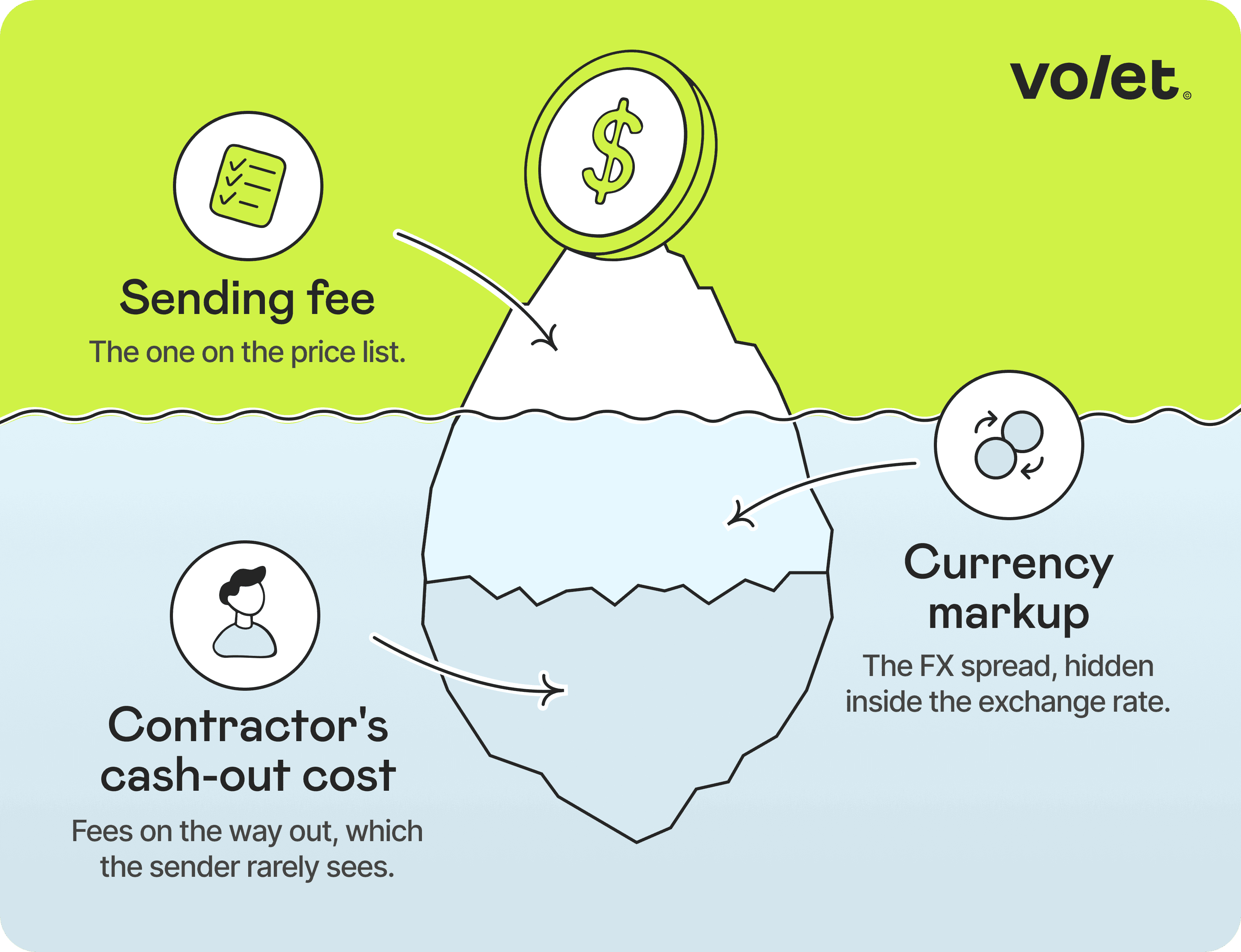
A payout costs the sum of three things: the sending fee, the currency markup, and what your contractor pays to reach the money.
The sending fee is the one on the price list. The currency markup (the FX spread) is the gap between the rate you get and the market rate. The third cost belongs to the contractor: fees on the way out, which the sender rarely sees.
The World Bank put the average cost of sending $200 abroad at 6.49% in the first quarter of 2025 (Remittance Prices Worldwide, Issue 53, March 2025). That is a consumer benchmark, not a business rate, but it shows how fast small payments lose value.
What a payment really costs for a small and a larger team
Take one payment to one contractor. The figures below assume you already hold stablecoins. Fixed fees weigh more on small payments, so a small team paying $500 per contractor sees a wider gap between wires and stablecoins than a larger team paying $1,500.
Small team, a $500 payment to each contractor:
Bank wire: $35–70 (7–14%)
Wise: about $5–10 (1–2%)
Volet.com: about $2–5 (0.4–1.0%) if the contractor keeps stablecoins, about $6 (1.25%) if they cash out to a local bank
Larger team, a $1,500 payment to each contractor:
Bank wire: $55–110 (4–7%)
Wise: about $6–22 (0.4–1.5%)
Volet.com: about $4–7 (0.3–0.5%), or about $19 (1.25%) with a bank cash-out
How we calculated: a wire costs $25–50 per transfer, in line with the published schedules of large US banks (October 2026). We added an assumed 2–4% currency markup, a range quoted by payment providers; banks say a markup applies but do not publish its size. Wise figures are illustrative.
With Volet.com, you pay a fee from 0.25%. The contractor pays to withdraw: 0.5 USDT (3.5 USDT on TRC-20, the Tron network) to a crypto wallet, or from 1% to a local bank.
If you need to buy stablecoins (USDT or USDC, two widely used dollar stablecoins) on a crypto exchange, it adds about 0.1–1.5%. This is an illustrative assumption. The real cost depends on the exchange, your country and how you fund the purchase. It covers a funding fee, a trading fee and a spread (the gap between buy and sell prices).
If your money is in another currency, the exchange rate adds to the cost. You also pay the blockchain network fee when you send the stablecoins to your Volet.com balance.
With this, Volet.com costs about 0.4–2.8% of a payment, and the gap to Wise can disappear.
For a larger team, what also changes is the operating question: who checks wallet addresses, who reconciles payments, who keeps records. Automation helps here: Volet.com can send payouts straight to contractors' crypto wallets through an API or smart contracts, and the recipient only needs a compatible wallet address.
Compliance requirements depend on the product and country, and bank and card withdrawals usually require verification. Payouts straight to wallets carry a blockchain network fee. At this volume, confirm limits and requirements with the Volet.com sales team first.
Volet.com helps build your global payments
In fiat, crypto, and stablecoins. Via API, hosted checkout, or easy-to-install plugins. Accept, send, and manage funds — all from code.
They do not save money when your funds start in a bank account, when contractors cash out at a high cost, or when payments are rare.
You hold only fiat. That means regular money in a bank account. Buying stablecoins on an exchange first adds about 0.1–1.5% by bank transfer, so the advantage over Wise can disappear.
Contractors need local currency. Local transfers from Volet.com start at 1%. Card withdrawals start at 3%.
Contractors already use a low-cost provider. If they receive money through a service at around 1%, switching may save little, and they may not want to change.
Payments are rare. For one $300 payment, opening a Volet.com account may take more effort than it saves.
You need contracts and tax forms handled for you. A contractor-management platform does that. Volet.com handles the payout.
More than lower fees: flexibility and convenience
Stablecoins make international payouts simpler. You can send dollar-linked digital assets across borders without relying on traditional banking hours or arranging separate bank transfers in every country. Contractors receive funds directly in a compatible crypto wallet and choose when and how to convert them into local currency.
For businesses paying contractors across multiple countries, this means fewer payment bottlenecks, predictable dollar-denominated transfers and easier scaling. API-based automation can also reduce manual work when paying dozens or hundreds of recipients.
What stays the same: taxes, status and token rules
Paying in stablecoins does not remove your reporting duties. Many tax authorities, such as the US IRS, treat a payment in digital assets as worth its dollar value on the day it is received. For independent contractors, the IRS counts it as self-employment income. Keep the date, amount, dollar value and transaction record of every payout. Rules differ by country, so confirm them with a tax adviser.
This approach is for independent contractors. Employees' wages follow separate rules. A stablecoin payout moves money. It is not a contract, a worker-status decision or a payroll system.
The token matters too. USDT is the largest stablecoin by market value, with about 60% of the market (DefiLlama, 22 October 2026). In the EU, however, MiCA, the EU's crypto-asset regulation, has tightened the rules for stablecoins on regulated platforms, and some of those platforms restrict USDT for EU users. Check which token your contractor can legally cash out in their country.
How to try it with Volet.com
1. Ask a contractor to open a Volet.com account. If they already hold a crypto wallet, you can pay to its address instead. Check the token and network first: a payout on the wrong network can be lost. Some contractors in countries with unstable currencies prefer to hold dollars. Availability and withdrawal methods depend on the country and account verification.
2. Fund your business balance with crypto. Crypto deposits carry a blockchain network fee, paid by the sender.
3. Add recipients by email or upload a CSV file. One manual batch takes up to 50 recipients in one currency. Volet.com validates the data, you pay once, and you track the status with an Order ID. Completed payouts are irreversible, so check each recipient before you pay.
4. Ask the contractor to withdraw and tell you what arrived.
Run one test payout next month and compare the total cost with your current method.
This article is for information only and is not financial, legal or tax advice. Stablecoins carry risks, including loss of their dollar peg. Names and marks belong to their owners; Volet.com is not affiliated with them.
Scale your payments with Volet.com
Accept payments, send payouts, manage crypto and fiat across the globe — in one account.