We explain every common cause with exact crypto withdrawal processing time ranges, so you can diagnose your crypto withdrawal is delayed and know what to do next.
Quick diagnostic
Do you have a blockchain transaction hash (TXID)? This is not the same as your platform's internal order number. A real blockchain hash has 64-66 characters — you can paste it into a block explorer and find the transaction (more on this below.).
NO — you only have a platform order number, or no ID at all. Your crypto withdrawal is pending inside the platform — i.e. it hasn't been broadcast yet. What does the status show?
"Under Review" or "Pending Verification" → Reason 3
You topped up your platform balance with a card in the last 72 hours, hit a withdrawal limit, or KYC is incomplete → Reason 4
Pending, no explanation, under 4 hours → Reason 5
YES — you have a blockchain hash (TXID). The platform has done its part. Open the block explorer and paste your hash.
Zero confirmations, or hash not found → Reason 1 or 2
Confirmations accumulating, but recipient hasn't credited the funds → Reason 6
Transferring to a bank account and crypto withdrawal nor arrived after more than 24 hours → Reason 7
How to track your withdrawal in real time
Every withdrawal passes through three stages. Knowing which stage your withdrawal is in tells you immediately where to look for the problem.
Stage 1 — Platform processing. You submit the withdrawal. The platform runs internal checks, queues the transaction, and prepares to broadcast it. At this point, no Transaction ID (a.k.a. TXID) or blockchain transaction hash exists yet. The money is still inside the platform.
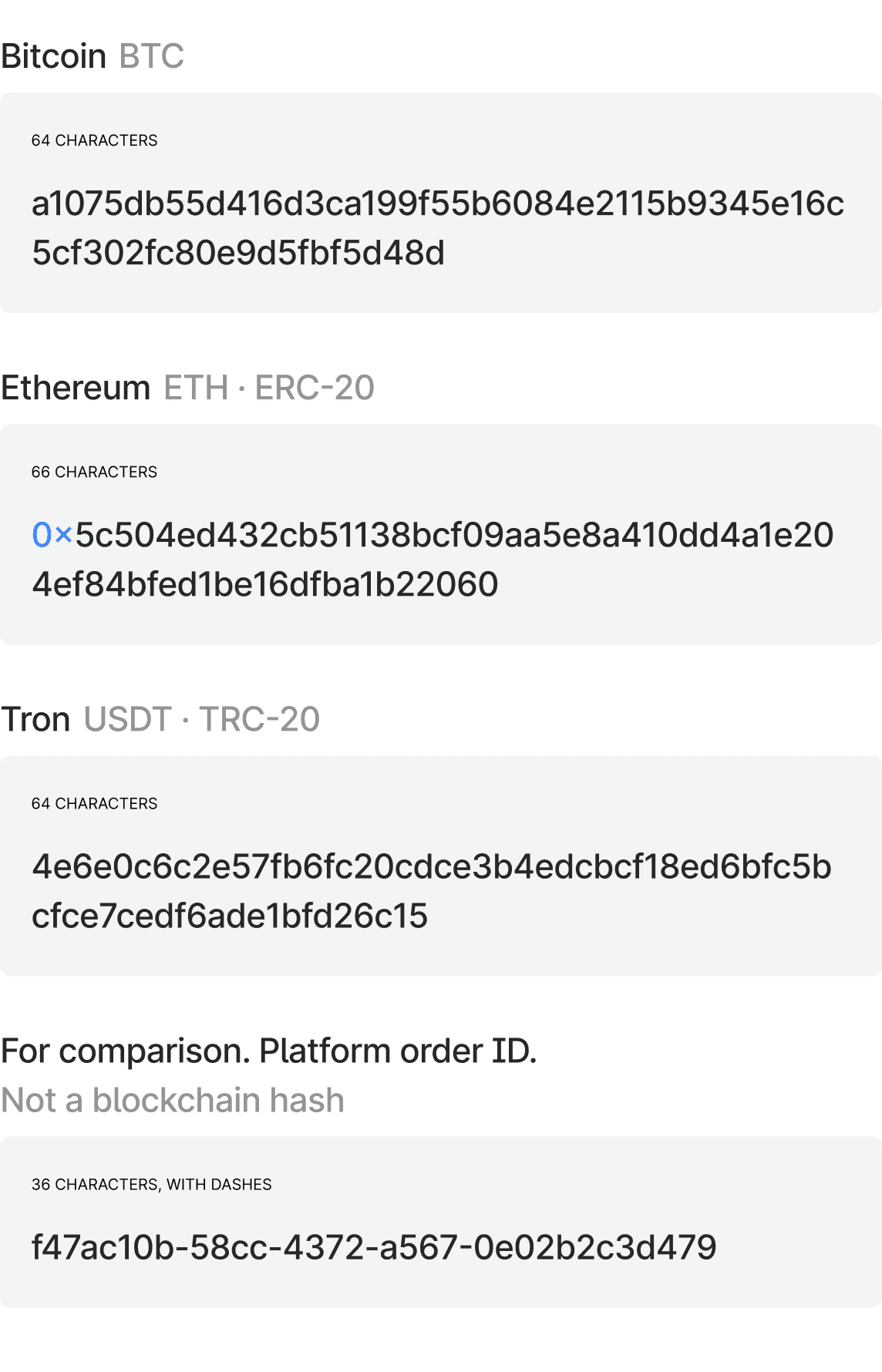
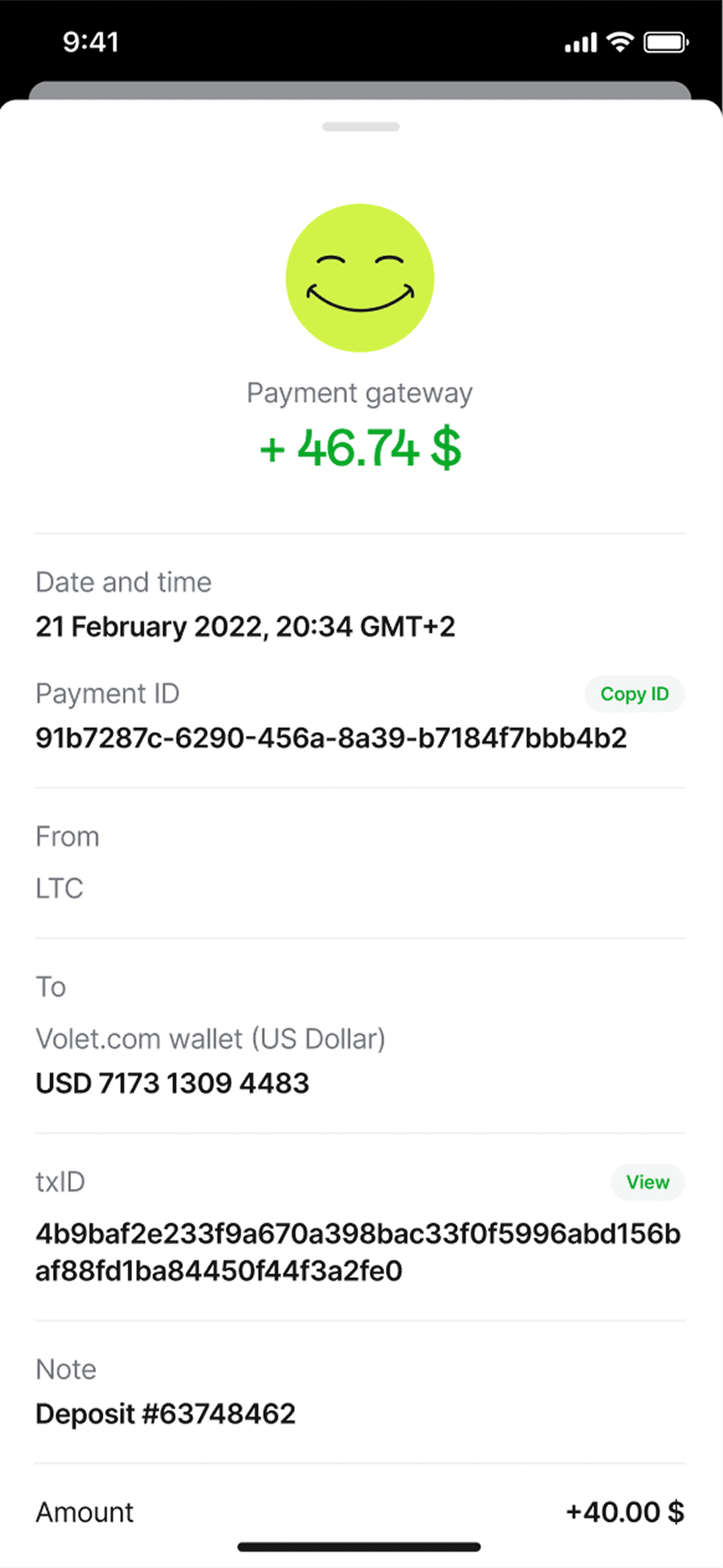
Stage 2 — Blockchain confirmation. The platform broadcasts the transaction to the network. A Transaction ID is generated. A TXID is a unique string of letters and numbers (typically 64 characters) that the blockchain assigns to every transaction. It's your proof the transaction exists and is moving. You can find your TXID in the transaction history section of your platform dashboard. Once you have it, you can track the transaction in real time on a block explorer — a public website that shows every transaction on a given blockchain.
Ethereum hashes always start with 0x. Bitcoin and Tron hashes start directly with hex characters — and can be easily confused. Platform order IDs are shorter, contain dashes, and cannot be looked up in a block explorer
Network
Block explorer
Ethereum (ERC-20)
etherscan.io
Tron (TRC-20)
tronscan.org
Solana
solscan.io
TON
tonviewer.com
BNB Chain (BEP-20)
bscscan.com
Bitcoin
mempool.space
The explorer shows the transaction status, current confirmation count, fee paid, and timestamp. A transaction with a growing confirmation count is moving normally. If you see zero confirmations after several hours it means that a crypto transaction is stuck in the mempool — usually due to congestion.
Stage 3 — Recipient credit. The receiving wallet or exchange reaches its required confirmation count and credits your balance.
How to check whether this is a delay — or a scam
Is your wait time normal? If your Bitcoin withdrawal is taking too long or your Ethereum withdrawal is delayed, check whether your wait time falls within the normal range for your specific scenario.
Is this a scam? Know the crypto withdrawal scam red flags: a legitimate platform will never ask you to pay a fee in order to receive your own money. If any platform demands the following before releasing your withdrawal, stop immediately and do not pay:
A "tax" or "tax clearance fee" to unlock funds
A "liquidity fee," "compliance fee," or "activation fee"
A "risk premium" based on a percentage of your balance
A "green channel" or "express processing" fee
An additional deposit to "verify your identity" before withdrawal
These are not real fees. They are pressure tactics used by fraudulent platforms to extract more money before disappearing. Paying will not release your funds — it will trigger another demand.
Other warning signs:
Support communicates only through Telegram, WhatsApp, or email — no official support ticket system
Early small withdrawals worked; a larger one is suddenly blocked
No maintenance announcement, but withdrawals have been stuck for days with no TXID
Support acknowledges the delay but cannot provide a TXID or specific timeframe
To find the transaction hash, just check the details section for that transaction on your platform
If you do see these flags: stop all deposits immediately. Document everything — screenshots of your balance, transaction history, and all support communications. Report to your local financial regulator or consumer protection authority. Do not engage with anyone who contacts you through social media or Telegram claiming to be platform support — this is a common follow-on scam targeting people with stuck withdrawals.
1️⃣ The platform uses batch processing — or is under maintenance
Batch processing. Not all platforms process withdrawals the moment you submit them. Many group outgoing transactions and broadcast them at fixed intervals — every one, two, or four hours. If you submit a withdrawal at 13:01 and the next batch runs at 14:00, you wait 59 minutes before a TXID is generated. The platform has accepted your request; nothing is wrong. The TXID simply won't appear until the batch fires.
This is one of the most common sources of short, unexplained delays — and most platforms don't surface their batch schedule anywhere visible.
Scheduled maintenance. Platforms periodically pause withdrawals for infrastructure upgrades or security updates. Withdrawal requests submitted during maintenance are queued and processed as soon as the window closes. Most maintenance windows last under four hours and are announced in advance by email or in-app notification.
🧠 What to do: Check the platform's official status page and any announcements in your email or the app. If there's a maintenance window that overlaps with your withdrawal timestamp, wait for it to close. If no incident is listed and your withdrawal has been pending more than six hours with no TXID, contact support.
2️⃣ Wrong network
A USDT withdrawal slow to arrive — or not arriving at all — is often caused by a network mismatch. USDT runs on nine different networks; USDC on seven. The outcome depends on which networks you're confusing.
Ethereum and its L2 networks — Arbitrum, Optimism, Base — share the same address format. Sending USDT via Arbitrum to an address you associate with Optimism doesn't lose your funds. They arrive on Arbitrum and are fully accessible to whoever controls that wallet — they just need to switch their wallet to the Arbitrum network.
TRC-20 (Tron) vs. ERC-20 (Ethereum) is a different situation entirely. These are separate blockchains with incompatible addresses. Most platforms catch this mismatch before you confirm — address validation will block the transaction. But if it goes through:
Non-custodial wallet: the funds are likely unrecoverable. No one holds a master key to retrieve them.
Custodial platform (exchange or wallet service like Volet.com): recovery may be possible. The platform controls the private keys and can locate funds on the other chain. Contact support with your TXID.
🧠 What to do: Before every withdrawal, verify that the network you're sending on matches the network the recipient address expects. This check takes ten seconds and prevents hours of recovery work.
One account, many exchanges
Buy and sell crypto and stablecoins at great prices quickly and seamlessly. Volet.com connects you to the best the crypto world has to offer.
Every blockchain has limited throughput — the number of transactions it can process per second. When demand spikes — during a bull market, a major token launch, or high DeFi activity — transactions queue in a waiting area called the mempool.
Think of it as a traffic jam: miners and validators pick the highest-fee transactions first, and lower-fee ones wait. This is what leaves your BTC withdrawal stuckfor hours during peak Bitcoin activity — or shows an Ethereum translation pending with no movement on Etherscan.
The trickiest part is that once a transaction is broadcast to the network, neither you nor the platform can speed it up.
🧠 What to do: Check the current confirmation count, pasting your TXID into the block explorer for your network. If the count is increasing — even slowly — the transaction is moving. If it shows zero confirmations after several hours, the network is congested. The most practical step is to wait; the transaction will clear once congestion eases.
4️⃣ The platform is running a security, compliance, or Travel Rule check
Before broadcasting a withdrawal, most platforms run an automated risk review. This is standard — it protects you from unauthorized transactions and is not a sign of a problem with your account.
Reviews typically trigger when:
The withdrawal amount is large (many platforms flag transactions above $5,000–$10,000)
The destination address is new — never used from this account before
The account shows unusual patterns: new device, unfamiliar location, atypical transaction size
Security settings were recently changed
These reviews take 15 minutes to 24 hours. They rarely take longer.
Travel Rule delays
Since 2023, regulators in the EU, UK, Singapore, and a growing number of other jurisdictions require licensed crypto platforms to share sender and recipient information when transferring funds between two regulated services — similar to how banks handle wire transfers.
This is called the Travel Rule. If the receiving platform doesn't yet support the protocol, or if the automated handshake between the two platforms fails, your withdrawal moves to a manual compliance queue.
You'll see a "Pending" status with no explanation — because from the system's perspective, nothing is wrong; it's waiting on a data exchange. This most commonly affects transfers between two exchanges or two licensed wallets. Withdrawing to a private, unhosted wallet typically doesn't trigger Travel Rule review.
🧠 What to do: Check the withdrawal status in your dashboard. "Under Review" or "Pending Verification" means a compliance check is running — no action is required from you. If the status hasn't changed after 24 hours, contact support with the asset, network, amount, and exact time of the request.
5️⃣ The receiving wallet needs more confirmations
Your transaction can be fully confirmed on the blockchain and still not appear in the recipient's balance. Different platforms require different numbers of confirmations before crediting funds — and until that threshold is met, your balance shows nothing.
Examples:
Bitcoin: some exchanges credit after 1 confirmation; others require 3 or 6
Ethereum: requirements range from 12 to 35 confirmations depending on the platform
TON, Tron, BNB Chain, Arbitrum, Base, Optimism: usually 10+ confirmations
🧠 What to do: Look up the deposit confirmation requirement for your specific asset and network in the recipient platform's help center. Open the block explorer with your TXID and check the current count. If confirmations are accumulating — even slowly — the funds will arrive. Compare the current count to the required threshold.
6️⃣ Your account hit a hold or a withdrawal limit
Three specific situations cause this type of delay, and all three are easy to miss.
Daily or monthly withdrawal limit reached. Most platforms cap how much you can withdraw in a 24-hour or 30-day window. When you hit the cap, you'll see an error message or a disabled button. The limit resets automatically at the end of the period.
Cooling-off period after a card deposit — on exchanges specifically. Some trading exchanges hold withdrawals for 24–72 hours after you fund with a card. The reason: it breaks a specific fraud pattern — someone deposits with a stolen card, withdraws immediately, then files a chargeback. Once the hold lifts, withdrawals proceed normally.
This applies to exchanges where card funds go into a trading balance first. If you're using an on-ramp service — where you buy crypto and it's sent directly to your external wallet — there is no hold; delivery should be immediate.
KYC not completed or partially completed. Most platforms allow limited withdrawals without full identity verification, then pause processing once you reach an unverified account threshold. The withdrawal sits pending until verification is complete.
🧠 What to do: Check your account's withdrawal limits and verification status. Limits and cooling-off holds both lift automatically — no action needed except waiting, then retrying manually. If KYC is incomplete, complete it before contacting support.
7️⃣ You're withdrawing to a bank
How crypto reaches your bank account depends on where it's coming from.
Withdrawing from a custodial platform balance (for example, you hold crypto in your Volet.com account and request a bank transfer): the blockchain isn't involved. The platform converts your crypto to fiat internally and sends it over standard banking rails — SEPA, SWIFT, or a local transfer. It works the same way as a fiat withdrawal; your balance just happens to be denominated in crypto.
Doing a full off-ramp — sending crypto from an external wallet to a platform address, which then forwards the equivalent in fiat to your bank — involves two stages: blockchain first (fast), then banking (usually slow).
Either way, once the fiat enters the banking system, it moves on banking time — not blockchain time:
Withdrawal method
Typical arrival
Visa / Mastercard payout
Minutes to a few hours
SEPA (EUR, Europe)
Instant
Local bank transfer (INR, BRL, NGN, IDR, and others)
1–3 business days
SWIFT (USD, international)
3–5 business days
🧠 What to do: Confirm the expected window hasn't passed yet — and check for holidays in both countries. Weekends and public holidays add time. A SWIFT sent on Friday afternoon may not process until next Tuesday. If the expected window has passed, contact support with your withdrawal reference number.
When to contact support — and what to do if they don't respond
Contact support when:
No TXID after 4 hours — the platform hasn't broadcast the transaction
TXID exists but zero confirmations after 12 hours — check network status first, then contact support if the network looks clear
Bank transfer hasn't arrived after the expected window — contact the platform first, then your bank
What to include in your message: the asset, the network, the amount, the exact time of the request, the TXID if you have it, and the destination address (first and last 6 characters are sufficient).
If support doesn't respond within 48 hours:
First, verify independently using the block explorer. If your TXID shows a confirmed transaction, the funds left the platform — this is a neutral third-party fact that doesn't change regardless of support response time. Screenshot and save this evidence.
Second, use official channels only. Do not respond to anyone contacting you through Telegram or social media claiming to be platform support — this is a common secondary scam targeting users with stuck withdrawals.
Third, escalate: use the platform's official social accounts or community forums. For regulated platforms, the relevant financial regulator is the final escalation point. Keep all communication in writing.
How to avoid delays next time
Choose the right network for USDT. Ethereum L1 and Tron are familiar, but Solana, TON, and Ethereum L2 networks confirm in seconds for under $0.01. Volet.com supports nine networks for USDT and seven for USDC — including TON, Solana, and L2 — so you can choose speed over habit.
Complete identity verification before you need to withdraw. Verification takes a few minutes. Finding out you're unverified when a withdrawal is already queued is more expensive in time than the verification itself.
Add destination addresses in advance. Many platforms apply stricter security checks to first-time destination addresses. Whitelisting an address a day ahead often bypasses the manual review trigger entirely.
Know the recipient platform's confirmation requirements. A 30-second search in the recipient's help center tells you whether to expect a two-minute or a two-hour wait after your transaction confirms on-chain.
For frequent spending, consider a crypto card. If you regularly withdraw to spend funds, a card loaded directly from your wallet balance removes the bank transfer step entirely — and the 1–5 business day wait that comes with it.
Spend your fiat and crypto easily, anywhere
With truly global Volet.com virtual and plastic cards.
Until a TXID is generated, the transaction hasn't reached the blockchain yet — it's still inside the platform. At that stage, some platforms allow you to cancel directly from the transaction history page.
Look for a "Cancel" button next to the pending withdrawal. Once a TXID exists, the transaction is on the blockchain and cannot be recalled by anyone, including the platform.
Not necessarily. The funds exist on the blockchain — on the wrong network. Whether you can recover them depends on the receiving platform.
If you sent to an exchange that supports both networks, contact their support with your TXID and explain the network mismatch — many exchanges have a recovery process for this, sometimes with a small fee.
If you sent to a private wallet you control, you may be able to access the funds by importing the wallet into a client that supports that network. Contact support before attempting anything on your own.
No. This is not a real compliance requirement — it is a scam.
Legitimate platforms never charge a fee to release funds you already own. Compliance checks happen on the platform's side before processing; they do not require payment from you.
If any platform demands money before releasing your withdrawal — regardless of what they call it — stop immediately, do not pay, and do not send any additional funds.
Document everything with screenshots and report to your country's financial regulator.