Payoneer has been the default for freelancers and global businesses since 2005. Millions of people use it. Dozens of marketplaces integrate with it. That familiarity carries real weight.
Today Payoneer still remains a solid platform for the specific scenario it was built for: receiving marketplace payments in USD, EUR, or GBP and withdrawing to a local bank account. For that use case, it has the integrations, the regulatory standing, and the track record.
For everything adjacent to that — receiving in crypto, sending in bulk, accepting payments from customers, operating in markets where USDT is the practical dollar equivalent — Payoneer's model shows its age. So there is a reason to check whether the platform you chose in 2021 still fits what your business needs in 2026.
Key Takeaways
Stay with Payoneer if:
Your income comes through Upwork, Fiverr, Amazon, or another marketplace that pays directly to Payoneer
You need local receiving account numbers in USD, GBP, EUR, or CAD for fiat-only clients
Your business requires a payment partner with multi-decade regulatory standing and formal FCA/FDIC oversight
You operate entirely in fiat and have no immediate need for crypto
Consider Volet.com if:
You receive income in USDT, USDC, BTC, or other crypto and want to convert, spend, or withdraw without going through a third-party exchange
You run mass payouts to contractors, affiliates, or users at volume — where the recipients already know and trust your platform and the bottleneck is cost and processing speed, not compliance documentation
You want to accept crypto payments from your customers
You are in a market where Payoneer's cross-currency fees or stablecoin restrictions are blocking you today
You send small payouts below $100 regularly — Payoneer's $4 minimum makes these economically inviable.
What Changed at Payoneer in 2025–2026
Fee increases. Payoneer fees changed materially in March 2025. Withdrawals under $400 now carry a fixed $4 fee — effectively 1% to 4% on smaller amounts. Cross-currency withdrawals (USD to INR, PKR, or NGN) cost up to 2% above the mid-market rate, on top of the receiving fee already charged when money arrived.
Account freezes. On Trustpilot, where Payoneer has a 3.5 rating out of 5 from more than 63,000 reviews, the most common complaint is not fees. It is frozen funds. Reports of Payoneer accounts frozen or blocked during compliance holds appear across Trustpilot, Reddit, and G2. KYC compliance reviews can last weeks. Funds land in the account, become visible, and cannot be touched while the review runs.
Stablecoin support — limited and late. In February 2026, Payoneer announced stablecoin capabilities powered by Bridge, a Stripe subsidiary. Payoneer stablecoin support covers USDC and USDT, allowing businesses to receive, hold, and send them. It sounds like a meaningful upgrade. The reality is narrower: as of June 2026, the service is available only in the United States and Brazil, while Argentina, Colombia, Mexico, and Hong Kong are listed as "coming soon."
The acquisition. On June 15, 2026, Nuvei — a Canadian payment infrastructure company founded in 2003 — announced a definitive agreement to acquire Payoneer for $2.75 billion in an all-cash deal. The transaction is expected to close in mid-2027, pending regulatory approval. For existing users, the near-term experience stays the same. But it's highly likely that the acquisition will reorder product priorities.
Payoneer vs. Volet.com: Platforms Overview
Payoneer was built on fiat rails. It added crypto later, through a partner. The stablecoin wallet sits outside the Payoneer balance. Conversion, custody, and blockchain operations belong to Bridge.
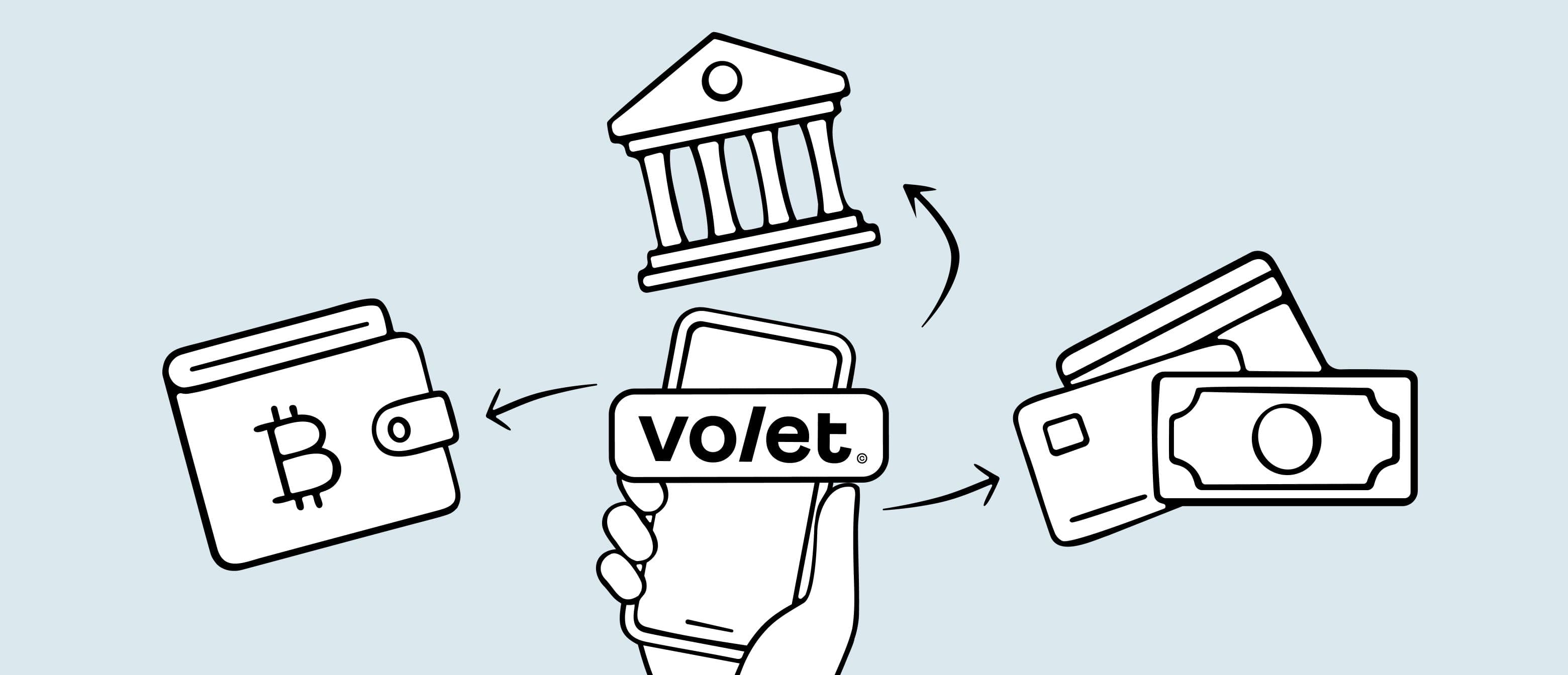
Volet.com is a crypto payment platform built with crypto and fiat as equal parts of the same system. Major crypto tokens as well as USDT and USDC across nine and seven networks respectively live in the same account as USD and EUR. Moving money from crypto to fiat, or from fiat to a prepaid card, happens within one platform without redirecting to a third-party wallet. That architectural difference shows up in every comparison that follows.
Feature
Payoneer
Volet.com
Fiat currencies (receive)
70+
USD, EUR
Fiat currencies (send)
150
28
Stablecoin support
USDC, USDT (US + Brazil only)
USDT (9 networks), USDC (7 networks) — worldwide
Crypto support
None natively
BTC, ETH, TON, SOL, BNB, XRP, LTC, TRX, AVAX, POL
Mass payouts
Only fiat
Crypto + stablecoin + fiat, 180 countries
Payout processing
Sequential
Parallel on-chain
Monthly fee (business)
None (but $29.95/yr if < $6K received)
None
Inactivity fee (personal)
Varies by region
$1/month after 6 months without a transaction
Crypto acquiring
No
From 0.25%
P2P transfer
same country — up to 4.00 USD / EUR / GBP; different country — up to 1% + up to 4.00 USD
Fiat, crypto, stablecoin — free; 0.5% for business accounts
Operates through partner licenses across multiple jurisdictions, including an MSB (Money Service Business) registration in Canada
Brand recognition in freelance markets
Very high
Growing
Operating since
2005
2014
Fee Comparison: Four Real Scenarios
The numbers below use realistic mid-range figures for both platforms — not best-case for one and worst-case for the other. Where a range exists, we show the full range and anchor the estimate to a stated assumption.
Payoneer vs Volet.com — fee calculator
Adjust the parameters to match your real scenario. All rates are published minimums — actual may be higher.
Freelancer receiving funds and withdrawing to a local bank
$2,000
Payoneer — monthly cost
—
Volet.com — monthly cost
—
Fee comparison
Payoneer
Volet.com
Payoneer: 1% receiving fee applies to client-to-Payoneer transfers in a non-local currency. FX markup on withdrawal is applied at transaction time and is not shown on the published fee page — corridor estimates used here. Volet.com: USDT deposit is $1 flat regardless of amount. Local bank transfer deposit is free in 21 supported currencies — but the 1% local withdrawal fee applies in both cases. Annual Payoneer fee of $29.95 not included (waived above $6,000/yr received).
Business sending batch payouts to contractors across multiple countries
$100,000
$200
Payoneer — batch cost
—
Volet.com — batch cost
—
Fee comparison
Payoneer
Volet.com
Payoneer: cross-border P2P transfers are priced at up to 1% + up to $4.00 per transaction — both components apply simultaneously. On a $200 payout: 1% = $2 + $4 = $6 per transaction (3% effective rate). Volet.com: mass payout rates from published pricing. All rates are published minimums — actual may be higher.
Business accepting crypto payments from customers
$50,000
ø
Payoneer
Crypto acquiring not available
Volet.com — monthly cost
—
Card processing — monthly cost
—
Volet.com vs card processing
Volet.com
Card processing
Volet.com crypto acquiring: 0.25% when the merchant receives the same currency the customer paid in (e.g. customer pays BTC, merchant receives BTC; or customer pays USDT, merchant receives USDT). 0.5% when settlement requires conversion to a different currency (e.g. customer pays BTC, merchant receives USDT). Volet.com does not replace card payments — fiat card transactions require a separate processor. Standard card benchmark: 2.9% + $0.30/tx (estimated avg $100 tx). High-risk: 6% mid-range estimate.
Platform distributing small payouts — tips, bonuses, loyalty rewards
1,000
$8
Payoneer — monthly cost
—
Volet.com — monthly cost
—
Fee comparison
Payoneer
Volet.com
Payoneer cross-border transfer: up to 1% + up to $4.00 per transaction — both components apply. On an $8 payout: $0.08 + $4.00 = $4.08 per transaction (~51% effective rate). Volet.com on-chain rate (0.25%) is the temporary introductory rate; Volet-to-Volet is 0.5%. Network fee on L2/Solana/TON estimated at $0.005/tx.
Scenario 1: Freelancer Receiving $2,000 per Month, Withdrawing to a Local Bank
A freelancer in, say, Nigeria, India, or Pakistan receives $2,000 from a client and wants local currency in their bank account.
Payoneer fee item
Rate
On $2,000
Receiving fee (client pays)
1%
$20
Cross-currency withdrawal (USD → INR / NGN / PKR)
1%–2% above mid-market
$20–$40
Total
$40–$60/month
Realistic annual cost
$480–$720
The 1% receiving fee is Payoneer's published rate for client-to-Payoneer transfers. The withdrawal FX markup depends on the corridor: lower-friction routes (USD → INR) typically run around 1%; high-friction routes (USD → NGN, USD → PKR) can reach 2%.
Volet.com fee item
Rate
On $2,000
Receiving via USDT (stablecoin deposit)
$1 flat
$1
Withdrawal to local bank (NGN, INR, PKR)
from 1%
from $20
Total
~$21–$25/month
Realistic annual cost
$252–$300
The $1 deposit fee covers any stablecoin amount — on $2,000 it is effectively 0.05%. For NGN and INR, local withdrawal is available; PKR is withdrawal-only (no deposit by local transfer), so stablecoin remains the practical receiving method.
Scenario 2: Business Sending 500 Payouts per Month
A CPA network sends affiliate commissions to 500 contractors across 40 countries. Average payout: $200. Total batch: $100,000.
Payoneer fee item
Rate
On $100,000
Cross-border Payoneer-to-Payoneer transfer
1%, min $4/transaction
~$2,000 (floor applies: 500 × $4)
For non-Payoneer recipients: wire + FX
up to 3%
up to $1,500
Total (Payoneer-only recipients)
~$3,000
The 1% minimum-$4 structure means every transaction under $400 hits the flat floor. On a $200 payout, the fee is $4 — that is 2% effective. On a $50 payout, it is 8%. The published rate is 1%; the effective rate on a mixed-size batch is higher.
Volet.com fee item
Route
Rate
On $100,000
Mass payout via USDT/USDC to external wallets
Crypto wallet
$0.5 flat per payout
$250
Fiat wallet (with conversion)
0.5% + $0.5
$500.50
Mass payout via Volet-to-Volet
—
0.5%
$500
Typical blended (mix of crypto + Volet)
$250–$600
For a network that pays primarily in USDT to recipients who hold crypto wallets — the most common setup in affiliate and iGaming — the realistic cost sits near $250–$350. For a mixed batch including card payouts, the blended rate rises.
Scenario 3: Accepting Crypto Payments from Customers
A SaaS company wants to accept USDT from customers in Southeast Asia and settle in USD. Monthly volume: $50,000.
Payoneer: Not possible. Payoneer does not offer crypto acquiring. Merchants cannot accept BTC, ETH, or USDT through Payoneer's checkout. This row in the comparison is blank — not zero, but absent.
Volet.com fee item
Rate
On $50,000
Crypto acquiring (USDT → USD settlement)
from 0.25%
from $125
USDT → USD conversion
0%
$0
Withdrawal to bank account
1–1.5%
$500–$750
All-in cost
1.25–1.75%
$625–$875
Integration options: full API, Hosted Checkout (no backend required), WooCommerce or WordPress plugin, and Connect Wallet (non-custodial smart contract). For an independent developer, the Hosted Checkout path takes under an hour and requires no backend code. With Connect Wallet, funds settle directly into the merchant's wallet via smart contract — Volet.com acts as processor, not custodian.
Scenario 4: Micropayments — Tips, Bonuses, and Small Rewards
A creator platform distributes weekly tips to 1,000 users. Average tip: $8.
Payoneer fee item
Rate
Per transaction
Cross-border transfer
1%, min $4
$4 (floor kicks in)
Effective rate on $8 tip
—
50%
Effective rate on $20 tip
—
20%
Monthly cost on 1,000 × $8 payouts
$4,000
The $4 minimum is not an edge case — it is the standard rate for any cross-border transfer under $400. On a $200 payout it costs 2%; on an $8 tip it costs 50%. The minimum fee structure makes Payoneer economically inviable for small payouts at volume.
Volet.com fee item
Rate
Per transaction
Volet-to-Volet transfer
0.5%
$0.04 on $8
On-chain USDT/USDC payout
$0.5 flat
$0.5 on $8
Monthly cost on 1,000 × $8 payouts
$40–$160
Volet.com's percentage-based model scales proportionally — an $8 tip costs $0.02–$0.04 to send, not $4. The monthly fee on the same batch is $40–$160 rather than $4,000. Volet.com’s minimum-fee structure is not a quirk; it applies to every business where a meaningful share of payouts falls below $400 — affiliate micro-commissions, gaming bonuses, cashback rewards, loyalty points.
Crypto and Stablecoins: Where the Platforms Diverge Most
This is the core structural difference between the two platforms in 2026.
Payoneer's stablecoin service is a pilot. It covers two countries. The wallet is operated by a third party. Users who want stablecoin functionality in Indonesia, Turkey, Argentina, or Kenya cannot access it yet. Users who already have USDT and want to deposit it into Payoneer cannot do so — they must first convert through an external exchange. In other words: you cannot receive USDT directly through Payoneer in most markets today.
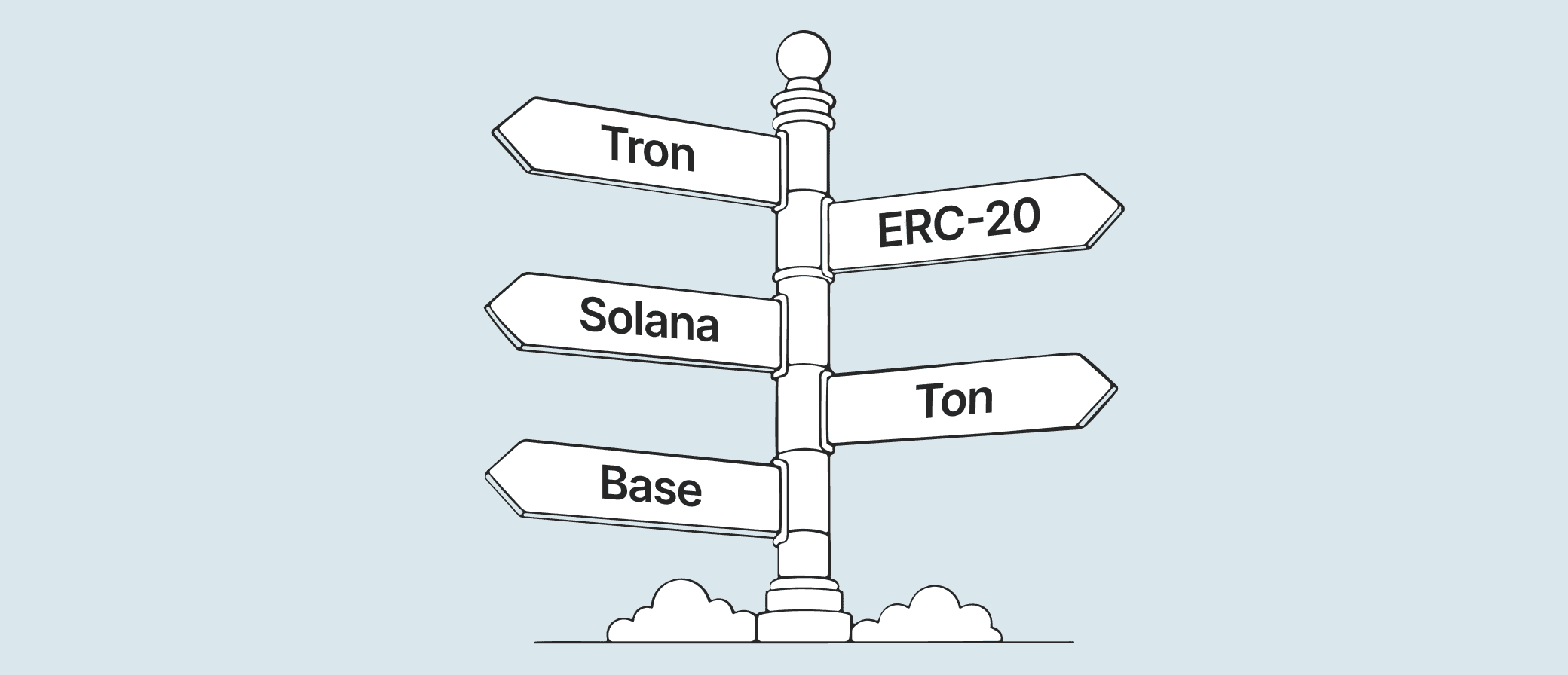
Volet.com supports USDT on nine networks (TRC-20, ERC-20, BEP-20, SOL, POL, AVAX, ARB, OP, and TON) and USDC on seven. Deposits from any of these networks are accepted. Withdrawals are available to all of them. The deposit fee for stablecoins is $1 flat, regardless of the amount. Withdrawing stablecoins costs 0.5% plus the network fee ~$0.5-3.5.
For a freelancer in Vietnam or Nigeria who already holds USDT from Binance or OKX, Volet.com is a direct path in. Payoneer is not.
Marketplace integrations. Upwork, Fiverr, Amazon, Airbnb, and hundreds of other platforms pay directly to Payoneer accounts. If your income comes from these platforms, Payoneer is not just convenient — it is often mandatory.
Compliance infrastructure for business-to-contractor relationships. Many companies that hire internationally use Payoneer precisely because it provides a recognizable, regulated layer between the business and the contractor. For a company paying a new freelancer in a country it has never operated in, Payoneer's regulatory standing reduces friction on both sides — the contractor is easier to onboard, the payment is easier to document. This matters most for high-value, one-to-one engagements where both parties need a paper trail.
Broad fiat coverage. Payoneer supports receiving in 70+ currencies and sending to 150 countries through traditional banking rails. It provides virtual bank account numbers in USD, EUR, GBP, CAD, AUD, JPY, SGD, and HKD. These function like local bank accounts in their respective countries. A US client can pay a Pakistani freelancer using a US ACH transfer, with no mention of international wire fees on either side.
For businesses or freelancers whose clients pay in fiat and whose contractors withdraw in fiat — with no crypto anywhere in the chain — Payoneer's coverage is wider and its fiat withdrawal options to cards and bank accounts are more extensive.
Regulatory maturity. Payoneer is licensed by the FCA in the UK, regulated by the Central Bank of Ireland, and subject to FDIC oversight in the United States. It has operated for 21 years across 190+ countries. That track record carries compliance credibility — particularly for larger businesses that need to demonstrate payment partner due diligence to their own clients or auditors.
Brand recognition. In freelance markets across South Asia and Southeast Asia, "Payoneer account" functions almost as a synonym for "getting paid internationally." That cultural familiarity reduces friction in client relationships.
What Volet.com Does Better
Crypto is native, not bolted on. USDT, USDC, BTC, ETH, and eight other cryptocurrencies are part of the core product — not a partner integration arriving in a quarterly rollout.
Mass payouts and crypto paymentat scale. Payoneer is a fiat payout platform that does not offer crypto acquiring and processes batch payments sequentially through banking infrastructure. Volet.com was built specifically for high-volume crypto payouts — parallel on-chain processing, stablecoin support across multiple networks, and acquiring rates that reflect the company's core focus rather than a bolt-on feature.
Volet.com's parallel on-chain processing submits all transactions in a batch simultaneously. On L2 networks (Arbitrum, Base) or Solana, confirmation takes milliseconds and network fees run below $0.01 per transaction. A batch of 500 payouts that takes 30+ minutes sequentially completes in under a minute in parallel.
For iGaming platforms where a player expects their withdrawal within seconds of requesting it, or for creator platforms paying out on a Friday evening when thousands of users withdraw at once, that difference is the product.
Free P2P transfers between Volet.com accounts. If both the sender and recipient hold Volet.com accounts, transfers in USD or EUR as well as in stablecoins between those accounts are free. This matters for freelancers who work within teams or networks where multiple members are on the platform.
No crypto acquiring gap. Businesses that want to accept BTC, ETH, or USDT cannot use Payoneer. Volet.com offers crypto acquiring for business starting from 0.25%, compared to 2.9% for standard card processing and 4%–8% for high-risk categories. The Connect Wallet option lets buyers pay directly through MetaMask or a mobile wallet — no card data, no 3DS.
Fees verified from official pricing pages as of June 2026. Actual fees may vary by account type, transaction volume, corridor, and currency pair. Always confirm current rates on the provider's pricing page before making financial decisions.
Start sending and receiving money today
Use stablecoins for global reach and local fiat rails for easy top-ups and withdrawals.
Not directly. Upwork, Fiverr, Amazon, and most major freelance marketplaces pay out only to accounts they have integrated with — Payoneer being one of the most common.
Volet.com does not have marketplace integrations of this type. If your income comes exclusively through platforms that force a specific payout partner, Payoneer remains the practical choice for receiving those funds.
The workaround some freelancers use: withdraw from the marketplace to Payoneer, then transfer onward — but that adds one more fee layer, and it only makes sense if the total cost is still lower than alternatives. If your clients pay you directly by wire or stablecoin, Volet.com works without any workaround.
It depends on how you pay them. For USDT or USDC payouts, recipients can receive funds to any external crypto wallet — Binance, Trust Wallet, MetaMask, anything that holds the relevant token on the right network. No Volet.com account needed.
For fiat payouts to a local bank account, recipients generally need their own Volet.com account to use the local withdrawal rails.
For most affiliate networks and creator platforms whose contractors already hold crypto wallets, the stablecoin payout path requires no onboarding on the recipient side at all.
Some functions are available before full verification — account creation and basic API access require minimal documentation.
However, for fiat withdrawals, stablecoin deposits above basic limits, and any function that touches real money movement at scale, KYC and KYB verification is required.
Both platforms are custodial, which means both can freeze accounts when compliance systems flag activity.
To reduce the risk on either platform: complete full identity verification before building up a balance, withdraw regularly rather than letting funds accumulate, and keep records of the source of any funds you deposit.