A practical breakdown of how to accept stablecoin payments inside your product without building blockchain infrastructure.
Most platform teams still assume adding crypto requires a blockchain engineering effort, months of development, and a dedicated compliance function. It doesn't. The infrastructure already exists. What's changing now is how platforms choose to integrate it: not as an external checkout link or a third-party redirect, but as a native payment layer built directly into the product — invisible to the user, valuable to the business.
This guide explains what embedded crypto payments mean in practice, which integration model fits your platform, and what the operational reality looks like once your embedded crypto payment gateway is live.
What are embedded crypto payments
It's best explained by comparison.
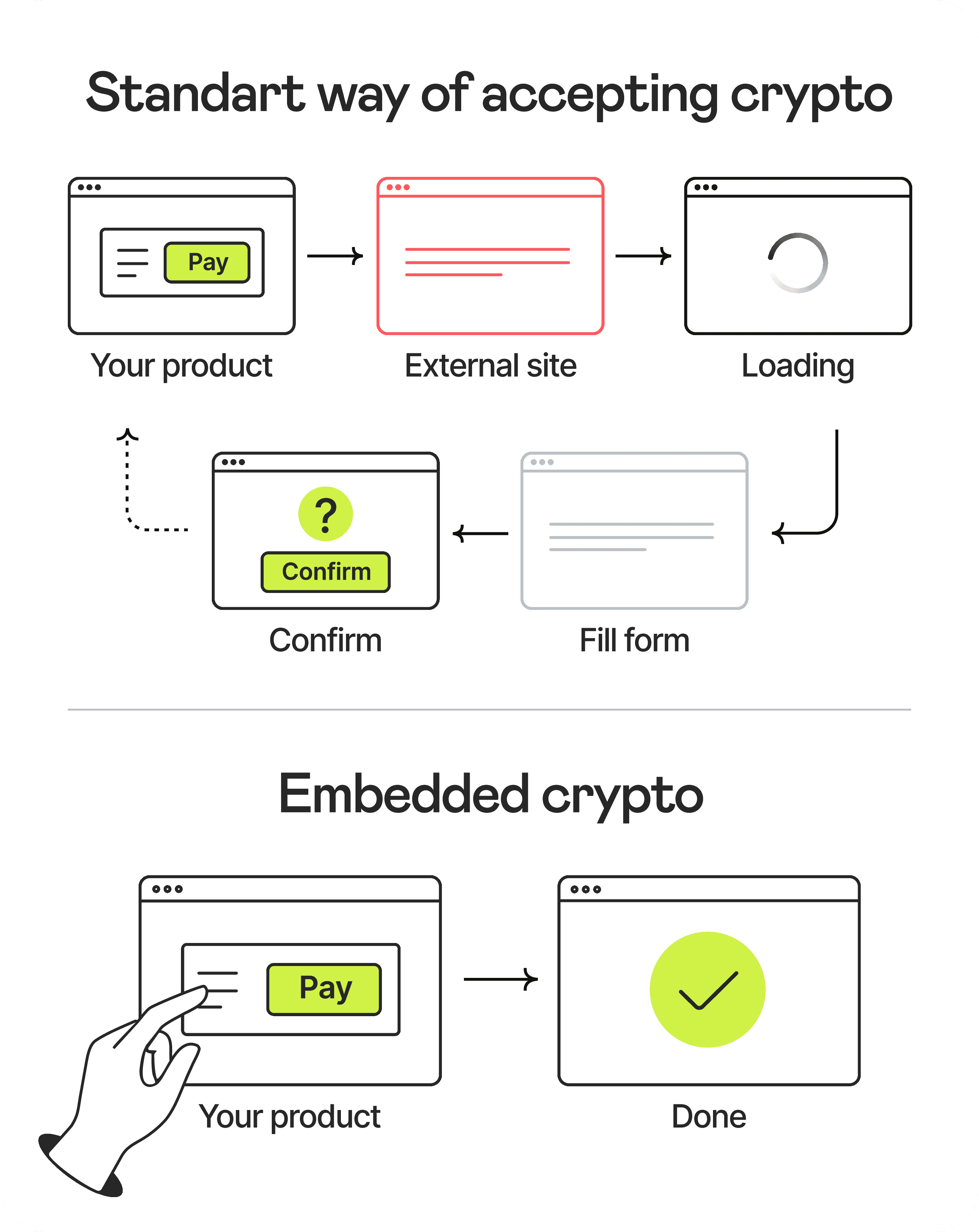
Pattern 1: Redirect — user temporarily leaves your platform
Your backend generates a payment URL via a single API call. The user clicks pay and is taken to an external crypto checkout page, completes the payment there, and returns to your platform. Every context switch is a potential drop-off point.
Pattern 2: Embedded — payment stays inside your product
Embedded crypto payments mean the entire payment flow happens inside your product. No redirects. No external branding. The user selects a payment method, confirms, and continues — all within your interface.
That said, the redirect pattern has real advantages worth naming: zero compliance and security burden (PCI DSS) on your side, no payment logic to maintain in your backend, and a full payment UI that's production-ready in hours. For early-stage products, Telegram bots, or teams without backend development resources, it's often the right trade-off.
Three scenarios where this improves your business economics
1️⃣ Cut payment processing costs by up to 90%. Standard card processing costs 2.9% + $0.30 per transaction on mainstream processors like Stripe. For platforms classified as high-risk — iGaming, forex, adult — processor rates run from 4% to 8%, with additional rolling reserves and monthly fees. When you add crypto payments to your platform through an embedded crypto payment gateway like Volet.com, acquiring costs from 0.25%. On $100,000 in monthly payment volume, that's the difference between $2,900–$8,000 in processing fees and only $250. The gap widens as volume grows.
Beyond fees: card payments in certain corridors in Southeast Asia, Latin America, and Africa see decline rates that regularly exceed 20–30% due to limited banking penetration and card issuance infrastructure. A declined payment is lost revenue regardless of what your processor charges. Stablecoin payments bypass card networks entirely — the transaction settles wherever there's an internet connection and a digital wallet, no issuing bank required.
2️⃣ Eliminate chargebacks as a cost line. Chargeback fees range from $15 to $25 per dispute depending on the processor, and apply regardless of outcome — i.e. even if you win. For digital goods platforms, subscription services, and marketplaces, chargeback rates often run at 0.5–1% of transactions, and exceeding processor thresholds triggers penalties or account termination.
On-chain transactions are irreversible by design: there is no payment institution to call, no chargeback window, no dispute queue. For high-volume platforms, removing chargebacks as a variable is both a cost reduction and an operational simplification worth quantifying in your annual planning.
3️⃣ Reach users who already hold stablecoins. Binance, Bybit, OKX, and similar exchanges collectively serve hundreds of millions of registered users. Many of them hold USDT or USDC as a primary liquid asset — not as a speculative position, but as a working balance. For users in countries with volatile local currencies or restricted dollar access, stablecoins function as their dollar account: they receive income in USDT, keep savings in USDT, and look for platforms that support embedded stablecoin payments natively.
For a fiat-only platform, those users face a specific friction: convert stablecoin to fiat via an exchange, wait for bank settlement, then pay. Many don't bother — they move to a platform that accepts their currency natively. This is particularly pronounced in affiliate marketing, freelance platforms, and creator ecosystems, where a significant share of the active user base already holds stablecoins from previous payouts or trading activity.
These users aren't a niche. In Southeast Asia, Eastern Europe, Latin America, and the Middle East, stablecoin holders represent a fast-growing share of the digitally active population.
Auto-conversion feature handles this at the point of receipt. Incoming crypto is converted to fiat — USD or EUR — immediately. Each transaction is recorded at its fiat-equivalent value at the time of confirmation.
Volet.com exports structured data — timestamps, amounts in fiat equivalents, network fees — that maps directly into standard accounting workflows.
Your finance team works with fiat balances and fiat reporting. The crypto rail is operationally invisible to them.
Three levels of payment integration
When you add crypto payments to your platform, there is no single right way to do it. The correct level depends on your team's technical capacity, the complexity of your payment flows, and how much control you need over the user experience.
Level
Type
Instrument
Time to launch
Best for
No-code
Embedded
CMS plugin
Minutes
WooCommerce, OpenCart, e-commerce without dev resources
Low-code
Redirect
Hosted Checkout
Hours
SaaS, marketplaces, Telegram Mini Apps
Full control
Embedded
Full API
1–2 days
Custom flows, full UX ownership
No-code: CMS plugin. Install the plugin for your platform — WooCommerce, OpenCart — enter your API key, and configure accepted currencies. From that point, your crypto checkout accepts USDT, USDC, and major cryptocurrencies alongside existing payment methods. The plugin handles address generation, transaction monitoring, and confirmation webhooks. Your development team does nothing at the infrastructure level.
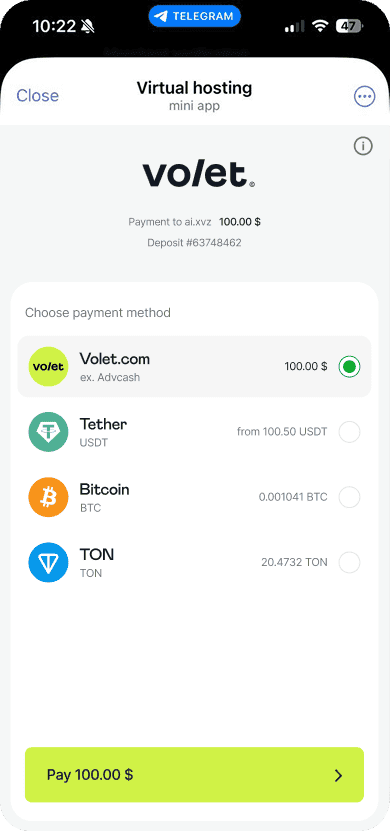
Low-code: Hosted Checkout. Your backend makes one API call and receives a payment URL. You redirect your user to it, or open it as a modal or webview. The crypto checkout page is managed by Volet.com — crypto and fiat support on one screen, no card payment compliance (PCI DSS) required on your side, as it is covered by the payment processor.
Hosted Checkout integration for Telegram
Telegram's audience for crypto-native products — subscription channels, trading communities, creator bots, gaming — is large and growing
If your product lives inside a Telegram bot or Mini App, Hosted Checkout may be a good fit. It opens as a webview directly inside Telegram — no browser redirect, no app switch, no break in the flow. The user reaches a payment trigger inside the bot, the webview opens, they confirm the payment, and the bot flow resumes as normal. Everything stays inside one app.
Full API. Full control over every step: address generation, transaction monitoring, currency routing, webhook handling, automated settlement. Crypto APIs give you the flexibility to choose which networks and currencies to offer, define confirmation thresholds by transaction size, and build a fully custom payment experience where crypto is indistinguishable from any other payment method in your product. This is the right choice for platforms that need complete control over the user experience or have complex multi-currency payment flows.
No setup fees, no monthly platform costs, no API call charges. You pay only on transaction volume.
How long does integration actually take
CMS plugin: Installation takes under 10 minutes. Test transactions take another 30 minutes. The limiting factor is KYB (Know Your Business) verification — typically half a day to 2 days depending on business size and jurisdiction.
Hosted Checkout: A single API call to generate the crypto checkout URL plus redirect or webview logic. An experienced developer completes this in a few hours. KYB runs in parallel and doesn't block development.
Full API: A straightforward store accepting crypto and confirming orders: approximately 4 hours. More complex flows — webhook handling, multi-currency reconciliation, custom confirmation logic — take 1–2 days. You can build against the sandbox environment before your account is verified.
Where to go from here
Embedded crypto payments are not a replacement for your existing payment stack — they're an addition that removes friction for a specific and growing segment of users, reduces processing costs at scale, and eliminates chargebacks on transactions where they matter most.
If you need to move fast and don't want to maintain payment logic, Hosted Checkout is the right starting point. If UX ownership matters — or you're building a high-volume product where the embedded experience drives conversion — Full API is the right investment.
Volet.com helps build your global payments
In fiat, crypto, and stablecoins. Via API, hosted checkout, or easy-to-install plugins. Accept, send, and manage funds — all from code.
No. Embedded crypto payments work through auto-conversion at the point of receipt. Incoming crypto is converted to fiat — USD or EUR — immediately. Your finance team works with fiat balances and fiat reporting. The crypto rail is operationally invisible to them.
Each transaction is recorded at its fiat-equivalent value at the time of confirmation. Volet.com exports structured data — timestamps, amounts in fiat equivalents, network fees — that maps directly into standard accounting workflows.
This is how embedded finance works in practice: the payment infrastructure operates invisibly at the infrastructure level, while your finance team sees a clean payment received at a specific dollar value on a specific date.
On-chain transactions are irreversible, so refunds require an active decision on your side. Define your policy before launch: refund in the same stablecoin, convert and refund in fiat, or issue platform credit.
Volet.com processes the outbound refund through the same infrastructure. The only decision your team needs to make in advance is what your refund policy is. This applies to all embedded crypto payments regardless of the integration level you choose.
KYB verification covers your business at the platform level. When you use a crypto payment gateway like Volet.com, AML screening of incoming transactions runs at the provider level — wallets are checked against sanctions lists and high-risk addresses are flagged before funds are credited.
Crypto APIs include built-in event hooks so your team receives structured transaction signals without needing to build in-house blockchain analytics infrastructure.
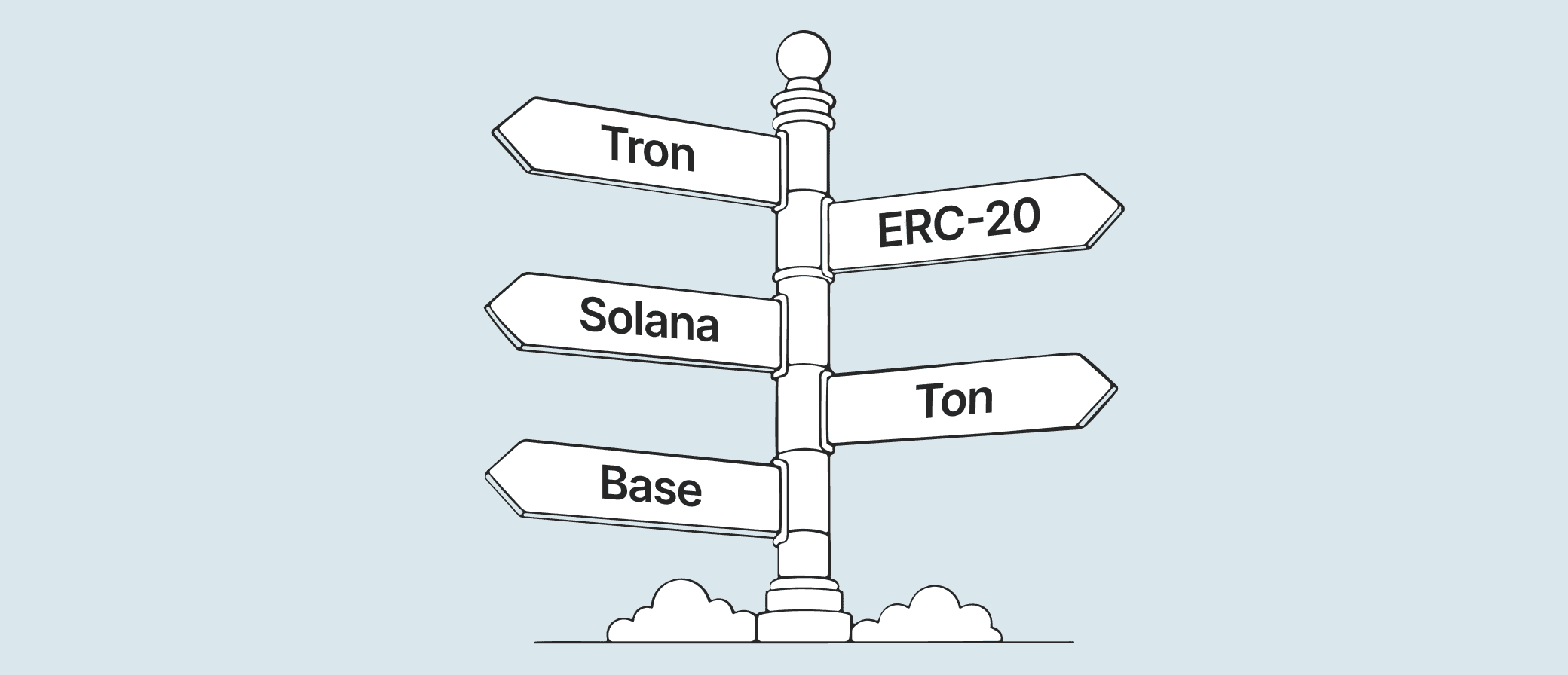
The right answer depends on where your users are. TRC-20 is the most widely recognised USDT network among retail users globally, which makes it a practical default for general-audience platforms.
L2 networks (Arbitrum, Base), Solana, and TON are increasingly common among crypto-native audiences — affiliate networks, trading communities, DeFi users — and offer faster confirmation times. Embedded stablecoin payments on these networks typically settle in seconds at near-zero cost.
The practical approach: accept on TRC-20 and at least one L2 network from launch, and let users select based on what their wallet supports. Your crypto checkout should display the network name clearly alongside the deposit address to prevent user error.
Yes. When you add crypto payments to your platform via the address-based flow, it works for any wallet or centralised exchange — users send funds directly to the generated deposit address, the same way they'd send a transfer to anyone else.
Contact Volet.com support — cross-network recovery is assessed case by case.
To minimise this: display the network name clearly alongside the deposit address at checkout, and consider restricting available networks to those most common among your user base during initial rollout.