You hold crypto. You want cash in your bank. Between those two points sit network fees, conversion spreads, identity checks, and banks that sometimes refuse to cooperate. This guide cuts through all of it.
You cannot send Bitcoin to a bank account the way you send a wire transfer. Banks run on fiat rails — SEPA, SWIFT, or a local transfer. Blockchains run on their own. To move crypto into your bank account, you need a service that converts it to fiat and sends the funds to your bank.
Three types of services do this: centralized exchanges, peer-to-peer marketplaces, and digital wallets with off-ramp functionality. Each works differently and suits a different situation. This guide covers all three — how they work, what they cost, and where people lose money or time.
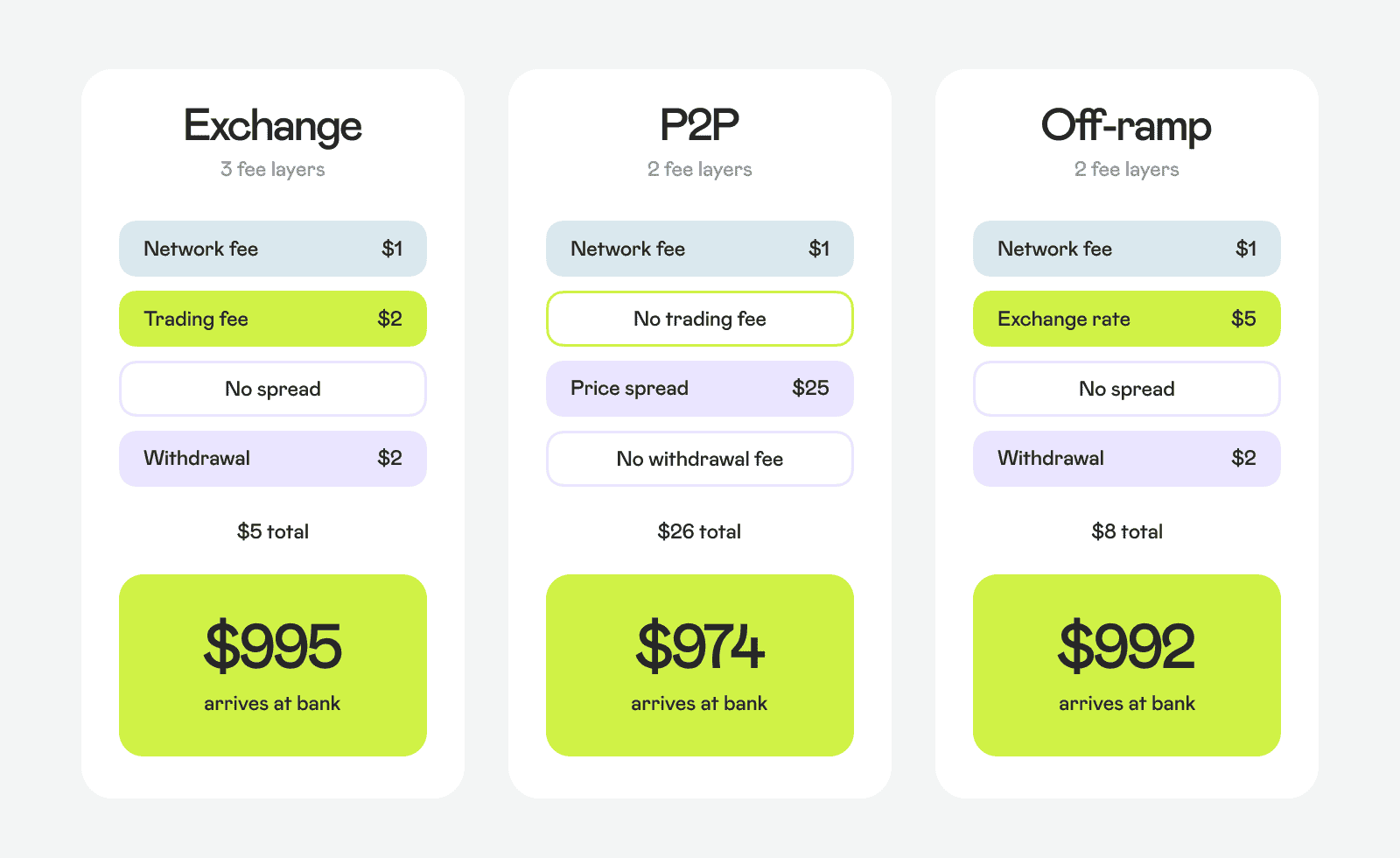
What happens to your $1000 in crypto transferred to bank
Illustrative example: SEPA rail, Ethereum network. Actual fees may vary by platform and volumes
Centralized Exchange
How it works. Centralized exchanges — Binance, Kraken, Coinbase, and others — are the most widely used path from crypto to bank account. The step by step crypto bank transfer process looks like this:
1. Create an account and complete identity verification (KYC). Every platform that lets you sell crypto and withdraw to bank requires this — prepare a government-issued ID and, in some cases, proof of address. Verification takes minutes on some platforms and up to two days on others.
2. Deposit crypto from your personal wallet to your exchange account. Choose the cheapest network the exchange supports for your token. Layer 2 networks (Arbitrum, Optimism), Solana, and TON cost less than a cent. Ethereum runs $0.05–0.40.
3. Sell your crypto for fiat currency through the trading interface. For a regular cash-out and small to medium amounts, a market order is simplest — it executes instantly at the current price.
4. Link your bank account and initiate a withdrawal. The name on your exchange account must match the name on your bank account exactly — a mismatch is one of the most common reasons transfers get rejected.
Once the withdrawal is submitted, the speed depends on the payment rail: SEPA Instant settles in minutes, standard SEPA takes one to two business days, and SWIFT wires take three to five days.
Who it's best for. This method suits people who already hold an exchange account or trade regularly. Exchanges offer high liquidity, which matters when you are selling large amounts — $10,000 or more. If you are looking for the best exchange to transfer crypto to bank, focus on supported withdrawal rails in your country, total fees, and processing speed rather than brand name alone.
Fees. Trading fees range from 0.1% to 0.5% per transaction. Fiat withdrawal fees depend on the rail: SEPA often costs €0–1, SWIFT runs $15–50. On top of this, you pay the blockchain network fee when depositing your crypto. Finally, there is the spread — the gap between the mid-market price and the price at which your order executes. On liquid pairs this gap is small; on thinner markets it adds up. Most exchanges also set minimum withdrawal amounts — some as low as $10, others $100 or more for SWIFT.
Pros. Deepest liquidity and widest selection of trading pairs. Transparent, published fee structures. Regulated in most major markets. Support for the broadest range of cryptocurrencies.
Pitfalls. Some banks reject incoming transfers from cryptocurrency exchanges. This is not rare — particularly with traditional banks that have restrictive policies toward crypto-related funds. Check your bank's stance before initiating a withdrawal, or you risk waiting for days only to see the transfer returned.
Large withdrawals can trigger compliance reviews, adding hours or days. And because the fees stack in multiple layers — trading, withdrawal, network, spread — the total cost is often higher than the headline number suggests.
Selling crypto for fiat is a taxable event in most jurisdictions.

Depending on your holding period and local laws, you may owe capital gains tax. And because you complete KYC on every regulated platform, your identity is linked to every transaction. Major exchanges actively share data with tax authorities or comply with their requests — assume your crypto sale will not go unnoticed.
Digital Wallet with Off-Ramp
How It Works. Digital wallets with off-ramp functionality — platforms like Volet.com — combine a crypto wallet, a currency converter, and fiat withdrawal in one place. The chain is shorter than on an exchange: no trading terminal, no order book, no buy or sell orders to manage.
Here’s the process to convert crypto to fiat and transfer it to your bank:
1. Sign up and complete KYC — the same identity verification as on an exchange.
2. Deposit crypto. Volet.com offers two ways. You can create a crypto wallet on the platform and receive USDT (TRC-20, ERC-20) or USDC (ERC-20) directly — then convert to fiat manually. Or you can use auto-conversion: send crypto, and the platform converts it to a fiat balance (USD, EUR) upon receipt. The auto-conversion route supports USDT on 9 networks and USDC on 7, so you can pick Solana or a Layer 2 chain and pay under a cent instead of dollars on Tron.
3. Enter your bank details and withdraw.
The fiat then travels over standard banking rails. Which rails are available depends on the platform: some support SEPA and SWIFT, others focus on local bank transfers in specific currencies. Volet.com, for instance, supports withdrawals in 28+ fiat currencies through local bank transfers, covering Latin America, Southeast Asia, and Africa — a practical option for users in regions where SEPA and SWIFT are not the norm.
Who it's best for. People who do not trade and have no interest in learning an exchange interface. Freelancers, influencers, affiliates, and other creators who receive crypto payments and need regular withdrawals to their bank. Anyone who needs fiat in a currency that major exchanges do not support for direct withdrawal.
Fees. The fee structure depends on how you deposit. Using Volet.com as a reference:
If you deposit crypto to a crypto wallet and then convert, the deposit itself is free. The platform applies its own exchange rate at conversion: 0.5% for BTC and ETH, 1% for stablecoins and other tokens. Withdrawal to a bank account costs 1%, plus the platform's exchange rate if converting to a local currency other than USD.
If you use auto-conversion — where crypto is converted to a fiat balance upon deposit — the fees are bundled upfront. Stablecoins carry a flat $1 fee plus a 0.5% rate if converting to EUR. BTC and ETH convert at a 0.5% rate, other tokens at 1%. Withdrawal to a bank account costs 1%, plus the platform's exchange rate if converting to a local currency other than USD.
Either way, the total cost is transparent: you see the rate, you see the fee, and you know exactly what reaches your bank before you confirm. Compared to an exchange — where trading fees, spread, and withdrawal fees stack in separate layers — off-ramp platforms bundle everything into fewer, more predictable numbers.
Pros. Simplicity. Fewer steps, fewer points of failure. The range of supported fiat currencies and local withdrawal methods is often broader than what exchanges offer.
On top of that, the withdrawal to your bank arrives from a registered company — not from an exchange with "crypto" in the name — which means banks are far less likely to reject it. And because the platform handles conversion internally, the whole process — deposit, convert, withdraw — can be completed in minutes rather than the hours it takes to navigate an exchange trading interface of a typical crypto exchange.
Pitfalls. The selection of supported cryptocurrencies may be narrower than on a major exchange. Volet.com supports 10 cryptocurrencies (BTC, ETH, TON, BNB, SOL, POL, AVAX, LTC, XRP, TRX) and stablecoins (USDT on 9 networks, USDC on 7) — enough for most users, but not every token.
These platforms are not built for trading. If you need limit orders or charting tools, use an exchange. And as with any service holding your funds, verify the platform's licensing before depositing.
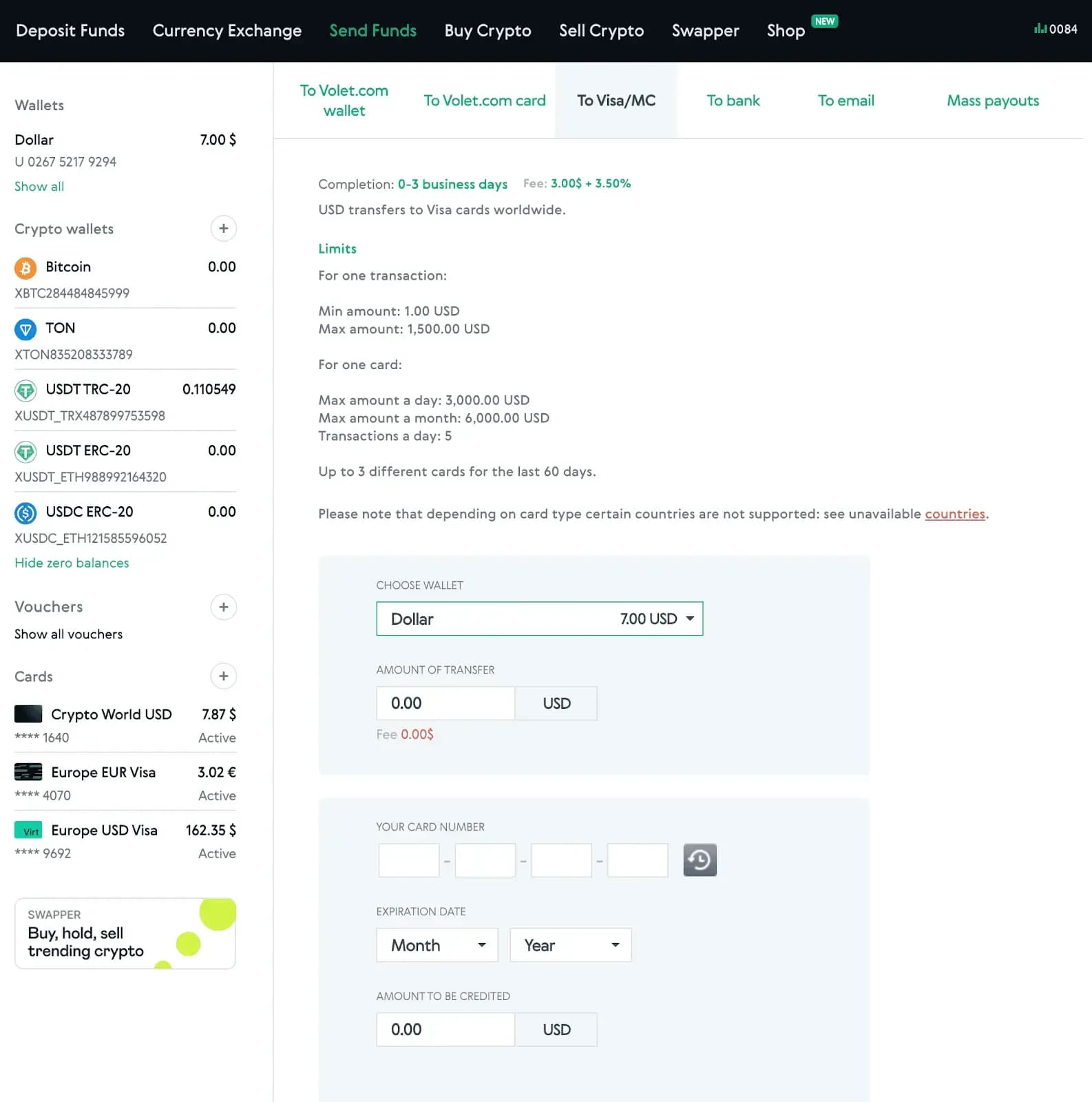
Volet.com’s interface allows you to swap crypto, convert to fiat, and withdraw to your bank account, all from a single screen
Accept USDT, USDC, and leading crypto tokens worldwide
Start with the crypto payment gateway — instant settlements and fees from 0.25%
How it works. Peer-to-peer platforms connect you directly with a buyer for your crypto. Major exchanges like Binance, OKX, and Bybit have built-in P2P marketplaces. The process looks as follows:
1. Browse offers from buyers who want to purchase crypto using bank transfers. Filter by your currency, preferred payment method, and price.
2. Select an offer and open a trade. The platform locks your crypto in escrow — your coins are frozen and will not be released to the buyer until you confirm the money has arrived. This is your protection: the buyer cannot receive the crypto without your explicit confirmation.
3. Wait for the buyer to transfer fiat directly to your bank account.
4. Once you see the funds — fully cleared, not just pending — confirm receipt on the platform. The escrow releases the crypto to the buyer.
KYC is required on most P2P platforms, same as on exchanges. The key difference: since the fiat comes from another individual's bank account rather than from a crypto company, it arrives as an ordinary person-to-person transfer.
Who it's best for. P2P is particularly useful in regions where exchanges do not support direct fiat withdrawals — parts of Africa, Southeast Asia, Latin America. It is also a practical option when you want to sell crypto and withdraw to bank in a local currency that major platforms do not serve, since the payment appears as a regular bank transfer and avoids the friction some banks create with exchange-originated payments.
Fees. Most P2P platforms charge zero fees to the seller (the person posting the ad). The real cost hides in the spread: buyers typically offer prices 1–3% below the spot rate. That discount is your effective fee. If your crypto is already on the platform, there is no blockchain network fee.
Pros. Unmatched flexibility. You choose the buyer, the price, and the payment method. Local currencies that exchanges do not support for direct withdrawal — Nigerian naira, Vietnamese dong, Kenyan shilling — are readily available through P2P. Funds arrive as a regular bank transfer, which means fewer problems with bank compliance departments.
Pitfalls. Fraud is the primary risk in P2P transfers. Some scammers send forged payment confirmations or initiate chargebacks after the crypto is released. Never release crypto from escrow until the funds have fully cleared in your bank account — not "pending," but confirmed and available.
Also, liquidity is limited. Selling large amounts may require multiple trades with different buyers, which takes time and increases fraud risk exposure. And because each trade involves a human counterparty, the process is inherently slower than an exchange order.
How the Three Methods Compare
Centralized Exchange
Peer-to-Peer (P2P)
Digital Wallet / Off-Ramp
Typical total fee
0.3%–1.5% (trading + withdrawal + spread)
1–3% (hidden in the price spread)
From 0.25% (conversion + withdrawal)
Speed to bank account
1–5 business days depending on rail
Minutes to hours (depends on buyer)
1–5 business days depending on rail
Supported currencies
Mostly USD, EUR, GBP
Wide — local currencies through buyers
28+ fiat currencies (Volet.com)
KYC required
Yes
Yes
Yes
Minimum withdrawal
Varies ($10–$500+)
Set by the counterparty
Varies by currency and rail
Best for
Traders, large amounts, liquid pairs
Regions without direct fiat support, bank-restricted users
Regular withdrawals, local currencies, non-traders
Main risk
Bank rejection, holding periods, layered fees
Fraud, slow disputes, limited liquidity
Narrower token selection, platform-set rates
FAQ
Banks do not accept cryptocurrency. You must convert crypto to fiat and transfer the funds through a banking rail — SEPA, SWIFT, or a local transfer. Every method in this crypto to bank account guide handles that conversion for you. The difference is how many steps and fees are involved.
An exchange is usually slightly cheaper on fees alone — trading costs of 0.1%–0.5% plus a small withdrawal fee. An off-ramp platform like Volet.com costs a bit more, but the process is simpler and the total is predictable upfront. In practice, though, the choice depends less on price and more on where your crypto already sits and what withdrawal options are available to you.
If you trade on an exchange regularly, your funds are already there — no deposit step, no extra platform to learn. Withdrawing to a bank is just one more click, assuming your exchange supports it in your country.
If your crypto is in a personal wallet and you do not use an exchange, an off-ramp platform is the shorter path. No trading interface to navigate, and the selection of local bank transfer methods is often broader — especially for emerging markets in Africa, Southeast Asia, and Latin America.
If neither option offers a withdrawal method that works for you, P2P is the fallback — either through a P2P marketplace on a major exchange or through a dedicated exchange service. It is more hands-on, but it works where other methods do not.
Crypto to bank account fees come in layers: the blockchain network fee (under $0.01 on cheap networks, $2–4 on Tron), the platform's trading or conversion fee (0.1%–1.5%), and the fiat withdrawal fee ($0–50 depending on currency and rail). On an off-ramp platform like Volet.com, conversion starts from 0.25% and the structure is simpler. Always calculate the total across all layers before you confirm.
There is no single best exchange to transfer crypto to bank — it depends on your country, currency, and payment rails. For SEPA withdrawals in Europe, Kraken and Binance are commonly used. If you need local currency in emerging markets, an off-ramp platform like Volet.com may cover currencies that major exchanges do not. Compare total fees, supported currencies, and processing times for your specific situation.
The total time has two parts. First, the platform processes your crypto deposit and conversion — usually minutes to an hour. Second, the bank transfer depends on the rail: SEPA Instant arrives in minutes, standard SEPA in one to two business days, SWIFT in three to five days. A step by step crypto bank transfer on a well-chosen platform, with KYC already complete, can put money in your bank within 24 hours on a fast rail like SEPA.
Yes. Some banks block or delay incoming transfers from known cryptocurrency exchanges. If this happens, try a different bank that accepts crypto-related transfers, use a P2P marketplace where the payment arrives as a regular person-to-person transfer, or use a digital wallet platform as an intermediate step. Check your bank's policy before you initiate a withdrawal.