The cryptocurrency market has evolved significantly, and peer-to-peer (P2P) crypto exchanges have become a popular alternative to traditional centralized exchanges. These platforms allow you to buy, sell, and trade digital assets directly with other users—without the involvement of a central authority.
A P2P crypto exchange facilitates direct transactions between traders while offering multiple payment methods, enhanced privacy, and greater control over the trading process. With robust security measures like escrow services and two-factor authentication (2FA), these platforms ensure a safe and seamless trading experience for users worldwide.
With so many options available, how do you choose the best P2P crypto exchange? In this guide, we’ll explore the top 10 P2P exchanges, breaking down their trading fees, available cryptocurrencies, security features, and liquidity—so you can trade safely and efficiently.
What is a Peer-to-Peer (P2P) Crypto Exchange?
A peer-to-peer (P2P) crypto exchange is a decentralized platform that enables you to trade cryptocurrencies directly with other users—without a central authority facilitating the transactions.
P2P exchanges provide financial accessibility, making them ideal for both seasoned traders and newcomers looking for a cost-effective and efficient way to trade cryptocurrencies.
How Do P2P Bitcoin Exchanges Work?
Unlike centralized exchanges that automatically match and execute trades through an order book, peer-to-peer (P2P) Bitcoin exchanges use an escrow service to secure trades and prevent fraud.
How to Trade on a P2P Crypto Exchange
- Sign Up & Verify – Register on the platform and complete the identity verification process (if required).
- Browse Offers – Choose a buyer/seller based on their fee structure, payment options, and reputation.
- Initiate Trade – The escrow system temporarily holds funds until the transaction is confirmed.
- Confirm Payment – Make the payment via bank transfers, e-wallets, or other cryptocurrencies, then confirm the transaction.
- Release Crypto – Once payment is verified, the platform releases the digital assets to the buyer.
- Leave Feedback – Rate the other trader to build trust and enhance the crypto community.
This step-by-step process ensures safe, transparent, and dispute-free transactions.
How to Choose a P2P Crypto Exchange
Before selecting a P2P exchange, consider these key factors to ensure a secure and efficient trading experience:
- Trading Fees – Compare transaction fees, trading costs, and deposit/withdrawal charges to minimize expenses.
- Available Cryptocurrencies – Choose platforms that support Bitcoin, Ethereum, stablecoins, and other major cryptocurrencies.
- Payment Methods – Look for exchanges offering multiple payment methods, such as bank transfers, cash payments, and e-wallets.
- Security Features – Opt for platforms with 2FA, escrow protection, and strong security protocols.
- Accessibility – Ensure the exchange supports various fiat currencies and operates in your region.
- Liquidity – High liquidity allows for faster trade execution and better pricing.
- Customer Support – Reliable support services ensure efficient dispute resolution.
- User Interface – A simple and intuitive UI improves the trading experience for both new and experienced traders.
- Reputation & Reviews – Check user feedback and past trade success rates to evaluate a platform’s reliability.
Top 10 Best P2P Crypto Exchange Platforms
With so many P2P crypto exchanges out there, selecting the right one depends on security, liquidity, supported cryptocurrencies, payment methods, trading costs, and ease of use. In no particular order, here’s an in-depth review of the top 10 P2P exchanges, including their key features, best use cases, advantages, and drawbacks.
Binance P2P – Best for High Liquidity and Zero Trading Fees
Binance P2P, launched in 2019, is a peer-to-peer (P2P) trading platform within the centralized Binance ecosystem. While it generally offers high liquidity and often features zero trading fees from Binance itself, users should be aware of potential fees from payment providers. It's a popular option for both novice and experienced traders due to its ease of use and access to a large user base.
Key Features
- Zero transaction fees, making it a cost-effective option.
- High liquidity, ensuring fast trade execution.
- Supports over 100 payment methods, including bank transfers, cash payments, and e-wallets.
- Two-factor authentication (2FA) for enhanced security.
Best Use Case
Binance P2P is ideal for users seeking a highly liquid exchange with zero trading fees and extensive payment options.
Advantages
- No trading fees, reducing overall costs.
- Supports multiple payment methods, enhancing accessibility.
- Advanced trading tools, catering to professional traders.
Drawbacks
- Requires identity verification, which may be a concern for privacy-focused users.
- Some payment options may be unavailable in specific regions.
Paxful – Best for a Wide Range of Payment Methods
Founded in 2015 by Ray Youssef and Artur Schaback, Paxful's stated mission is to offer financial freedom to underserved populations. Initially focused on Bitcoin transactions via gift cards and bank transfers, Paxful now supports a wide range of payment methods, exceeding 350. While the availability of specific payment methods varies by region, this extensive selection has contributed to Paxful's popularity in emerging markets, particularly in Africa and Latin America.
Key Features
- Supports over 350 payment methods, including cash payments.
- Personalized peer-to-peer trading offers.
- Strong dispute resolution system for conflict management.
Best Use Case
Paxful is perfect if you need payment flexibility and prefer customized trades.
Advantages
- Diverse payment options.
- Supports various fiat currencies, making it accessible globally.
- Two-factor authentication (2FA) for security.
Drawbacks
- Higher trading fees compared to Binance P2P.
- Some sellers charge additional percentage fees on transactions.
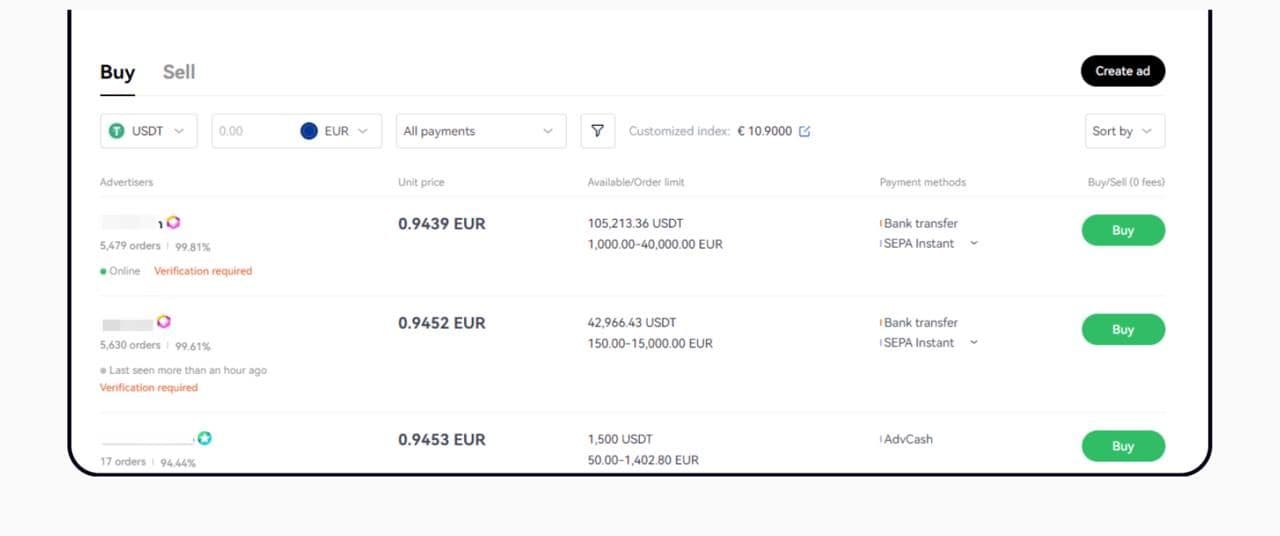
OKX P2P – Best for High Security and Compliance
OKX P2P, part of the OKX exchange founded by Star Xu, facilitates peer-to-peer cryptocurrency transactions. OKX emphasizes security and compliance on its P2P platform, employing measures such as escrow services. However, users should be aware that no platform can guarantee absolute security, and compliance is also dependent on individual user adherence to KYC/AML regulations.
Key Features
- Zero transaction fees for buyers and sellers.
- Supports other cryptocurrencies like Ethereum and Tether.
- Escrow system ensures secure transactions.
Best Use Case
OKX P2P is ideal if you need a secure platform that balances low costs and compliance.
Advantages
- Low trading costs for frequent traders.
- Supports multiple digital assets, offering a diversified portfolio.
Drawbacks
- Requires identity verification for withdrawals.
- Limited availability in some regions.
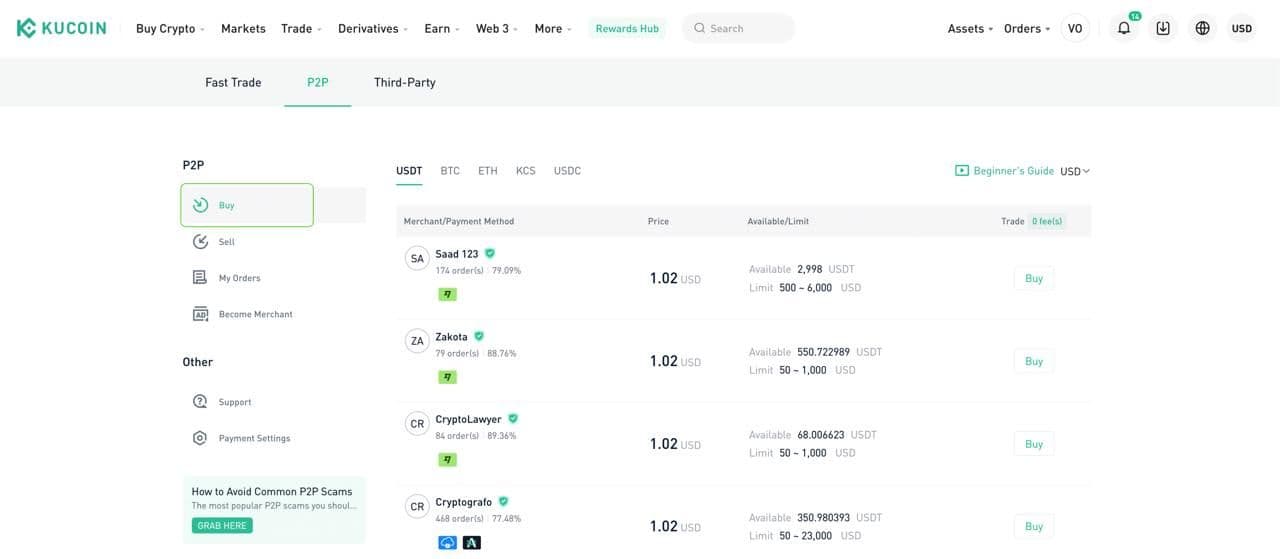
KuCoin P2P – Best for Low Trading Fees and Crypto Security
KuCoin P2P, launched in 2017, is a peer-to-peer (P2P) trading platform within the KuCoin exchange, founded by Michael Gan and Eric Don. While KuCoin itself often does not charge trading fees on its P2P platform, users should be aware of potential fees charged by payment providers or individual traders. KuCoin emphasizes security on its platform, including its P2P service, though it's important to recognize that no platform can guarantee absolute security. KuCoin P2P can be a suitable option for frequent traders who prioritize cost-effectiveness and security measures
Key Features
- Zero transaction fees for P2P trades.
- Supports various fiat currencies.
- Implements advanced security measures to protect traders.
Best Use Case
Great for experienced traders looking for high liquidity and minimal trading fees.
Advantages
- Fast and efficient trading process.
- User-friendly interface, making it accessible to all traders.
Drawbacks
- Requires identity verification for full access.
- Limited availability in some countries.
Bybit P2P – Best for Experienced Traders and Fast Transactions
Bybit, founded in 2018, is a cryptocurrency exchange that also offers a peer-to-peer (P2P) trading platform. While Bybit is known for its trading features that appeal to both experienced and newer traders, its P2P platform offers a range of payment options and typically utilizes an escrow system to enhance transaction security. While escrow systems can mitigate risk, they do not guarantee entirely secure transactions. Transaction speed on Bybit P2P can vary depending on the chosen payment method and other factors.
Key Features
- High liquidity, reducing waiting times for trade execution.
- User-friendly interface, ensuring seamless navigation.
- Supports bank transfers, digital assets, and e-wallet payments.
Best Use Case
Designed for professional traders who require fast and efficient transactions.
Advantages
- Secure transactions with escrow protection.
- Multiple payment options, enhancing flexibility.
Drawbacks
- Higher trading costs for certain fiat currencies.
- Limited availability in some regions.
Huobi P2P – Best for Secure Escrow Transactions
HTX P2P, part of the HTX exchange founded in 2013, facilitates peer-to-peer cryptocurrency trading. HTXi utilizes an escrow system on its P2P platform to enhance transaction security. While HTX P2P is available in numerous countries and its security measures are a consideration for users, it's important to recognize that no platform can guarantee absolute security. HTX is a widely used exchange, but users should conduct their own research and due diligence before using any trading platform, including Huobi P2P.
Key Features
- High liquidity, allowing fast transactions.
- Supports bank transfers and e-wallet payments.
- Advanced security protocols to prevent fraud.
Best Use Case
Best for users who prioritize security and require fast trade execution.
Advantages
- Escrow system enhances transaction safety.
- User-friendly interface, making it accessible to all traders.
Drawbacks
- Limited fiat currency options in some regions.
- Identity verification required for large transactions.
Remitano – Best for Advanced Trading Tools
Remitano is a peer-to-peer (P2P) cryptocurrency exchange that also offers other services like investment products. While Remitano provides a range of trading tools and functionalities, it's more suitable for users seeking a user-friendly platform for buying, selling, and trading cryptocurrencies, including via P2P, rather than those requiring highly advanced trading features. It can be a good starting point for users exploring P2P trading and other basic crypto services.
Key Features
- High liquidity, ensuring smooth trade execution.
- Provides a secure environment with two-factor authentication (2FA).
- Supports various fiat currencies and multiple payment methods.
Best Use Case
Best for users looking for a combination of P2P trading and advanced trading tools.
Advantages
- Advanced trading features, suitable for experienced traders.
- Strong security measures for fraud prevention.
Drawbacks
- Higher trading fees compared to competitors.
- Customer support disputes may take longer to resolve.
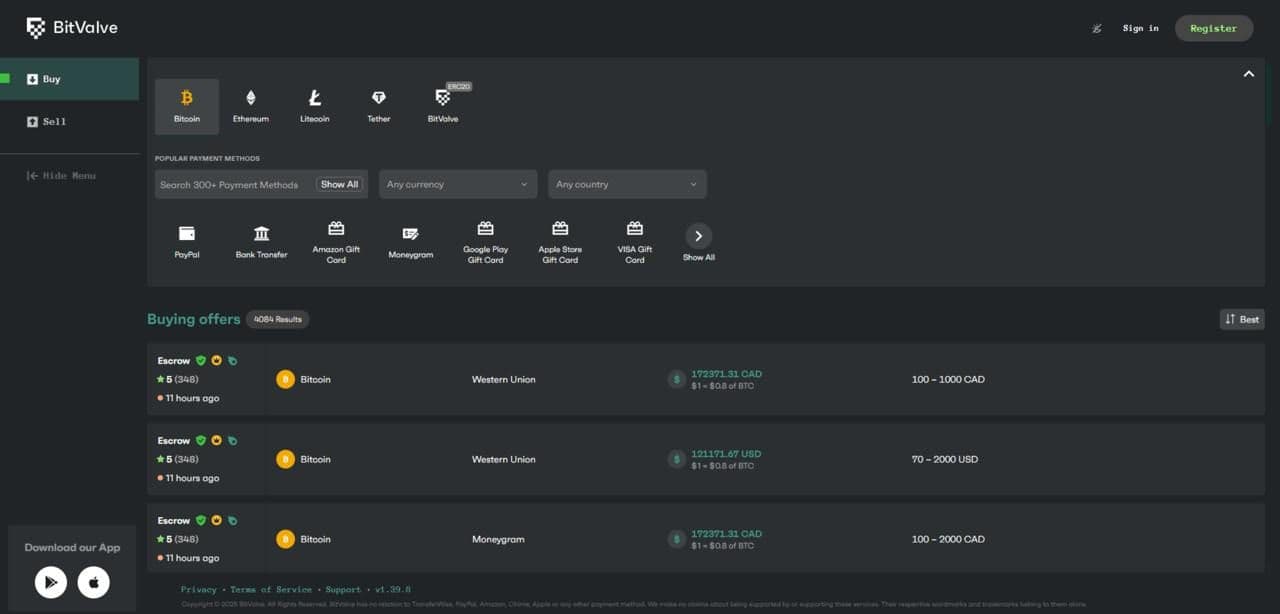
BitValve – Best for Alternative Payment Options
BitValve is a peer-to-peer (P2P) cryptocurrency exchange that supports trading between cryptocurrencies and various fiat currencies. While BitValve offers a selection of payment options, including some alternative methods, whether it's the "best" depends on individual user preferences and needs. It's important to note that BitValve is a centralized platform, not a decentralized exchange, meaning it operates with a central authority.
Key Features
- Supports gift cards, bank transfers, and mobile payments.
- Escrow services ensure safe transactions.
- Competitive fee structure compared to traditional exchanges.
Best Use Case
BitValve is great if you need alternative payment methods beyond traditional bank transfers.
Advantages
- Flexible payment options, including digital wallets.
- Secure transactions with escrow protection.
Drawbacks
- Limited cryptocurrency selection compared to larger platforms.
- Interfaces may be complex for novice users.
Bisq – Best for Users Prioritizing Privacy and Control of Funds
Bisq is a decentralized, open-source, peer-to-peer (P2P) cryptocurrency exchange that prioritizes user privacy and control over funds. Unlike centralized exchanges, Bisq does not hold user funds; it operates as a non-custodial platform. This means users retain control of their cryptocurrency throughout the trading process.
Key Features
- Decentralized and open-source: No central authority controls the platform.
- Non-custodial: Users retain control of their funds until the trade is executed.
- Supports a variety of cryptocurrencies and fiat currencies.
- Offers various payment methods, including bank transfers and some alternative options.
- No KYC/AML requirements for basic trading (though larger trades may require it).
Best Use Case
Bisq is ideal for users who prioritize decentralization, privacy, and control over their funds. It's a good option for those who are comfortable with a more technical setup and understand the implications of non-custodial trading.
Advantages
- Enhanced privacy due to its decentralized and non-custodial nature.
- Greater control over funds as they are not held by the exchange.
- Open-source software, allowing for community contributions and transparency.
- No central point of failure or control.
Drawbacks
- Can have a steeper learning curve for novice users.
- Liquidity might be lower compared to larger, centralized exchanges.
- Trade matching can sometimes be slower than on centralized platforms.
- Requires users to run the Bisq software on their computers.
- Limited customer support compared to centralized exchanges.
Hodl Hodl – Best for Non-Custodial Bitcoin Trading
Hodl Hodl is a global peer-to-peer (P2P) Bitcoin exchange that prioritizes security and control of funds through its unique non-custodial multi-signature escrow system. Unlike traditional exchanges, Hodl Hodl never takes custody of users' Bitcoin.
Key Features
- Non-Custodial Escrow: Users retain complete control of their Bitcoin until the trade is finalized. The Bitcoin is held in a multi-signature escrow, requiring keys from the buyer, seller, and Hodl Hodl to release the funds.
- Bitcoin-Focused: Primarily designed for Bitcoin (BTC) trading.
- Privacy-Oriented: No mandatory KYC/AML for trading (though there might be limits on trade size).
- Variety of Payment Methods: Supports various payment methods, including bank transfers, and some alternative options.
Best Use Case
Hodl Hodl is ideal for Bitcoin traders who prioritize security and maintaining control of their Bitcoin. The non-custodial nature is particularly appealing to those who prefer not to entrust their Bitcoin to a centralized exchange.
Advantages
- Enhanced Security: The non-custodial escrow system significantly reduces the risk of exchange hacks or theft.
- Complete Control: Users always have direct control over their Bitcoin.
- Increased Privacy: No mandatory KYC/AML for standard trades.
Drawbacks
- Primarily focused on Bitcoin trading; limited or no support for other cryptocurrencies.
- Can have a learning curve, particularly understanding how the multi-signature escrow works.
- Liquidity might be lower compared to larger, centralized exchanges.
- Requires users to understand and manage Bitcoin transactions and wallets.
- Disputes can be more complex to resolve since Hodl Hodl doesn't hold the funds.
Final Thoughts
Now that you know the top P2P crypto exchanges, it’s time to choose the one that fits your trading style. Whether you want zero trading fees, multiple payment methods, or a secure environment, there’s a platform that meets your needs.
If you’re looking for fast transfers and fiat support, Volet.com is a solid choice. If high liquidity and zero fees matter most, Binance P2P might be better. And if you need hundreds of payment options, Paxful has you covered.
Whatever you choose, trade smart. Stick to secure platforms, use escrow protection, enable two-factor authentication (2FA), and always confirm receipt before releasing funds. Now, go ahead, set up your account and start trading with confidence. The crypto market is waiting.
FAQs
What does peer-to-peer (P2P) mean?
It refers to direct transactions between users without a central authority.
What is a CEX platform?
A centralized exchange (CEX) is a company-controlled platform that facilitates crypto trading.
What are the advantages of Bitcoin P2P platforms?
They offer financial affordability, privacy, and multiple payment methods.
Are P2P exchanges safe?
Yes, but only if they use escrow services and two-factor authentication (2FA).
How do I start trading on a P2P platform?
Sign up, verify your identity, browse offers, and trade securely via escrow services.
Disclaimer
This article is for informational purposes only and does not constitute legal, financial, or professional advice. Readers should seek professional guidance before making any financial decisions. The author and publisher assume no liability for any actions taken based on this content.