A client sends you $1,000. Depending on your wallet, you keep about $990 — or lose $50 before you even convert it. There is no single best digital wallet for international payments: the right one depends on how your client pays and where you live. We compared 12 wallets, and our calculator shows what that $1,000 turns into in your currency.
Best Digital Wallets for International Payments in 2026
- 12/10/2026
- Mikhail Kenegesov
- 20 min
Getting paid from abroad? Your wallet choice costs real money.
Key takeaways

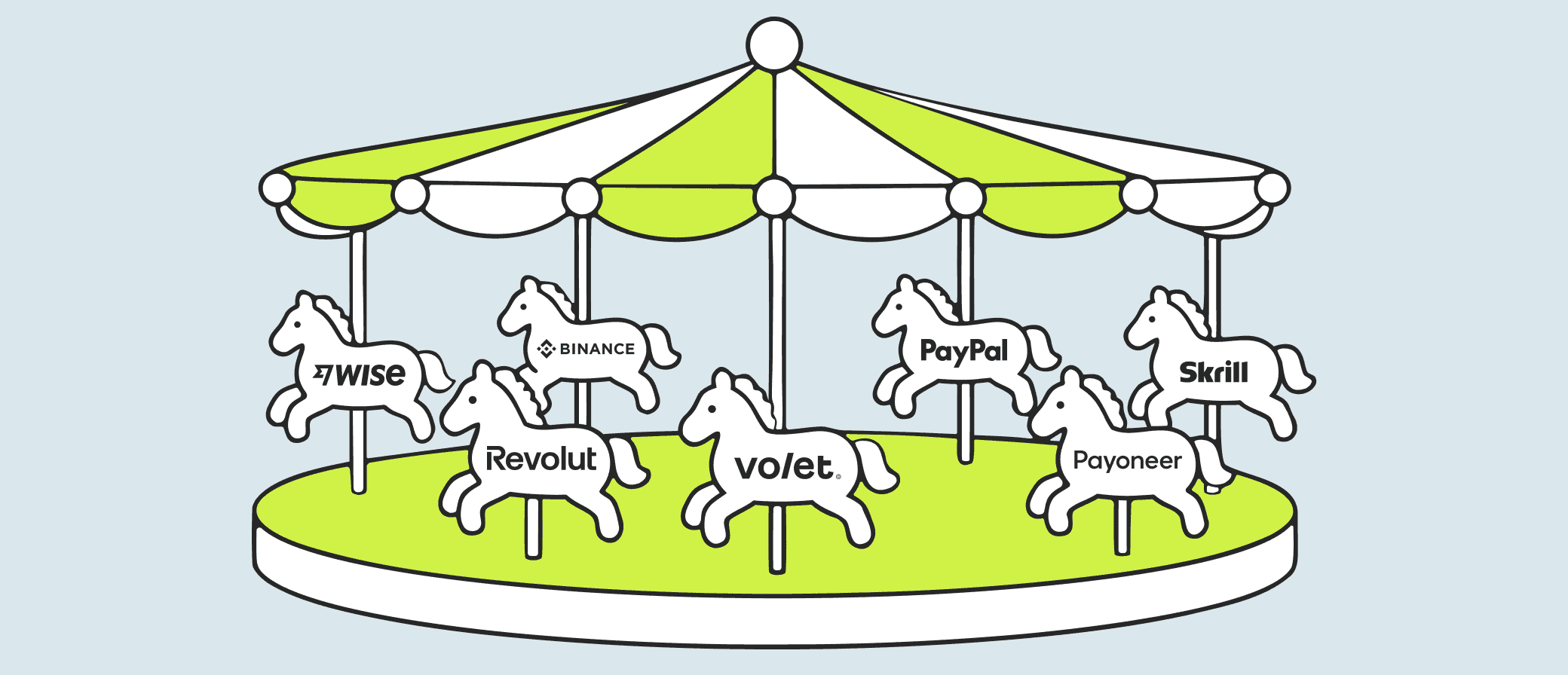
The wallet type matters more than the brand: bank-style accounts, e-money wallets, hybrid crypto + fiat (regular money) wallets, exchanges and self-custody wallets solve different tasks.
Where you live decides what you can open: popular wallets such as Wise and Revolut serve residents of a set list of countries, so check availability before you compare fees.
How your clients pay decides where you should get paid: bank transfers need local account details, card payments can cost up to about 5%, whereas stablecoins need only a crypto address.
Conversion is where the costs hide: turning $1,000 into another currency costs from about $2 to $40 depending on the wallet, so compare the final amount, not the "no fee" label.
Who holds the keys decides your risk: a custodial wallet can restore your access but can also freeze your account during a check; a self-custody wallet cannot be frozen, but nobody can recover it if you lose your recovery phrase.
How much does it really cost? A $1,000 test
The same $1,000 payment can leave you with noticeably different amounts depending on the wallet. The gap comes from three places: the fee to receive, the currency conversion and the withdrawal.
Start sending and receiving money today

Use stablecoins for global reach and local fiat rails for easy top-ups and withdrawals.
What is a digital wallet, and which type do I need?
A digital wallet is an app or online account that holds your money and lets you pay, send and receive it from your phone. Most open online, without a visit to a bank branch, and keep balances in several currencies at once. Compared with a regular bank account or card, that gives you four things:
- Local account details abroad. A client in the US or the EU pays you as if by domestic transfer, without international wire fees.
- Several currencies in one place. You receive dollars, hold euros and choose when to convert into your local money.
- Cheap transfers between users. Sending money to someone with the same wallet is often free and arrives in seconds.
- Crypto next to regular money. Some wallets also hold stablecoins such as USDT and USDC, which a client anywhere can send you without a bank.
Tap-to-pay wallets such as Apple Pay and Google Pay only store a card you already have and cannot receive money from abroad, so we leave them out.
**Multi-currency accounts **— a licensed provider holds your money in several currencies and gives you account details and a debit card, much like a bank account built for life across borders.
This type fits you best if clients pay you by bank transfer or you spend in several countries. Receiving is usually cheap, so the main cost is converting from one currency to another. The catch is that most providers open accounts only for residents of supported countries, and few of them handle crypto.
- Best for: clients abroad who pay by bank transfer; 40+ currencies, no crypto
- Get paid: local account details in 22 currencies; free domestic payments in USD, EUR, GBP and 6 more
- Withdraw: bank transfer, card, ATM
- Card: debit card; free ATM withdrawals up to $250 a month, then $1.95 + 1.95%
- Available to: open from 160+ countries, but you can hold money only if you live in a supported country
- Watch out: in some countries, including India, you cannot keep a balance, and money you receive is sent straight on to your local bank, with limits on how much you can receive. Receiving a USD wire or SWIFT payment costs $6.11
- Best for: living or travelling across several countries; 35+ currencies, crypto in some countries
- Get paid: local account details; transfers from other Revolut users
- Withdraw: bank transfer, card, ATM, crypto to an external wallet
- Card: debit card; on the Standard plan, 5 free ATM withdrawals or €200 a month
- Available to: residents of the EU, UK, US, Switzerland, Australia, New Zealand, Singapore, Japan and Brazil
- Best for: marketplace payouts and clients paying in major currencies
- **Get paid: **receiving accounts in USD, EUR, GBP, JPY, AUD and CAD; free in the account's currency, 1% (min $1) in another
- Withdraw: local bank (such as €1.50 in the same currency, up to 2% into another), card, ATM
- Card: Mastercard; cash withdrawals with conversion cost $3.15 + up to 3.5%
- ID check: full ID and account review
- Available to: most countries (190+)
- Watch out: $29.95 a year if you receive less than $6,000 in 12 months; transfers to Payoneer users in other countries cost 1% (min $4)
E-money wallets — a payment company holds your balance and ties it to your email, so the wallet works best when the person paying you uses the same service. It is the familiar choice for clients who pay online by card or through an invoice.
That convenience costs the most in this guide: fees to receive a payment from abroad and a markup on the exchange rate can together eat several percent of every payment.
- Best for: clients who pay online by card or email; 20+ currencies
- Get paid: email, invoice, checkout
- Withdraw: bank account
- Card: debit card in some markets
- Available to: most countries
- Best for: payments between Skrill users; 40+ currencies
- Get paid: email to a Skrill account; free between US users
- Withdraw: bank account ($5.50 in the US), prepaid card, ATM
- Card: Visa Prepaid Card in the US, $10 a year; $2.50 per ATM withdrawal
- Available to: many countries
- Watch out: prices differ by country of residence; these are US prices
Hybrid crypto + fiat wallets — the provider holds both your regular money and your crypto in one account, so you can receive stablecoins and spend or withdraw them as dollars, euros or local money.
This type suits you if clients pay you in USDT or USDC. Receiving crypto costs little, because the sender pays the network fee, and most of your costs come later: conversion, card top-ups and withdrawals to a bank.
- Best for: getting paid in stablecoins and spending in USD or EUR; holds USD, EUR and 10+ cryptocurrencies, including USDT and USDC on 9 networks
- Get paid: crypto and stablecoins free on Volet.com's side; converting USDT or USDC into a USD or EUR balance on arrival costs $1, other coins convert free; free transfers between Volet.com accounts; free "Pay me" links; crypto payment acceptance via API from 0.25%
- Withdraw: local bank in 30+ currencies (from 1%), SEPA (from 1%), SWIFT (1% + $25), Visa or Mastercard card (from 3%), crypto to an external wallet; top-up and withdrawal currency lists differ
- ID check: email to open; ID for cards and for fiat deposits and withdrawals
- Available to: 180+ countries; web account and Android app
- Watch out: no bank account details, so clients cannot pay you by domestic bank transfer
- Best for: freelancers in Latin America, Africa and Asia paid in US dollars; balances kept in USDC and EURC
- Get paid: US account details (ACH 0.5% to 1.75% depending on your country, wires 1.25%), a euro account, payment links, stablecoins
- Withdraw: P2P through 500+ local payment methods; direct bank withdrawal in 15+ countries, up to $8,000 a month
- Card: virtual Visa card in the US and Argentina; free to issue, 1% on the first $200 loaded each month
- ID check: ID and a selfie, usually checked within 24 hours
- Available to: 190 countries
- Watch out: US account details are not available in every country, including Turkey, Kenya and Vietnam
**Exchange & P2P wallets **— your balance sits with a crypto exchange or a custodial crypto wallet that comes with a marketplace for swapping crypto into local money.
This type works for trading crypto and cashing it out when no direct bank withdrawal is available.
Costs hide in the exchange spread and in the price other users set on the P2P market. The main risks are rules that change from country to country and money from P2P buyers that can get your bank account frozen.
- Best for: trading crypto or cashing it out through a marketplace; 600+ cryptocurrencies
- Get paid: crypto address, Binance Pay
- Withdraw: crypto to an external wallet, P2P sale for local money, fiat in some regions
- Available to: not the US, Canada, the Netherlands or the Philippines; UK closed to new users
- Watch out: since July 2026, EU residents cannot sign up, deposit or open new trades; withdrawals still work
- Best for: trading crypto and cashing out through P2P
- Get paid: crypto address, transfers from other Bybit users
- Withdraw: crypto to an external wallet, P2P sale for local money
- Card: Bybit Card in selected countries of Latin America and Asia-Pacific; free virtual card; EU residents get a separate Bybit EU Card
- ID check: full; stricter for the card
- Available to: not the US, Canada, mainland China, Hong Kong or Singapore
- Watch out: EU residents need a new account and a new ID check on a separate platform, Bybit EU
**Self-custody wallets **— here nobody holds your money but you: the wallet keeps the keys to your crypto, and no company can freeze it.
This type suits you if you want full control of your crypto or a place for long-term savings. Inside the wallet you pay only network fees, but turning crypto into regular money goes through partner services that charge their own fees.
The flip side of control is responsibility: lose your recovery phrase or approve a malicious transaction, and the money is gone for good.
- **Best for: **full control of your crypto, plus a card to spend stablecoins; Ethereum-compatible networks, Bitcoin and Solana
- Get paid: crypto address
- Withdraw: send crypto, or sell for USD, EUR or GBP through partners
- Card: MetaMask Card in 40+ countries across Europe and the Americas; no annual fee on the virtual card
- ID check: none for the wallet; required for the card
- Watch out: if you lose your recovery phrase, nobody can restore your funds; new US and UK card sign-ups are paused
- Best for: holding 10M+ assets on 100+ blockchains
- Get paid: crypto address
- Withdraw: send crypto, or cash out through third-party services
- Card: none
- ID check: none for the wallet; crypto purchases through partners need ID
- Watch out: if you lose both your recovery phrase and your cloud backup, nobody can restore your funds
- Best for: spending stablecoins by card while you keep control of your crypto; USD, EUR and GBP accounts
- Get paid: SEPA, ACH, Faster Payments and stablecoins, all free
- Withdraw: send crypto, bank transfer
- Card: Visa; virtual card for all users, plastic from the Premium plan
- **ID check: **full for the card and fiat account
Prices and availability checked in October 2026. They change often, so check the provider's own page for your country before you sign up.
Can I get paid into digital wallets?
Yes, as long as the wallet matches how your clients already pay.
How your client pays | Wallets that fit | What you pay to receive |
|---|---|---|
| Bank transfer | Wise, Payoneer, Airtm, Wirex | Free to 1.75%, depending on currency and country; more for international wires |
| Card or online payment | PayPal, Payoneer, Skrill | Up to about 5% plus a fixed fee for a client abroad |
| Marketplace or platform payout | Payoneer, Airtm, PayPal | Depends on the platform |
| Stablecoins | Volet.com, Airtm, Wirex, Binance, Bybit, MetaMask, Trust Wallet | The network fee, paid by the sender |
Bank transfer. Get local account details: an account number the client's bank treats as a domestic transfer. With Payoneer, ask clients to pay in your account's currency, or you pay 1%. Volet.com gives no bank details, so for bank-only clients Wise, Payoneer, Airtm or Wirex is the direct route.
Card or online payment. Many clients know PayPal, but on a $1,000 payment for services from a client abroad, you pay about $50 in fees. Payoneer card payments and Skrill transfers from abroad cost close to 4%.
Marketplace or platform payout. Check the platform's list of payout methods first: Volet.com, for example, is not among Upwork's.
Stablecoins. A client needs only your crypto address and pays the network fee. Volet.com charges nothing for a crypto deposit. Clients can also pay you through a free "Pay me" link, from their Volet.com balance or a crypto wallet.
Agree on the token and the network before you send an invoice. USDT is the most common stablecoin in Asia, Africa and Latin America, while clients in the EU often prefer USDC, which fits the EU's MiCA rules. Ask the client to send on the network you chose, or the money can be lost.
Read more: Which Blockchain Network To Choose by Use Case
Can I move money across borders with digital wallets?
Yes, but where you live decides which wallets you can open, and conversion is where cross-border costs hide.
Check availability first. Many wallets serve only residents of certain countries, and even a wallet open in 160+ countries may offer different features in yours. In India, for example, Wise does not let residents keep a balance and limits how much they can receive.
Compare the conversion cost. Every wallet converts at its own rate. Compare what it adds on top of the mid-market rate, the rate you see on Google:
Wallet | What conversion costs | On $1,000 |
|---|---|---|
| Wise | Mid-market rate plus a fee from 0.23% | From $2.30 |
| Revolut (Standard, EU) | Free up to €1,000 a month on weekdays, then 1%; another 1% on weekends | $0 on a weekday within the allowance |
| Payoneer | Up to 2% when you withdraw into another currency | Up to $20 |
| PayPal | A 3–4% markup on the exchange rate | $30–40 |
| Skrill (US) | 3.99% | $39.90 |
| Volet.com | The rate and fee are shown before you confirm | Shown before you confirm |
| Airtm (P2P) | Set by the person you exchange with; changes in real time | Depends on the offer |
Send money to someone abroad. The cheapest route is often a transfer between two users of the same wallet: transfers between Volet.com accounts, for example, are free. The recipient then withdraws to a local bank in their own currency.
Withdraw into local money. Most wallets pay out to a local bank. Where bank withdrawals are not available, Airtm also pays out to local mobile wallets, such as GCash and Maya in the Philippines and Mercado Pago in Argentina, and exchanges offer P2P markets.
Crypto crosses borders the same way everywhere. A USDT or USDC transfer costs only the network fee, and how fast it arrives depends on the network.
Read more: What's the Difference Between USDT and USDC? A Clear Comparison
Can I spend from digital wallets in real life?
Yes, as long as the wallet comes with a card, and most of them do in at least some countries. What differs is where the card takes the money from, and that decides how you top it up and what you pay.
The card spends your balance directly. Wise, Revolut, Payoneer and Skrill cards pay from the money already in your account. There is nothing to move before you pay; just watch the conversion fee when you pay in another currency and the monthly ATM limits.
You top up a separate card balance. With Volet.com and Airtm, the card has a balance of its own: you move money from the wallet to the card before you spend, and each top-up has a fee (from 1% + $1 on Volet.com). Fewer, larger top-ups keep the fixed part of the fee low. A separate balance also limits what you can lose if your card details are stolen.
Read more: How Crypto Users Actually Lose Money in 2026
The card converts crypto as you pay. MetaMask Card, Bybit Card and Wirex spend stablecoins and convert them at checkout. Your money stays in crypto until the moment you pay, but every purchase is a conversion, and which card you can get depends heavily on your country.
There is no card. Trust Wallet has no card of its own. To spend, you first sell your crypto or send it to a wallet that has one.
Before you rely on a card, check three things:
- 3D Secure, the extra check many online shops require. Without it, some subscriptions, AI tools and cloud services decline the card.
- Apple Pay and Google Pay, if you pay by phone.
- The card's currency. A USD card used for payments in euros or pesos converts every purchase.
Are digital wallets safe?
Usually, but a wallet balance is often not a bank deposit, and the risks depend on who holds the keys. Most wallets in this guide are custodial: a company holds your money, checks your ID and can help if something goes wrong. Self-custody wallets, such as MetaMask and Trust Wallet, keep your private keys, the secret codes that control your crypto, on your device, so you carry the whole responsibility.
Custodial | Self-custody | |
|---|---|---|
| Wallets | Wise, Revolut, Payoneer, PayPal, Skrill, Volet.com, Airtm, Binance, Bybit | MetaMask, Trust Wallet, Wirex (crypto only) |
| Who holds the money | The provider | You |
| Lost password or phone | Support can restore access after an ID check | Only your recovery phrase or backup restores access |
| Can the account be frozen? | Yes, for example during a compliance check | There is no account to freeze, but stablecoin issuers can block specific tokens |
| ID check | Required | Not for the wallet itself; required for cards |
Why accounts get frozen. A provider can pause an account to check where the money came from, usually after something it cannot explain: a large first payment, money from a third party or a name that does not match your ID. To lower the risk:
- finish full verification before your balance grows;
- keep invoices or contracts that show where each payment came from;
- receive money only in your own name;
- withdraw regularly instead of keeping months of income in one wallet.
If an account is frozen anyway, answer the document request quickly, and only through the provider's official support.
Read more: How Volet.com Works: Verification, Deposits, Fees, and More
Turn on the protections:
- Two-factor authentication (2FA) through an authenticator app, not SMS: a scammer can steal SMS codes by moving your number to a new SIM card. Volet.com supports authenticator apps, email codes and messenger bots, and asks for a one-time code at every login by default and may confirm new devices by email.
- Official sites and apps only, opened from a bookmark: fake sites often appear in search ads.
- **No shared codes: **Volet.com support staff never ask for a password or a login code.
- A small test payment before the first large one, especially to a new address or network.
- With a self-custody wallet, keep the recovery phrase on paper and offline, read what a transaction asks you to approve before you sign it, and keep large savings on a separate wallet, such as a hardware wallet.
Read more: Account Security: Time Waster or Life Saver?
How to choose the right digital wallet?
Find your situation in the table below, identify a suitable wallet type, then dive deeper into the particular wallet to check if it fits you.
| Your situation | Wallet type that fits | Examples |
|---|---|---|
| Clients abroad pay you by bank transfer | Multi-currency account with local account details | Wise, Payoneer |
| You live or travel across several countries | Multi-currency app with a debit card | Wise; Revolut where available |
| Clients or marketplaces pay you online | E-money wallet or payout account | PayPal, Skrill, Payoneer |
| You are paid in stablecoins, directly or through a payment link, and spend in regular money | Hybrid crypto + fiat wallet | Volet.com, Airtm |
| You trade crypto or cash it out through a P2P market | Exchange wallet | Binance, Bybit |
| You want full control of your crypto | Self-custody wallet | MetaMask, Trust Wallet |
Start global payouts today — in crypto and fiat

Reach creators, partners and teams in any country with payouts in USDT, USDC or to Volet.com wallets.
FAQ
A move can change what you can use. Tell your provider before you move: some services close accounts when the new country is not supported, and you may have to withdraw your money first.
With Volet.com, you send your new residence documents to support, and the services, payment methods and cards available in the new country open up.
Crypto usually arrives in minutes, depending on the network: Volet.com deposits typically take 1–15 minutes. A withdrawal to a local bank usually takes up to 3 business days, and an international SWIFT transfer can take several days.
For more details see: Why did my crypto withdrawal take so long? 7 reasons** **
It may. In the EU, crypto service providers collect data on users' transactions from 2026 under the DAC8 rules and share it with tax authorities; other countries are adopting the same OECD standard (CARF).
Declare your income as your country requires.
Usually not. Most freelancers get paid into a personal account: Wise, Payoneer, PayPal and Volet.com all let you receive money from clients, as long as the account is verified and in your own name.
A business account makes sense when the money goes to a company you registered, when clients need invoices in your company's name, or when you accept payments from many customers through a website.
On Volet.com, both personal and business accounts can accept payments through a "Pay me" link, API or hosted checkout after verification. A business account is opened in your company's name, so bank transfers you send show your company as the sender.
Do More With Your Money
Manage digital money effortlessly: send, receive, and exchange crypto for business and everyday life
Let’s talk about your payment needs!
Message your manager in any language:
Author

Mikhail KenegesovProduct Editor
I curate knowledge management initiatives and lead customer support operations in FinTech, affiliate-driven digital platforms, and AI model training projects.
Follow us to never miss a new article